Facts
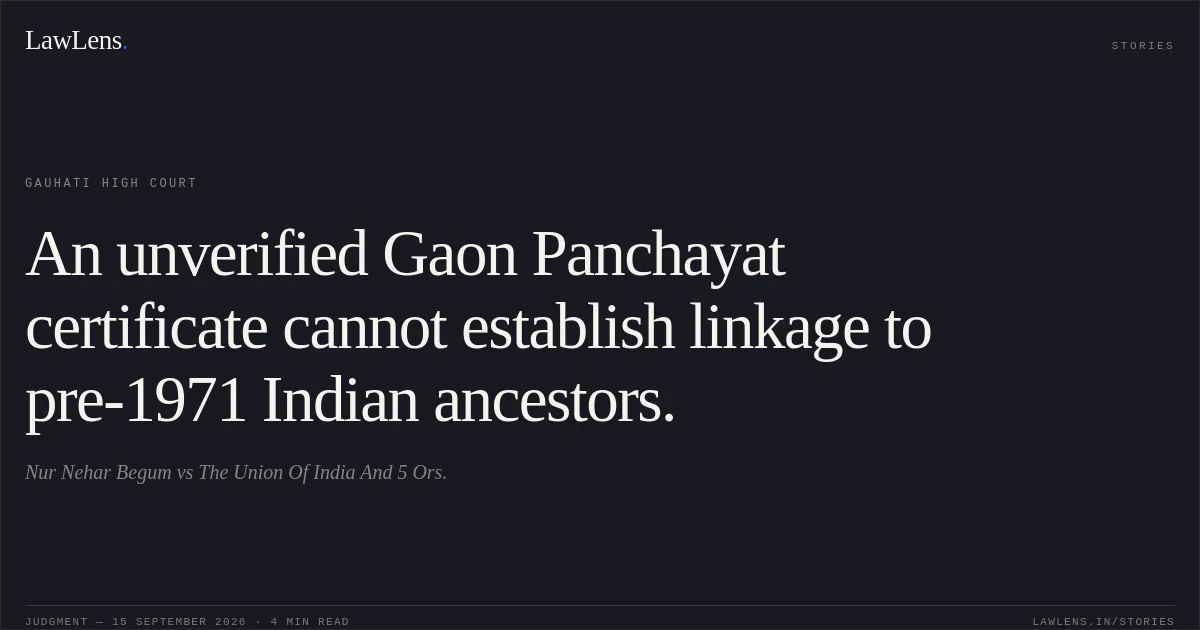
The petitioner challenged the opinion dated 30 November 2019 of the Foreigners Tribunal No. 2, Dhubri, in FT Case No. 679/F/15, arising from Police Reference Case No. 1023/1998, declaring her a foreign national entering Assam after 25 March 1971.
Source reference: p.3, para.2She claimed Indian citizenship by birth and asserted that her father, Habibur Rahman, and grandparents, Nayeb Ali and Joygon Bibi, were Indian citizens whose names appeared in the 1951 NRC and electoral rolls of 1966 and 1970.
Source reference: pp.3–5, paras.3, 6–7Before the Tribunal, she examined herself, her father, and the Secretary of the concerned Gaon Panchayat, and relied on the 1951 NRC extract, land records, her father’s HSLC certificate, electoral rolls, and a Gaon Panchayat certificate linking her to her parents.
Source reference: pp.3–9, paras.4, 9–19The Tribunal rejected the NRC extract as inadmissible, disbelieved or discarded the land and academic records, and found that the Gaon Panchayat certificate did not establish the necessary linkage between the petitioner and her projected Indian ancestors.
Source reference: pp.12–14, paras.29, 36, 42Issues
Whether the petitioner produced sufficient and legally admissible documentary evidence establishing her linkage with an Indian ancestor present in India before 25 March 1971, thereby discharging the burden under Section 9 of the Foreigners Act, 1946.
Source reference: pp.10–11, paras.27–28, 33Whether the Tribunal lawfully rejected the 1951 NRC extract, land document, HSLC certificate, and Gaon Panchayat certificate relied upon by the petitioner.
Source reference: pp.12–14, paras.29, 35–42Whether the Tribunal’s appreciation of evidence disclosed perversity, material irregularity, or jurisdictional error warranting interference under the High Court’s certiorari jurisdiction.
Source reference: p.12, para.37Law Applied
Section 9 of the Foreigners Act, 1946 places the burden on the proceedee to prove that he or she is not a foreigner.
Source reference: p.10, para.27In proceedings of this nature, the proceedee must establish both legacy evidence—the presence of an Indian ancestor in India before 25 March 1971—and linkage evidence connecting the proceedee with that ancestor through cogent documentary material.
Source reference: p.10, paras.27–28Under Section 15 of the Census Act, 1948, census records are not open to inspection and NRC extracts are inadmissible in evidence for proving domicile or citizenship, as held in Bhanbhasa Sheikh v. Union of India and reaffirmed in Abdul Mojid @ Mojid Ali v. Union of India, 2019 (2) GLT 45.
Source reference: pp.11–12, paras.29–30A Gaon Panchayat Secretary’s certificate is not, by itself, proof of citizenship; under Rupjan Begum v. Union of India, (2018) 1 SCC 579, its authenticity and the authenticity of its contents must be verified, and it can ordinarily serve only as supporting linkage evidence.
Source reference: pp.13–14, para.40Khudeja Khatun v. Union of India, 2018 (3) GLT 347, similarly requires proper proof and verification of such a certificate.
Source reference: p.14, para.41The High Court’s jurisdiction under Article 226 in certiorari proceedings is supervisory, not appellate, and interference is justified only where there is reliance on inadmissible evidence, consideration of no evidence, perversity, gross error, or material irregularity causing jurisdictional error.
Source reference: p.12, para.37Reasoning
The Court accepted that the electoral rolls of 1966 and 1970 could indicate the presence of Nayeb Ali, Joygon Bibi, and Habibur Rahman in India before the cut-off date, but held that such material constituted, at most, potential legacy evidence.
Source reference: pp.11–12, paras.31–32The petitioner still had to prove through reliable documentary evidence that she was the daughter of Habibur Rahman and granddaughter of Nayeb Ali.
Source reference: pp.11–12, paras.31–32The 1951 NRC extract was inadmissible under Section 15 of the Census Act.
Source reference: p.12, para.38The land document contained an unexplained age anomaly concerning Habibur Rahman and was not proved by its issuing authority; the HSLC certificate also omitted his father’s name and the school name, justifying the Tribunal’s doubts regarding both documents.
Source reference: pp.12–13, paras.35–39Although the Gaon Panchayat Secretary testified, he admitted that the petitioner’s parentage was recorded on the basis of the NRC and Kabin Nama, neither of which adequately established the claimed relationship in the proceedings; the Kabin Nama itself was not produced in evidence.
Source reference: p.15, para.42Consequently, the Court found no perversity or jurisdictional error in the Tribunal’s assessment and held that the required linkage evidence was absent.
Source reference: pp.14–15, paras.42–43Holding
The Court answered the issues against the petitioner.
It held that she failed to establish, by cogent and admissible documentary evidence, her linkage with the projected Indian ancestors appearing in the pre-1971 electoral records.
Source reference: pp.14–15, paras.42–43The Tribunal’s opinion dated 30 November 2019 declaring her a foreign national of the post-25 March 1971 stream was upheld.
Source reference: p.15, para.44The writ petition was dismissed, the interim order was vacated, and the records were directed to be returned to the Foreigners Tribunal.
Source reference: p.15, paras.44–46Acts & Sections Cited
1 provisions across 1 statute referred to in this judgment. Each provision opens on LawLens.
Census Act, 19481
Original Court PDF
Nur Nehar BegumvsThe Union Of India And 5 Ors.
Click to open original judgment
Original judgment, available to read, download and summarize on LawLens.in