Facts
The petitioner, a Class I contractor, executed a National Highway project under an agreement dated 8 December 2010 with the Assam PWD, NH Works. The contract was completed on 30 October 2020.
Source reference: pp. 2–6; paras. 1–3Price-adjustment amounts relating to the contract were subsequently paid to the petitioner, including ₹36.47 crore under a bill dated 25 October 2022, after statutory deductions.
Source reference: pp. 2–6; paras. 1–3The petitioner disclosed the receipt in its audited balance sheet, income-tax filings and GST annual return, but treated the amount as exempt on the bona fide belief that GST was not payable on price adjustments relating to a pre-GST contract.
Source reference: pp. 6–7, 34–40; paras. 3, 39–43The GST authorities investigated the matter under Sections 67(1) and 70 of the CGST Act.
Source reference: pp. 7–9; paras. 4–5On 4 August 2024, the respondents issued a show-cause notice under Section 74(1) of the CGST Act demanding ₹4,37,73,372 for July 2017 to March 2023, along with interest and penalty, alleging suppression, wilful misstatement and intent to evade tax.
Source reference: pp. 9–10; para. 6The petitioner challenged the notice under Article 226 of the Constitution, contending that the statutory preconditions for invoking Section 74(1) were absent and that the notice was time-barred.
Source reference: pp. 10–18; paras. 7–21Issues
Whether the respondents could invoke Section 74(1) of the CGST Act without prima facie establishing fraud, wilful misstatement or suppression of facts with intent to evade tax?
Source reference: pp. 21–24, 33–40; paras. 25–27, 38–44Whether the petitioner’s disclosure of the price-adjustment receipts in its balance sheet, income-tax filings and GST annual return negated an allegation of suppression or wilful misstatement?
Source reference: pp. 34–40; paras. 39–46Whether the High Court could interfere under Article 226 at the stage of a show-cause notice, notwithstanding the availability of statutory remedies?
Source reference: pp. 47–56; paras. 61–74Whether the impugned notice, issued by invoking the extended limitation period under Section 74(1), was without jurisdiction and liable to be quashed?
Source reference: pp. 57–65; paras. 78–86Law Applied
The Court applied Section 74(1) of the CGST Act, which permits recovery of unpaid or short-paid tax only where such non-payment is by reason of fraud, wilful misstatement or suppression of facts with intent to evade tax.
Source reference: pp. 21–24; para. 25Explanation 2 to Section 74, as applicable during the relevant period, defined suppression as non-declaration of facts or information required to be declared in returns or failure to furnish information sought in writing by the proper officer.
Source reference: p. 22; para. 25The Court relied on Pushpam Pharmaceutical Co. v. CCE, Anand Nishikawa Co. Ltd. v. CCE, Continental Foundation Joint Venture Holding v. CCE, CCE v. Ballarpur Industries Ltd., Uniworth Textiles Ltd. v. CCE, CCE v. H.M.M. Ltd., Associated Cement Companies Ltd. v. Commissioner of Customs, CCE v. Chemphar Drugs and Liniments and Cosmic Dye Chemical v. CCE for the principles that mere non-payment, omission or an incorrect declaration does not establish wilful suppression; suppression requires a deliberate withholding of information with intent to evade tax, and the burden lies on the Revenue to establish the jurisdictional ingredients for the extended limitation period.
Source reference: pp. 26–33; paras. 29–37The Court further applied the Article 226 exceptions to the alternative-remedy rule, particularly where proceedings are wholly without jurisdiction, arbitrary, or founded on failure to consider relevant material.
Source reference: pp. 47–56; paras. 61–74Reasoning
The Court found that the petitioner had disclosed the receipt of the price-adjustment amounts in its audited balance sheet, income-tax filings, GST annual return and declaration before the GST authorities.
Source reference: pp. 34–40; paras. 39–43Treating the receipts as exempt was, on the record, a legal and factual misunderstanding arising from the pre-GST nature of the contract and the manner in which the Assam PWD and the Ministry prepared and approved the bills; it was not a deliberate concealment of the receipts.
Source reference: pp. 37–40; paras. 43–46The show-cause notice merely asserted that the petitioner had failed to self-assess correctly and that such failure was deliberate, without identifying material demonstrating fraud, wilful misstatement or suppression with intent to evade tax.
Source reference: pp. 23–25, 57–59; paras. 27, 78The Court also noted that the authorities had not obtained crucial information regarding the dates of completion of the relevant works and had issued the notice hurriedly to prevent the limitation period from expiring.
Source reference: pp. 58–64; paras. 78–83Mere non-payment or incorrect self-assessment could potentially support an ordinary tax demand, but could not, without more, justify the exceptional invocation of Section 74(1) and the extended limitation period.
Source reference: pp. 30–33; paras. 32–38Since the jurisdictional conditions for Section 74(1) were absent, the notice was not merely legally erroneous but issued in excess of jurisdiction.
Source reference: pp. 47–56, 64–65; paras. 61–74, 84–86Holding
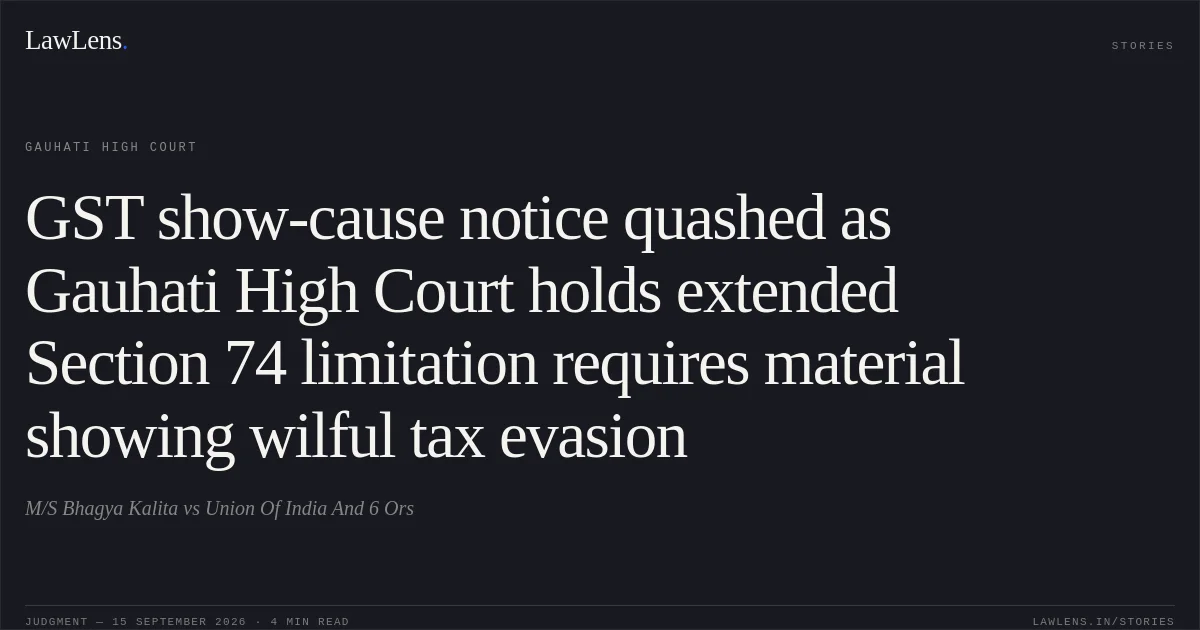
The Court held that the Revenue had failed to establish the statutory preconditions for invoking Section 74(1) of the CGST Act.
The petitioner’s disclosure of the relevant receipts and its bona fide claim of exemption did not constitute fraud, wilful misstatement or suppression of facts with intent to evade tax.
Source reference: pp. 34–40, 57–65; paras. 39–46, 78–85The show-cause notice dated 4 August 2024 was therefore held to be arbitrary, time-barred and without jurisdiction.
Source reference: p. 66; paras. 86–87The writ petition was allowed; the impugned notice was quashed by issuance of a writ of certiorari, and the consequential levy of penalty, surcharge and interest was also set aside.
Source reference: p. 66; paras. 86–87No order as to costs was made; pending interlocutory applications were dismissed and any interim order stood merged with the final judgment.
Source reference: p. 66; paras. 86–87Acts & Sections Cited
15 provisions across 3 statutes referred to in this judgment. Each provision opens on LawLens.
Central Goods and Services Tax Act, 2017
ASSAM GOODS AND SERVICES TAX ACT, 20172
Central Excise Act, 19441
Original Court PDF
M/S Bhagya KalitavsUnion Of India And 6 Ors
Click to open original judgment
Original judgment, available to read, download and summarize on LawLens.in