Facts
The petitioner was appointed on compassionate grounds as Assistant Grade-III by order dated 16 September 2014.
Source reference: p.3; para. 6Condition No. 5 of the appointment order required him to pass the Hindi Typing Examination and possess the prescribed computer qualification; however, no time limit was specified for acquiring these qualifications.
Source reference: p.3; para. 6The requirement of the Hindi Typing Examination had been modified/abolished by circular dated 1 July 2013, and the petitioner subsequently obtained the requisite computer qualification and qualified the Hindi Typing Test through CPCT, reflected in the score card dated 16 September 2016.
Source reference: p.3; paras. 6–7He had also acquired the PGDCA qualification in June 2016.
Source reference: p.6; para. 10The petitioner claimed annual increment from 18 September 2016, the date on which he acquired the requisite qualification.
Source reference: p.2; para. 3The State contended that he had qualified CPCT only through a mark-sheet dated 17 February 2018 and that increment was therefore correctly granted after completion of one year from that date.
Source reference: p.2; para. 3The petitioner challenged the order dated 21 June 2018 denying him the increment from the earlier date.
Source reference: p.6; para. 11(i)Issues
Whether the petitioner, whose appointment order prescribed passing the Hindi Typing Examination, was entitled to annual increment from the date of acquiring the requisite qualification rather than after completion of one further year?
Source reference: pp. 3–6; paras. 6, 9–10Whether the petitioner acquired the requisite Hindi Typing/CPCT qualification on 18 September 2016, thereby entitling him to consequential pay fixation and arrears from that date?
Source reference: pp. 2–3, 6; paras. 3, 6–7, 10Law Applied
The Court applied Article 226 of the Constitution of India.
Source reference: p.1It relied on Condition No. 5 of the petitioner’s appointment order, which made Hindi Typing qualification a condition of appointment.
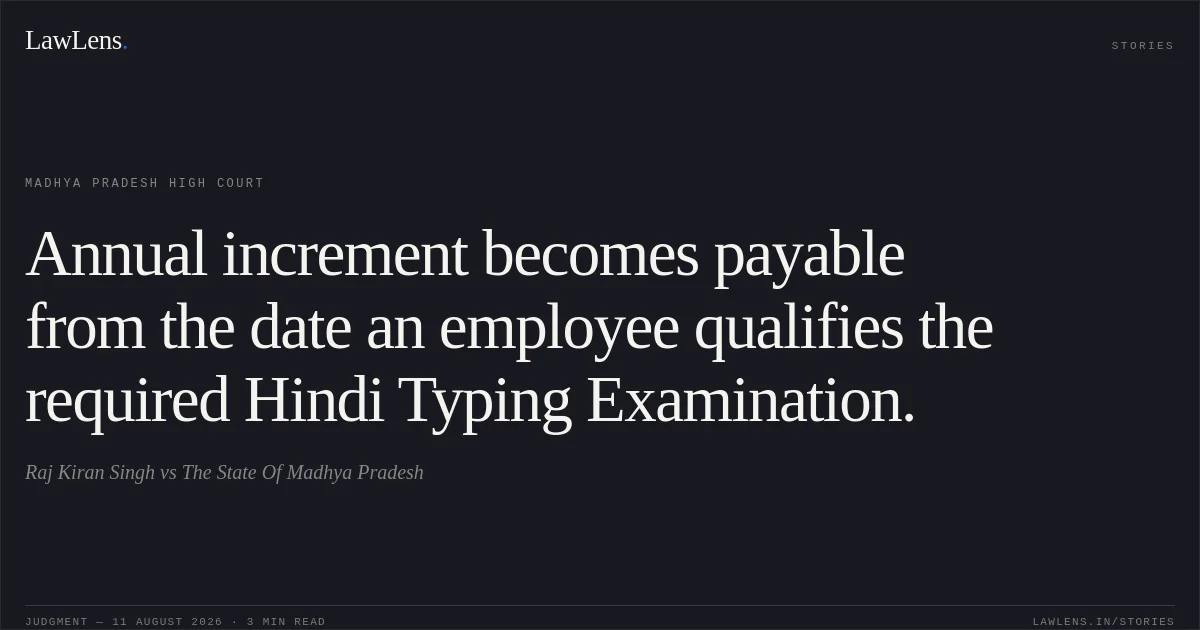
Source reference: p.3; para. 5Under the Full Bench decision in Manoj Kumar Purohit v. State of M.P., 2016 (1) MPLJ 449, where the appointment order incorporates passing the Hindi Typing Test as a requirement, an employee becomes entitled to increment only upon passing that test; however, the increment cannot be deferred for an additional year after qualification.
Source reference: p.5; para. 9The Division Bench reaffirmed this principle in Anuroop Singhai v. State of M.P., W.A. No. 37 of 2018, holding that increment is payable from the date of qualifying the Typing Examination.
Source reference: p.5; para. 9The Court also relied on the GAD clarification dated 4 July 2018, which stated that for Assistant Grade-III and equivalent posts, Hindi Typing qualification through CPCT was mandatory, while English Typing qualification was not essential.
Source reference: pp. 4–5, 6; paras. 8, 10Reasoning
The Court found that the petitioner’s appointment order expressly required Hindi Typing qualification but prescribed no deadline for acquiring it.
Source reference: p.3; para. 6On examination of the CPCT score card dated 16 September 2016, the Court concluded that the petitioner had qualified the Hindi Typing Test and acquired the requisite qualification on that date; it also noted that his PGDCA qualification had already been obtained in June 2016.
Source reference: pp. 3, 6; paras. 6–7, 10Applying Manoj Kumar Purohit and Anuroop Singhai, the Court held that the benefit of increment accrued on the date of qualification itself and could not lawfully be postponed by one year.
Source reference: pp. 2–3, 5–6; paras. 3, 9–10The State’s reliance on the later mark-sheet dated 17 February 2018 was therefore rejected.
Source reference: pp. 2–3, 5–6; paras. 3, 9–10Holding
The petition was allowed/disposed of with directions.
The impugned order dated 21 June 2018 was quashed.
Source reference: p.6; para. 11(i)The respondents were directed to grant the petitioner annual increment with effect from 18 September 2016, revise his pay, and pay consequential arrears with interest at 6% per annum from the date of entitlement until payment.
Source reference: p.6; para. 11(ii)The exercise was to be completed within three months of receipt of the certified copy of the order; failure to comply would attract interest at 12% per annum on the outstanding amount from the date of default until actual payment.
Source reference: p.6; para. 11(iii)Original Court PDF
Raj Kiran SinghvsThe State Of Madhya Pradesh
Click to open original judgment
Original judgment, available to read, download and summarize on LawLens.in