Facts
The respondent, a Class-IV employee of the Bar Council of Uttarakhand, had previously received Grade Pay of ₹2,400, but later drew Grade Pay of ₹4,200.
Source reference: para. 2The Bar Council alleged that the higher fixation resulted from manipulation and issued a show-cause notice in 2023. The respondent challenged that notice in Writ Petition (S/S) No. 731 of 2023 and obtained an interim order preventing reduction of his salary; that petition remained pending.
Source reference: paras. 2–3In June 2025, the Bar Council resolved to withhold annual increments, Deepawali bonus and dearness allowance from certain employees, including the respondent, while disputes involving them remained pending.
Source reference: para. 4The respondent challenged that resolution and the consequential orders in Writ Petition (S/S) No. 2349 of 2026. The Single Judge stayed their operation and directed payment of service benefits as previously received.
Source reference: para. 5The Bar Council appealed, contending that the interim order granted final relief and that continued payment at the higher grade pay could make recovery difficult if the respondent’s salary fixation were ultimately found erroneous.
Source reference: paras. 6–7Issues
1. Whether the Single Judge’s interim order should be set aside where it directed payment of service benefits despite the pending dispute over the respondent’s Grade Pay fixation.
Source reference: paras. 5–72. Whether the disputes in the respondent’s two writ petitions should be heard and decided together, with payment of the disputed benefits dependent on their outcome.
Source reference: paras. 8–9Law Applied
The judgment cites no statute, regulation or judicial precedent.
Source reference: paras. 7–9It applies the case-specific principle that interim relief should account for the parties’ competing interests and the practical consequences of the pending dispute; the Court considered that deciding the salary-fixation challenge alongside the benefits challenge would balance the equities and serve the ends of justice.
Source reference: paras. 7–9Reasoning
The respondent’s entitlement to Grade Pay of ₹4,200 remained unresolved in the earlier writ petition, and he acknowledged that an adverse final decision could make a substantial amount recoverable.
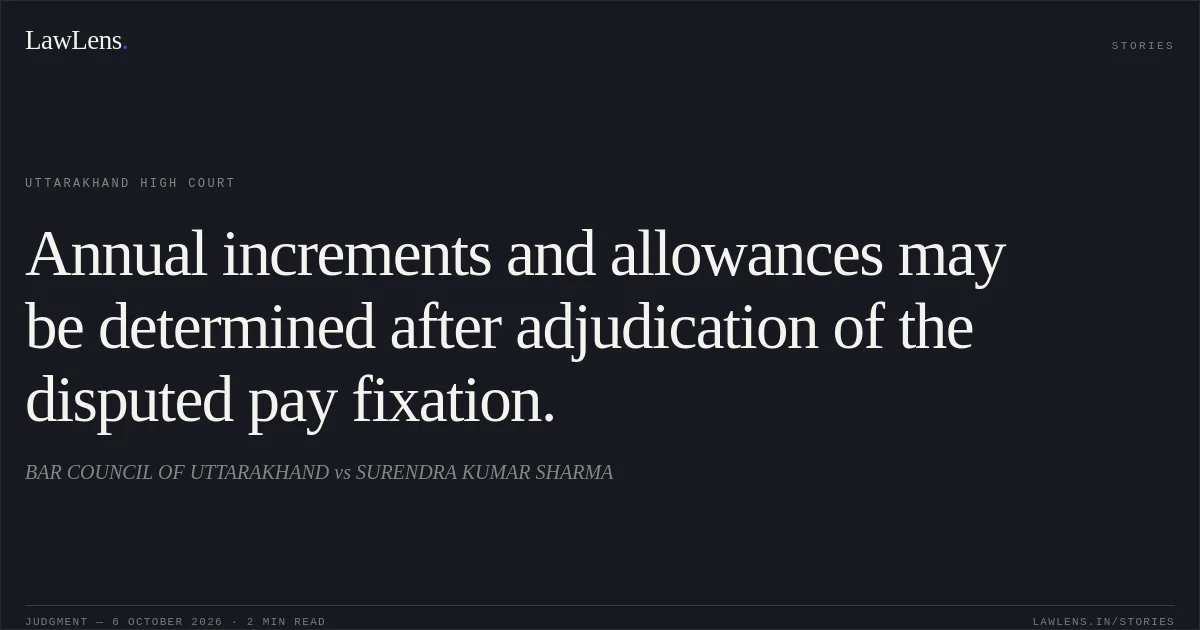
Source reference: paras. 7–8Rather than maintain the Single Judge’s direction on benefits while the underlying salary dispute remained undecided, the Court accepted the respondent’s proposal to have both petitions heard together. It considered that this course would allow the benefits issue to be addressed in light of the final determination of the salary-fixation dispute and would balance the parties’ interests.
Source reference: paras. 8–9Holding
The Court allowed the appeal to the extent of setting aside the Single Judge’s order dated 9 September 2026.
It directed that Writ Petition (S/S) No. 731 of 2023 and Writ Petition (S/S) No. 2349 of 2026 be heard and decided together, and directed the appellants to file a counter-affidavit in the latter petition within two weeks. The respondent’s annual increment and other allowances are to be paid depending on the outcome of the petitions.
Source reference: para. 9The Bar Council also stated that it would decide within four weeks on reimbursement of the respondent’s medical bills in compliance with prior court orders; that statement was recorded.
Source reference: paras. 10–11The special appeal was disposed of, with pending applications also disposed of.
Source reference: paras. 12–13Original Court PDF
BAR COUNCIL OF UTTARAKHANDvsSURENDRA KUMAR SHARMA
Click to open original judgment
Original judgment, available to read, download and summarize on LawLens.in