Facts
The applicants in O.A. No. 2051/2025 and O.A. No. 2052/2025 were appointed as Fireman/Fireman Driver in the Fire & Emergency Services Department of the Union Territory of Jammu and Kashmir following a recruitment process that included physical tests, written examinations, document verification, and medical examinations.
Source reference: p.42They contended that they discharged their duties sincerely and their service records were satisfactory.
Source reference: p.43The legality of this selection process had been previously challenged before courts, but these challenges were dismissed, and the selection process was upheld by the High Court.
Source reference: p.43-47Subsequently, allegations of irregularities in the recruitment process surfaced, leading the Government to constitute an Inquiry Committee vide Government Order No. 1513-JK(GAD) of 2022 dated 12.12.2022 to examine these allegations.
Source reference: p.43-44The Inquiry Committee submitted its report on 10.02.2024, followed by communications from the General Administration Department and the Anti-Corruption Bureau (ACB) concerning the alleged irregularities.
Source reference: p.44Based on these findings, the Government issued Government Order No. 608-Home of 2025 dated 15.12.2025, terminating the services of several appointees, including the applicants, on the grounds that the recruitment process was vitiated by irregularities.
Source reference: p.44The applicants argued that the termination order did not attribute any specific misconduct, fraud, or manipulation to them individually and was based solely on general observations in the inquiry report.
Source reference: p.45They further contended that the termination occurred without any show cause notice, framing of charges, or departmental enquiry.
Source reference: p.45In a connected matter, O.A. No. 643/2022, other applicants also belonging to the same recruitment process challenged the selection list issued pursuant to Advertisement Notification No. 01 of 2013 dated 12.03.2013, alleging leakage of the question paper prior to the examination.
Source reference: p.41-43They also sought to quash Order No. 823 of 2020 Dated 04.10.2020, which sanctioned the appointment of private respondents, and requested a re-conduct of the written test for Fireman/Fireman Driver.
Source reference: p.41-43The respondents asserted that the recruitment process came under scrutiny due to complaints of large-scale irregularities.
Source reference: no citationThe Inquiry Committee, after detailed examination, found serious irregularities and illegalities, supported by communications from the ACB, indicating a tainted process.
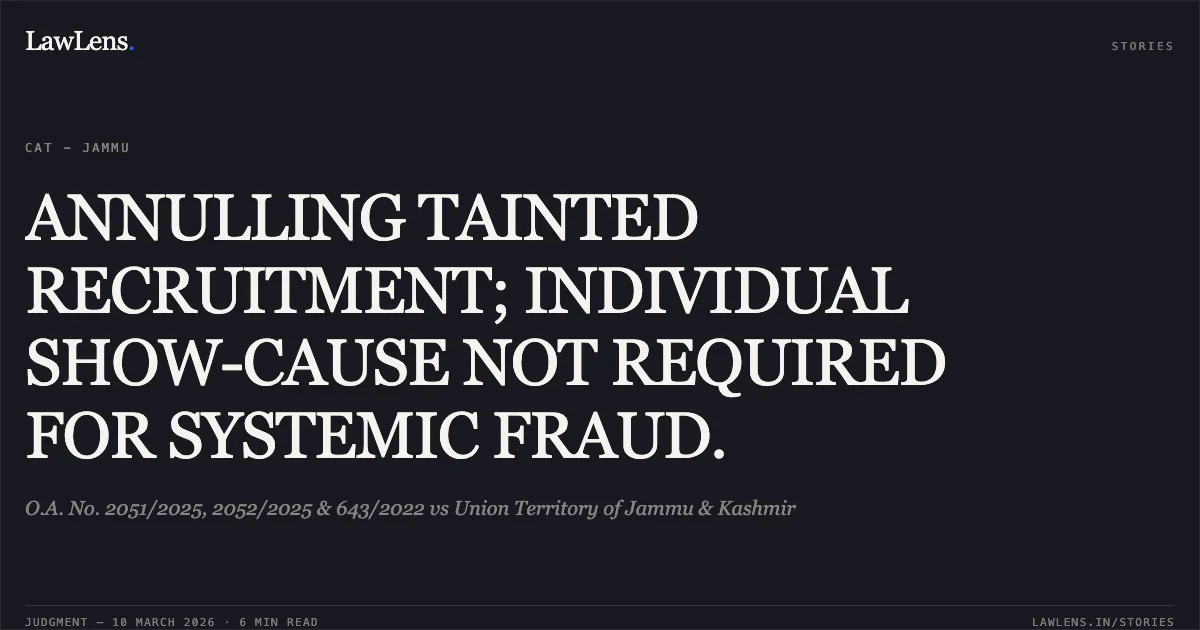
Source reference: p.48-49They argued that the termination was in the larger public interest to rectify the illegality and that individual notice or enquiry was not required as the termination was a consequence of systemic illegality, not individual misconduct.
Source reference: p.50-51Issues
Whether the applicants in OA Nos. 2051/2025 and 2052/2025 can claim continuation in service on the ground that no individual notice or departmental enquiry was held against each of them, despite the recruitment process itself being vitiated by grave and large-scale irregularities?
Source reference: p.57Whether OA No. 643/2022, challenging the validity of the selection process and appointments, survives for adjudication given the State's subsequent termination of the impugned appointments after an inquiry into the tainted recruitment?
Source reference: p.57Law Applied
The court primarily applied the principle that fraud vitiates every solemn act, citing *Punjab Urban Planning and Development Authority v. Karamjit Singh*, (2019) 16 SCC 782, to establish that no right can be claimed on the basis of a fraudulent act and that a poisoned source cannot yield protected benefits.
Source reference: p.64-65It further relied on the principle that appointments made in violation of the constitutional scheme or through an illegitimate process do not create enforceable rights, as held in *State of Bihar v. Upendra Narayan Singh*, (2009) 5 SCC 65.
Source reference: p.66The court also cited *Devendra Kumar v. State of Uttaranchal*, (2013) 9 SCC 363, stating that where entry into service is based on falsehood or illegality, the employee cannot seek equitable protection.
Source reference: p.67Additionally, the court referred to *State of West Bengal v. Baishakhi Bhattacharyya*, 2025 SCC OnLine SC 719, for the proposition that if the recruitment process is prima facie tainted, beneficiaries cannot insist on the preservation of such appointments, and collective termination may be justified if systemic irregularities are proven.
Source reference: p.68-71It also held that Article 311(2) of the Constitution is not attracted to protect appointments void ab initio or secured through a fundamentally vitiated process, citing *R. Vishwanatha Pillai v. State of Kerala*, (2004) 2 SCC 105.
Source reference: p.72Finally, the court invoked *Inderpreet Singh Kahlon v. State of Punjab*, (2006) 11 SCC 356, regarding mass irregularities and the circumstances under which an entire selection can be set aside if the process is sufficiently vitiated.
Source reference: p.75Reasoning
The court found that the recruitment process was "seriously tainted by fraud, manipulation and systemic irregularities" based on inputs from multiple agencies including ACB, Crime Branch, and CID.
Source reference: p.57-58These inputs revealed allegations of question paper leakage, mass copying, use of gadgets, impersonation, manipulation of marks, suspicious concentration of selections from particular districts, selection of under-qualified or ineligible candidates, and selection of multiple close relatives.
Source reference: p.58The court concluded that the recruitment was "so deeply contaminated that it lost the character of a fair public selection," thus affirming the Government's corrective action.
Source reference: p.59The court distinguished between individual misconduct post-appointment, which requires a departmental inquiry, and a fundamentally tainted selection process.
Source reference: no citationIt reasoned that when the "selection process itself collapses because it is infected by fraud, manipulation and systemic illegality," the government is not obligated to retain the beneficiaries.
Source reference: p.59-60The court highlighted the public trust associated with employment and stated that no indefeasible right arises from an appointment originating from a "seriously polluted" selection.
Source reference: p.60The court noted that administrative action to cleanse a tainted recruitment "stands on a different footing" from criminal prosecution, which requires proof beyond a reasonable doubt.
Source reference: p.62It emphasized that the State need not await the conclusion of criminal trials before rectifying a constitutionally suspect recruitment.
Source reference: p.62-63Regarding natural justice, the court acknowledged its importance but stated its application depends on context.
Source reference: no citationFor large-scale fraud and systemic manipulation, individual departmental inquiries would be unrealistic, futile, and would defeat public interest, especially when the "vice is embedded in the source itself."
Source reference: p.79The court rejected the argument that previous court proceedings upholding the selection created "perpetual immunity," as later credible evidence of manipulation surfaced.
Source reference: p.78-79The court observed that corrupt officials should be proceeded against, but their involvement "does not cleanse the appointments secured through a tainted process."
Source reference: p.61, 79-80Holding
The court held that the recruitment process for Fireman/Fireman Driver was seriously tainted by fraud, manipulation, and systemic irregularities.
Consequently, no enforceable right to continue in service survived for the beneficiaries of such a process.
Source reference: p.83Article 311(2) of the Constitution was deemed inapplicable, as the appointments were void ab initio or the outcome of a tainted selection, thus constituting a withdrawal of an unlawful benefit rather than punitive removal.
Source reference: p.83-84The court found that the impugned action could not be invalidated solely because criminal prosecution against all involved persons was ongoing or because all erring officials had not yet faced final proceedings.
Source reference: p.84O.A. No. 2051/2025 is dismissed.
Source reference: p.85O.A. No. 2052/2025 is dismissed.
Source reference: p.85O.A. No. 643/2022 is disposed of as infructuous, as the State's corrective action of terminating the appointments has addressed the grievance.
Source reference: p.85-86The court directed the authorities of the Union Territory of Jammu & Kashmir to ensure that the investigation is concluded, and all erring officials, middlemen, and other involved persons are proceeded against strictly and expeditiously, including through departmental proceedings and criminal prosecution, to uphold the rule of law and restore public faith.
Source reference: p.87-88Acts & Sections Cited
1 provisions across 1 statute referred to in this judgment. Each provision opens on LawLens.
Administrative Tribunals Act, 19851
Original Court PDF
O.A. No. 2051/2025, 2052/2025 & 643/2022vsUnion Territory of Jammu & Kashmir
Click to open original judgment
Original judgment, available to read, download and summarize on LawLens.in