01Facts
The petitioners sought quashment under Section 528 of the BNSS, 2023, of FIR No. 43/2024 at Police Station Mahila Thana, Sagar, registered under Sections 498-A and 34 IPC, and all consequential proceedings.
¶ 1The complainant's marriage with petitioner Umesh Hardeniya was solemnised on 22.06.2023. She alleged that he did not consummate the marriage, and that when she raised this he assaulted her and subjected her to physical and mental cruelty. She further alleged that his father, Shyam Bihari Hardeniya, and sister, Preeti Hardeniya, supported him and also harassed her.
¶ 2She began living separately from 17.09.2023. The FIR was lodged on 29.06.2024.
¶ 2The husband had earlier filed a restitution of conjugal rights petition under Section 9 of the Hindu Marriage Act, 1955 (HMA), and the complainant later obtained a decree under Section 12 HMA. By judgment dated 17.03.2026, the Family Court, Sagar, annulled the marriage.
¶ 3The petitioners contended that the allegations were vague and omnibus. The father-in-law is about 70 years old, and the sister-in-law is a doctor residing separately at Indore. The complainant lived with her husband and did not share a household with the other two.
¶ 4The State and complainant opposed the petition, contending that the allegations disclosed a cognizable offence to be tested at trial.
¶ 502Issues
i.1. Whether the decree of annulment dated 17.03.2026 under Section 12 HMA, by itself, bars continuation of prosecution under Section 498-A IPC against the accused.
¶ 8–13ii.2. Whether the allegations against the father-in-law and sister-in-law disclose specific, individual acts of cruelty or dowry demand sufficient to sustain prosecution under Sections 498-A/34 IPC.
¶ 14–20iii.3. Whether the allegations against the husband, Umesh Hardeniya, disclose the ingredients of Section 498-A IPC so as to warrant continuation of proceedings.
¶ 21–2203Law Applied
The Court relied on Section 528 BNSS (inherent power of the High Court) and Section 498-A IPC, which penalises cruelty by a husband or his relatives, read with Section 34 IPC on common intention.
¶ 14It applied the HMA distinction between void marriages under Section 11, which are void ab initio, and voidable marriages under Section 12, which remain valid until annulled by decree.
¶ 9Under State of Haryana v. Bhajan Lal and Neeharika Infrastructure, quashment is permissible only sparingly, where the FIR allegations, taken at face value, do not prima facie constitute an offence against the accused.
¶ 7Shivcharan Lal Verma and P. Sivakumar held that Section 498-A cannot survive where the marriage is void, and the Court treated them as distinguishable.
¶ 10, 12Reema Aggarwal v. Anupam gives "husband" in Section 498-A a purposive reading, so that a person in a marital relationship cannot escape liability merely by challenging its validity.
¶ 11Kans Raj, Preeti Gupta, Geeta Mehrotra, Kahkashan Kausar, and Arti Mehta v. State of M.P., 2026 INSC 533 hold that relatives of the husband must be prosecuted only upon specific, individual allegations or active participation, and that general or omnibus allegations do not suffice.
¶ 14–15, 20Each accused must be assessed individually.
¶ 16Provisions in the judgment · 7 · Linked ones open on LawLens
Bharatiya Nagarik Suraksha Sanhita, 2023 Section 528
Indian Penal Code, 1860 Section 34
Hindu Marriage Act, 1955 Section 5Section 9Section 11Section 12
Code of Criminal Procedure, 1973 Section 125
04Reasoning
The Court held that the Section 12 decree could not automatically defeat the prosecution. The marriage was voidable, not void ab initio, so the reasoning in Shivcharan Lal Verma and P. Sivakumar did not apply directly.
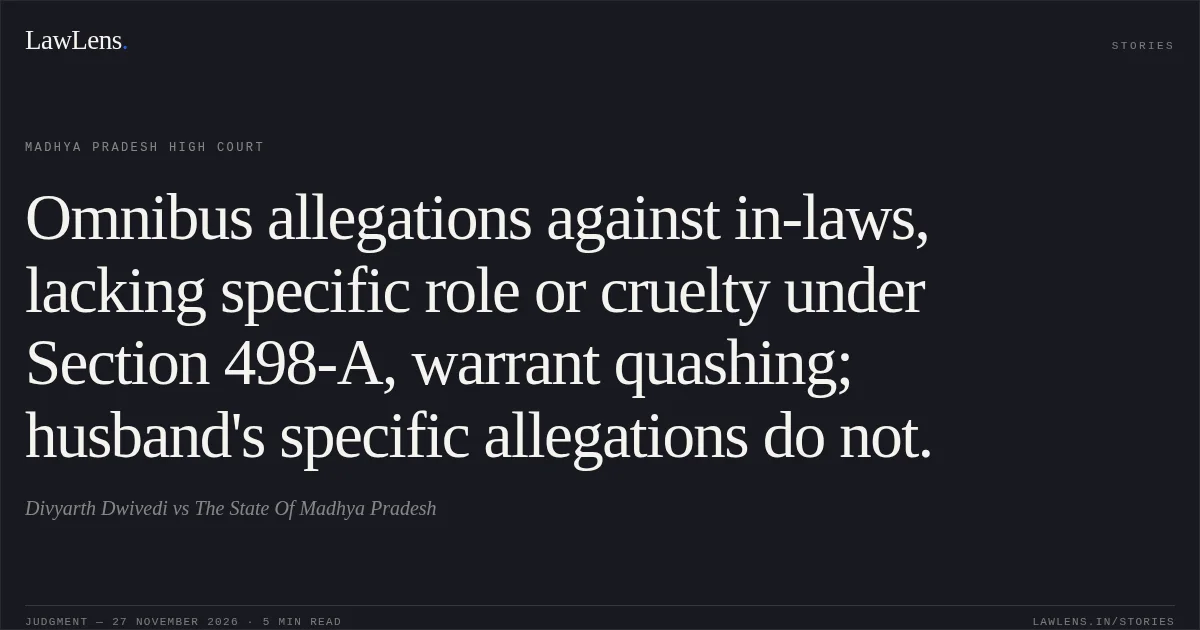
¶ 12–13The Court then examined each petitioner separately. As to the father-in-law and sister-in-law, the FIR attributed no particular incident, date, or act of cruelty or dowry demand to either. Their alleged conduct was limited to supporting the husband, or advising patience, while living separately.
¶ 18–19Under Arti Mehta and Kahkashan Kausar, such omnibus allegations do not justify prosecution, so continuing proceedings against them would abuse the process of law.
¶ 20As to the husband, the FIR contained specific allegations of non-consummation, irritation, assault, and cruelty directed at the complainant. These raised triable questions, and the Court declined to decide their truth at this stage, since doing so would amount to a mini-trial.
¶ 21–2205Holding
The Court held that a Section 12 HMA annulment does not, as an absolute rule, extinguish Section 498-A liability.
¶ 13, 22The FIR and all consequential proceedings under Sections 498-A/34 IPC are quashed as against petitioners Shyam Bihari Hardeniya and Preeti Hardeniya, because the allegations against them are general and omnibus.
¶ 20, 23The prayer for quashment as to Umesh Hardeniya is rejected, and proceedings against him shall continue in accordance with law. The petition is partly allowed. The Court clarified that its observations do not influence the trial court's merits determination.
¶ 21, 24Original Court PDF
Umesh HardeniyavsThe State Of Madhya Pradesh
Click to open original judgment
Original judgment, available to read, download and summarize on LawLens.in