Facts
The parties, married in Kolkata on 15 December 2018 under Hindu rites, lived together for substantial periods in London, where they had established their matrimonial home and financial interests.
Source reference: pp.3–4, 28–29After separating in November 2023, the husband instituted a divorce petition before the Alipore Family Court under Section 13 of the Hindu Marriage Act, 1955, on 4 September 2024, alleging irretrievable breakdown of marriage.
Source reference: p.4The wife subsequently initiated divorce and ancillary financial-relief proceedings before the UK Family Court on 10 October 2024, also relying on irretrievable breakdown of marriage.
Source reference: pp.4–5The husband participated in the UK proceedings while disputing jurisdiction. The UK Family Court ordered interim maintenance and costs, appointed an expert on Indian law, and directed that jurisdiction/forum be determined as a preliminary issue.
Source reference: pp.5–7The Indian Family Court rejected the wife’s application to stay the Indian divorce proceedings under Section 151 of the Code of Civil Procedure, 1908 (“CPC”).
Source reference: p.7On 31 October 2025, the husband instituted a separate title suit seeking a declaration that the UK proceedings were vexatious and without jurisdiction, permanent injunction, and recovery of amounts allegedly paid pursuant to the UK orders.
Source reference: pp.8–9The Alipore Trial Court granted an ex parte anti-suit injunction restraining the wife from prosecuting the UK matrimonial and financial proceedings.
Source reference: p.9The Calcutta High Court set aside that injunction on 15 December 2025, holding, inter alia, that the UK was a potentially appropriate forum and that the issues of jurisdiction and recognition remained pending.
Source reference: pp.12–14Issues
Whether the Alipore Trial Court was justified in granting an anti-suit injunction restraining the wife from prosecuting pending matrimonial and financial proceedings before the UK Family Court
Source reference: pp.17–24Whether the possibility that a future UK divorce decree based on irretrievable breakdown might not be recognised in India under Section 13 CPC justified intervention at the interlocutory stage
Source reference: pp.27–28Whether, applying the doctrine of forum non conveniens and comity of courts, the UK was the more appropriate forum for adjudicating the parties’ matrimonial dispute
Source reference: pp.20–23, 28–30Law Applied
Indian courts may issue anti-suit injunctions against a party subject to their personal jurisdiction, but such relief is exceptional and must be exercised with great caution.
Source reference: pp.18–20Under the principles stated in Modi Entertainment Network v. W.S.G. Cricket Pte. Ltd., the court must consider whether refusal of relief would defeat the ends of justice, whether the foreign proceedings are oppressive or vexatious, which forum is more convenient, and the requirements of judicial comity.
Source reference: pp.18–20The burden ordinarily lies on the applicant to establish that the foreign proceedings are oppressive, vexatious, or before a forum non conveniens.
Source reference: p.23The doctrine of forum non conveniens permits the court seized of proceedings to decline jurisdiction where another adequate and more appropriate forum exists; it is particularly relevant in cross-border matrimonial disputes.
Source reference: pp.20–23Anti-suit injunctions restrain the litigant, not the foreign court, and must be granted sparingly because they risk interfering with the jurisdiction and sovereignty of another court.
Source reference: pp.19–25Relying on Dinesh Singh Thakur v. Sonal Thakur, the Court held that the mere fact that a foreign divorce proceeding invokes a ground not available under the Hindu Marriage Act does not justify restraining the foreign proceeding.
Source reference: pp.25–27The possible non-recognition of a future foreign decree under Section 13 CPC is ordinarily a matter to be considered after the decree, and not a sufficient basis for prematurely halting pending proceedings.
Source reference: pp.27–28Reasoning
The husband failed to establish the exceptional circumstances necessary for an anti-suit injunction.
Source reference: no citationThe UK proceedings were still pending, and the UK Family Court was itself examining jurisdiction and forum; therefore, the Indian court could not assume that the UK court would ultimately exercise jurisdiction improperly or grant an unenforceable decree.
Source reference: pp.27–30The argument based on irretrievable breakdown was speculative and premature because the wife had yet to establish the basis for relief and no final decree had been passed when the injunction was granted.
Source reference: pp.27–28The parties had lived together in London for substantial periods, had made London their matrimonial home, and had established significant residential, personal, and financial connections there. These factors constituted substantial connecting factors supporting the UK as the forum conveniens.
Source reference: pp.28–29The pendency of an Indian matrimonial proceeding, or the fact that it was filed earlier, did not by itself make the foreign proceedings oppressive or vexatious.
Source reference: pp.23–25, 29–30Granting the injunction would improperly interfere with the UK Family Court’s jurisdiction and undermine comity between courts.
Source reference: pp.23–25, 29–30Holding
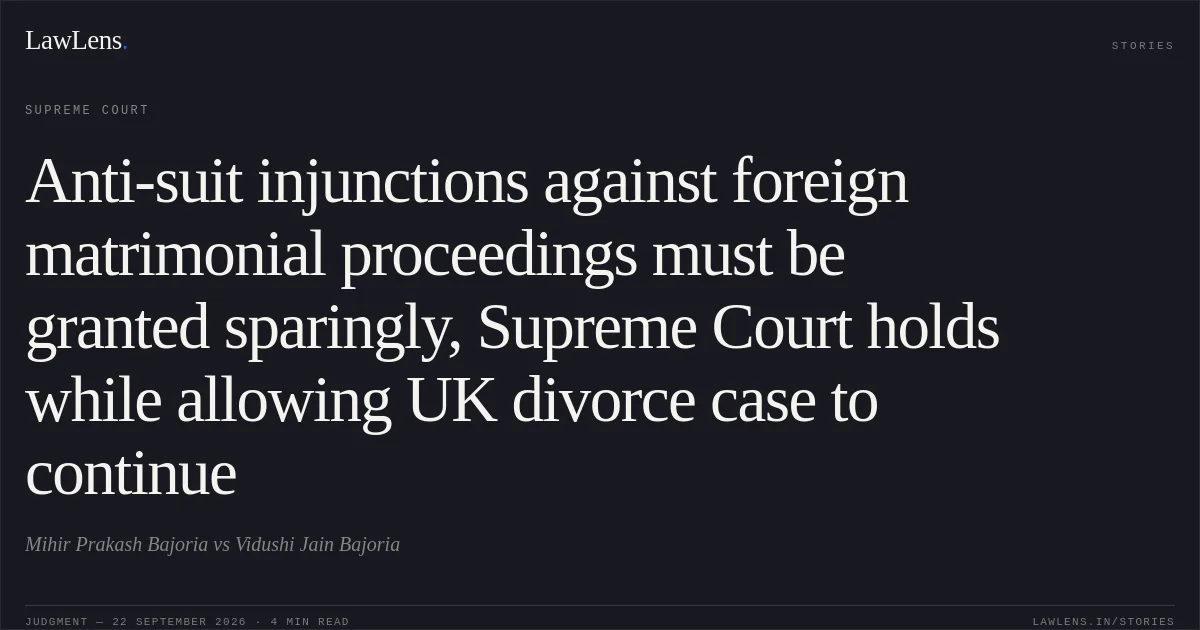
The Supreme Court dismissed the appeal and upheld the Calcutta High Court’s order setting aside the anti-suit injunction granted by the Alipore Trial Court.
It held that the injunction was unwarranted because the foreign proceedings were pending at an interlocutory stage, the UK was substantially connected with the parties’ matrimonial life, and the husband’s objection based on the possible future non-recognition of a UK decree was premature.
Source reference: pp.27–30The parties remained free to challenge any final or further orders of the UK Family Court before the competent forum; the Supreme Court expressed no opinion on the merits or enforceability of any subsequent UK decree.
Source reference: pp.30–32Acts & Sections Cited
4 provisions across 2 statutes referred to in this judgment. Each provision opens on LawLens.
Hindu Marriage Act, 19551
Code of Civil Procedure, 19083
Original Court PDF
Mihir Prakash BajoriavsVidushi Jain Bajoria
Click to open original judgment
Original judgment, available to read, download and summarize on LawLens.in