Facts
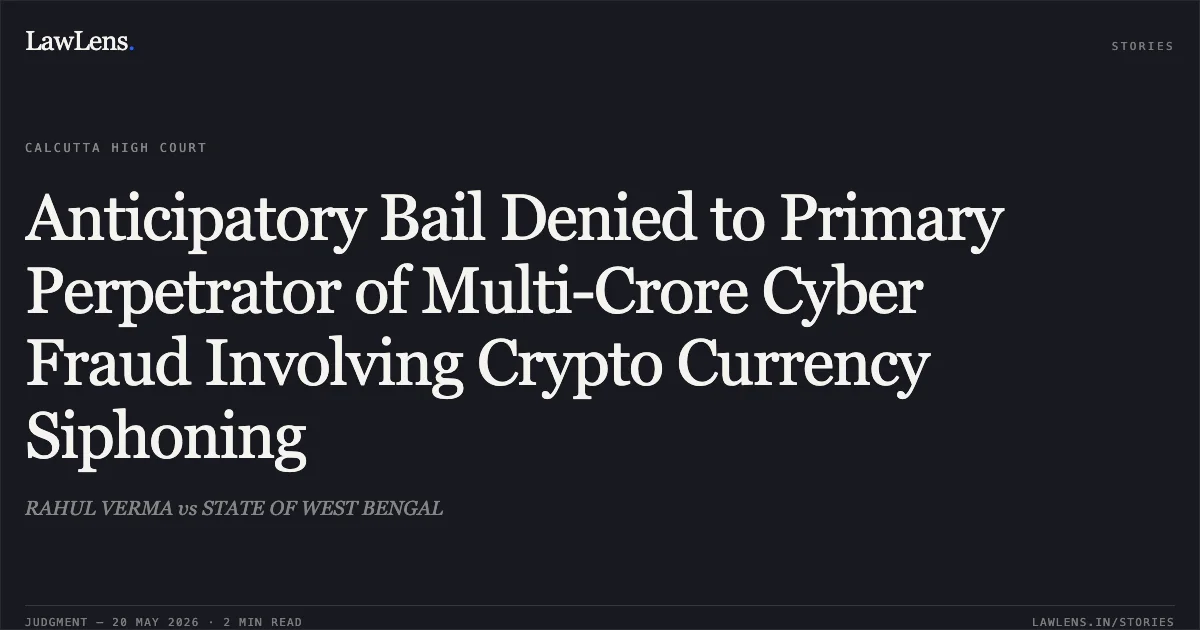
The petitioner sought anticipatory bail regarding a cyber fraud case involving approximately Rs. 315 crores
Source reference: para. 2The prosecution alleged that the petitioner orchestrated a complex scheme using multiple "mule" accounts and Shell companies to defraud over 1,000 victims through fake investment schemes and "digital arrest" scams
Source reference: para. 2Investigation revealed that funds were transferred to 11 bank accounts of Hughli Machineries Private Limited, which the petitioner accessed via his mobile and IP address
Source reference: para. 3The proceeds were subsequently converted into cryptocurrency and moved to foreign jurisdictions like Saudi Arabia and Dubai
Source reference: para. 3While co-accused members of the Ruia family (alleged beneficiaries) were granted anticipatory bail by a Co-ordinate Bench, the State argued the petitioner was the primary perpetrator
Source reference: para. 3, 5The petitioner was already in custody for a related 2024 case when this second, more expansive FIR was registered
Source reference: para. 2, 12Issues
1. Whether a second FIR is maintainable when a larger conspiracy is unearthed subsequent to an initial complaint involving the same period.
Source reference: para. 2, 72. Whether the petitioner is entitled to anticipatory bail on the grounds of parity with co-accused who were granted bail.
Source reference: para. 5, 63. Whether the nature of the alleged economic offence warrants the exercise of discretionary relief under Section 438 of the CrPC/Section 482 of the BNSS.
Source reference: para. 3, 8Law Applied
The court applied the principle that a subsequent FIR is maintainable if it uncovers a larger conspiracy beyond a single instance of fraud, as held in State of Rajasthan v. Surendra Singh Rathore
Source reference: para. 7Regarding economic offences, the court relied on P. Chidambaram v. Directorate of Enforcement, establishing that such crimes affect the economic fabric of society and form a class where anticipatory bail should be exercised sparingly
Source reference: para. 3, 8The court also referenced Sushila Agarwal v. State (NCT of Delhi) and Pratibha Manchanda v. State of Haryana regarding the cautious exercise of discretionary powers in serious criminal matters
Source reference: para. 3The court noted that applications for anticipatory bail should be heard by the regular Bench as per Shekhar Prasad Mahto v. High Court of Jharkhand
Source reference: para. 4Reasoning
The Court distinguished the petitioner’s role from the co-accused (the Ruia family) who received bail. While the Ruia family were alleged to be mere beneficiaries, the petitioner was identified as the "prime perpetrator" who actively executed the fraud, managed the technical IP addresses, and laundered money into cryptocurrency
Source reference: para. 6, 10The Court reasoned that the humongous scale of the fraud—involving thousands of crores and international transfers—demonstrated a sophisticated criminal enterprise that necessitates custodial interrogation to "remove the layers"
Source reference: para. 6, 9The Court found the prosecution's evidence regarding the petitioner's mobile phone and IP address usage to be incriminating
Source reference: para. 10Additionally, the petitioner's criminal antecedents and the risk of him fleeing due to his technological "deftness" weighed against granting relief
Source reference: para. 11, 12Holding
The Court answered the issues in the negative, holding that the petitioner stood on a "distinct footing" from the beneficiaries granted bail
The court emphasized that the humongous proportion of the fraud and the petitioner's role as a perpetrator disentitled him to discretionary relief
Source reference: para. 9, 13The application for anticipatory bail was dismissed, and the subsequent prayer for a stay on the order was rejected
Source reference: para. 14, 15Acts & Sections Cited
12 provisions across 2 statutes referred to in this judgment. Each provision opens on LawLens.
Bharatiya Nyaya Sanhita, 2023
Indian Penal Code, 18603
Original Court PDF
RAHUL VERMAvsSTATE OF WEST BENGAL
Click to open original judgment
Original judgment, available to read, download and summarize on LawLens.in