Facts
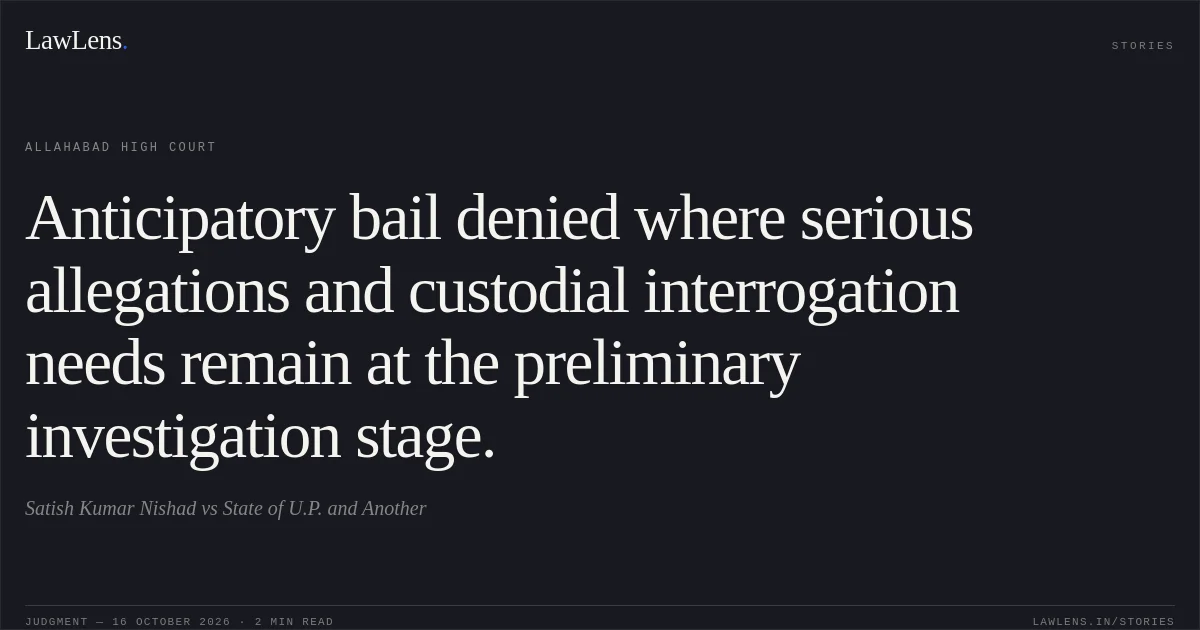
The applicant sought anticipatory bail in Case Crime No. 45 of 2026, registered at Police Station Kareli, District Prayagraj, under Sections 87, 64, 115(2) and 351(3) of the Bharatiya Nyaya Sanhita, 2023.
Source reference: para. 2The applicant denied the allegations and asserted that the victim was a consenting party; the State opposed bail, submitting that the victim was approximately 16 years old and had stated under Section 183 BNSS that the applicant raped her.
Source reference: para. 3–4The Court noted that a Division Bench had dismissed the applicant’s writ petition on 4 June 2026 and allowed 15 days to obtain bail, but that order had not been complied with.
Source reference: para. 6, p. 2Issues
Whether the applicant was entitled to anticipatory bail in light of the allegations, the victim’s age and statement, and the stage of the investigation.
Source reference: paras. 6, 10–12, pp. 2, 6–7Whether the applicant’s failure to comply with the prior order allowing time to obtain bail weighed against granting anticipatory bail.
Source reference: para. 6, p. 2Law Applied
The Court considered the anticipatory-bail power under Section 482 BNSS as an extraordinary discretion, not a routine entitlement, and applied the principles that the court should assess the accusation’s nature and gravity, the applicant’s role, the investigation’s needs, and risks such as flight or interference with evidence.
Source reference: paras. 7–9, pp. 2–6Relying on Srikant Upadhyay v. State of Bihar, the Court observed that anticipatory bail ordinarily should not be invoked where a warrant or proclamation has issued, while preserving the possibility of relief in extreme, exceptional cases.
Source reference: para. 7, pp. 2–3It also relied on P. Chidambaram v. Directorate of Enforcement for the proposition that pre-arrest bail should be granted sparingly and in exceptional cases.
Source reference: para. 8, p. 3Kishor Vishwasrao Patil v. Deepak Yashwant Patil for the need to balance personal liberty against the investigating agency’s need to investigate and interrogate; and Sushila Agrawal v. State (NCT of Delhi) for the relevant discretionary factors.
Source reference: para. 9, pp. 3–6The Court further distinguished the considerations governing regular bail from those governing anticipatory bail.
Source reference: para. 11, p. 7Reasoning
The Court found that the victim claimed to be about 16 years old and had alleged in her statement that the applicant raped her; it considered that her consent was therefore immaterial to the State’s opposition.
Source reference: paras. 4, 6, p. 2It also found a prima facie case, noted the preliminary stage of investigation and considered custodial interrogation necessary to ascertain the truth.
Source reference: paras. 6, 10, pp. 2, 6The applicant had not demonstrated that the case was false, and the Court considered his non-compliance with the earlier order granting 15 days to obtain bail.
Source reference: paras. 6, 10, p. 6Applying the principles governing the exceptional anticipatory-bail remedy, it concluded that the circumstances did not justify pre-arrest protection.
Source reference: paras. 10–12, pp. 6–7Holding
The Court held that the applicant was not entitled to anticipatory bail and dismissed the application.
Any interim order was vacated, and the Registrar (Compliance) was directed to send a copy of the order to the court concerned.
Source reference: paras. 14–15, pp. 7–8Acts & Sections Cited
7 provisions across 3 statutes referred to in this judgment. Each provision opens on LawLens.
Bharatiya Nyaya Sanhita, 20234
Bharatiya Nagarik Suraksha Sanhita, 20232
Code of Criminal Procedure, 19731
Original Court PDF
Satish Kumar NishadvsState of U.P. and Another
Click to open original judgment
Original judgment, available to read, download and summarize on LawLens.in