Facts
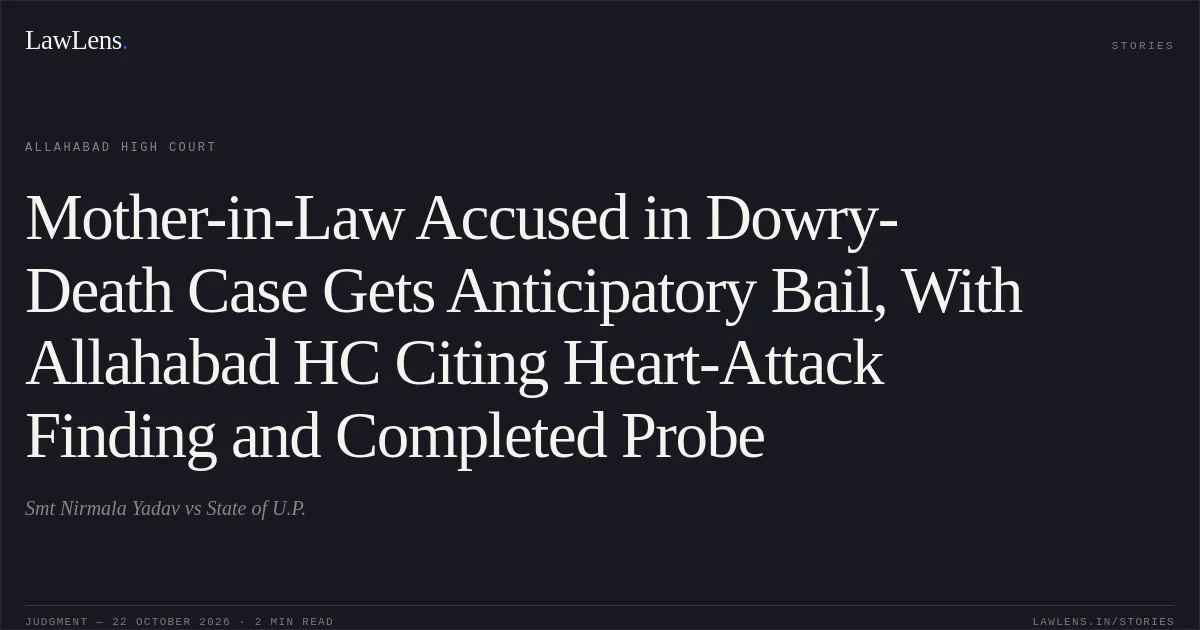
The applicant, the deceased’s mother-in-law, sought anticipatory bail in Case Crime No. 109 of 2025, registered under Sections 80(2), 85, 61 and 115(2) of the Bharatiya Nyaya Sanhita, 2023, and Sections 3/4 of the Dowry Prohibition Act.
Source reference: p.1The prosecution alleged dowry-related harassment and assault; the deceased, who had married the applicant’s son on 4 May 2021, became unconscious on the night of 18–19 February 2025 and died on 25 February 2025 while receiving hospital treatment.
Source reference: p.1; pp.3–4The post-mortem recorded shock resulting from myocardial infarction as the cause of death and noted contusions and an abraded contusion.
Source reference: pp.2, 4A charge-sheet was filed on 10 September 2025, and cognizance was taken on 3 January 2026.
Source reference: pp.1, 3The applicant relied, among other matters, on her cooperation with the investigation, the absence of any need for custodial interrogation, and the grant of regular bail to the deceased’s husband.
Source reference: p.3Issues
Whether, in the circumstances of the case, the applicant had made out a case for anticipatory bail.
Source reference: p.4Whether the applicant’s arrest was necessary after completion of the investigation and filing of the charge-sheet, when the Court found no requirement for custodial interrogation.
Source reference: pp.4–5Law Applied
The application was considered under Section 482 of the Bharatiya Nagarik Suraksha Sanhita, 2023, governing anticipatory bail.
Source reference: p.4The Court relied on Aman Preet Singh v. CBI, (2022) 13 SCC 764, which states that where an accused was not arrested during investigation and custody is not required, the filing of a charge-sheet alone does not justify sudden arrest; ordinarily, the court should issue summons, and a warrant requires the grounds contemplated under Section 87 CrPC, such as absconding or failure to obey summons.
Source reference: pp.4–5The Court also considered the nature of the accusation, the applicant’s role, and the circumstances of the case in deciding whether anticipatory bail was warranted.
Source reference: p.5Reasoning
The Court noted that the deceased had received hospital treatment for fever, seizures and suspected meningitis, and that the post-mortem attributed death to shock resulting from myocardial infarction.
Source reference: p.4The injuries identified were on non-vital parts of the body and were found not to have contributed to death.
Source reference: p.4The applicant had no criminal antecedents, had cooperated with the investigation, and the charge-sheet had already been filed; the Court found no need for her custodial interrogation.
Source reference: pp.4–5It also took account of the husband’s grant of regular bail and applied the principle in Aman Preet Singh that filing a charge-sheet, without more, does not warrant arrest where custody is unnecessary.
Source reference: pp.4–5The Court expressly refrained from expressing any opinion on the merits.
Source reference: p.5Holding
The Court allowed the anticipatory bail application.
In the event of arrest or appearance, the applicant was to be released on anticipatory bail until conclusion of trial on a personal bond of ₹50,000 with two sureties of the like amount, subject to conditions requiring cooperation with the trial, non-interference with witnesses, and prior court permission before leaving India.
Source reference: pp.5–6The prosecution, Investigating Officer or complainant was granted liberty to seek cancellation in the event of default or misuse of the conditions.
Source reference: p.6Acts & Sections Cited
10 provisions across 4 statutes referred to in this judgment. Each provision opens on LawLens.
Bharatiya Nagarik Suraksha Sanhita, 20231
Bharatiya Nyaya Sanhita, 20234
Code of Criminal Procedure, 19733
Original Court PDF
Smt Nirmala YadavvsState of U.P.
Click to open original judgment
Original judgment, available to read, download and summarize on LawLens.in