Facts
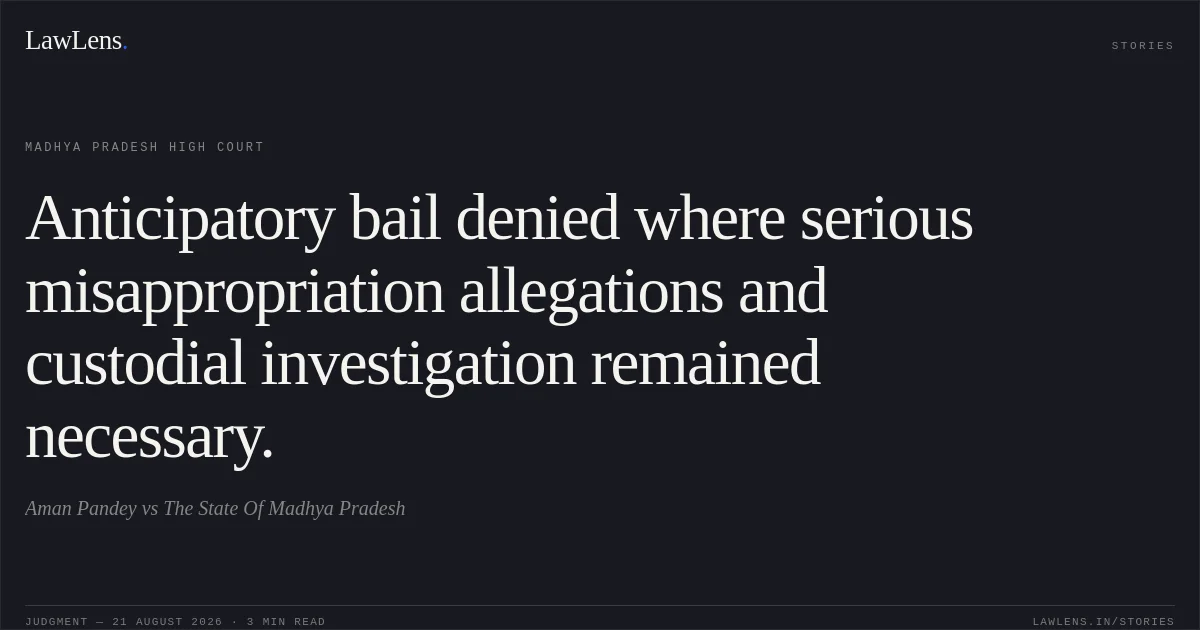
The applicant sought anticipatory bail under Section 482 of the Bharatiya Nagarik Suraksha Sanhita, 2023, in connection with Crime No. 265/2026 registered at Police Station Majhauli, District Jabalpur, for offences under Sections 316(2), 316(5), 318(2) and 3(5) of the Bharatiya Nyaya Sanhita, 2023.
Source reference: para. 1; p. 1The prosecution alleged that, during wheat procurement at Maa Annapurna Warehouse, a shortage of 5,168.70 quintals of wheat valued at approximately ₹1.35 crore was detected.
Source reference: para. 2; pp. 1–2The applicant was allegedly involved in the procurement process, including weighment, filling and stitching of gunny bags, preparation of weighment slips, and supplying information for entries on the e-Uparjan portal.
Source reference: para. 2; pp. 2–3The applicant denied the allegations, disputed the existence and authenticity of the alleged resolution or authorisation under which he purportedly worked at the procurement centre, claimed that he was only engaged in physical handling and labour-related activities, and relied on the documentary and electronic nature of the evidence.
Source reference: paras. 3–4; pp. 3–8He also claimed parity with two co-accused who had been granted anticipatory bail.
Source reference: paras. 3–4; pp. 3–8The State opposed the application, contending that the applicant’s precise role, the disputed authorisation, the alleged manipulation of procurement entries, missing records, and the shortage required effective investigation.
Source reference: para. 5; pp. 8–12Issues
Whether the applicant was entitled to anticipatory bail under Section 482 of the Bharatiya Nagarik Suraksha Sanhita, 2023, in view of the seriousness and magnitude of the alleged misappropriation and the ongoing investigation?
Source reference: paras. 1, 6–7; pp. 1, 12–15Whether the applicant’s disputed role, alleged participation in weighment and preparation of procurement records, and alleged furnishing of information for e-Uparjan entries required further investigation, including possible custodial interrogation?
Source reference: paras. 5–6; pp. 8–14Whether the applicant was entitled to parity with co-accused who had previously been granted anticipatory bail?
Source reference: paras. 4–6; pp. 7–14Law Applied
The Court applied Section 482 of the Bharatiya Nagarik Suraksha Sanhita, 2023, governing the High Court’s power to grant anticipatory bail.
Source reference: paras. 5–7; pp. 8–15The Court considered the seriousness of the accusations, the magnitude of the alleged economic loss, the specific role attributed to the applicant, the stage and requirements of investigation, the possibility of custodial interrogation, and the need to protect the integrity of the investigation.
Source reference: paras. 5–7; pp. 8–15It further applied the principle that disputed questions concerning the genuineness of documents, the applicant’s precise role, and the existence or legality of entrustment ordinarily should not be conclusively determined in an anticipatory-bail proceeding.
Source reference: paras. 3, 5–6; pp. 3–5, 8–14The Court also held that parity is not automatic; it requires comparison of the respective roles, material against each accused, and the circumstances in which protection was granted to the co-accused.
Source reference: para. 6; pp. 13–14Reasoning
The Court held that the allegations concerned more than a procedural irregularity: they involved an alleged shortage of 5,168.70 quintals of wheat valued at approximately ₹1.35 crore.
Source reference: para. 6; p. 12The applicant’s denial of the alleged resolution or authorisation and his contention that the document was forged raised disputed factual matters that could not be conclusively resolved at the anticipatory-bail stage.
Source reference: para. 6; pp. 12–13The Court also found that the prosecution had attributed specific conduct to the applicant—participation in weighment, preparation of weighment slips, and furnishing information for online procurement entries—which required investigation into his actual role and control over the procurement process.
Source reference: para. 6; pp. 12–13The fact that the evidence was documentary and electronic, and that no direct pecuniary benefit had yet been specifically attributed to the applicant, did not by itself justify anticipatory bail.
Source reference: para. 6; pp. 13–14Investigation was also required into missing records, electronic entries, statements of relevant persons, the alleged shortage, and the ultimate beneficiaries.
Source reference: para. 6; pp. 13–14Finally, the Court rejected parity because the applicant’s alleged role and the material against him required independent assessment.
Source reference: para. 6; p. 14Holding
The Court answered the issues against the applicant and held that he had not made out a case for the extraordinary protection of anticipatory bail.
Considering the substantial alleged misappropriation, the applicant’s specific alleged involvement in the procurement and recording process, the disputed documents, and the requirements of investigation, the application was rejected.
Source reference: paras. 6–7; pp. 12–15The Court clarified that its observations were confined to deciding the anticipatory-bail application and would not prejudice the merits of the case; the Investigating Officer was directed to proceed independently and in accordance with law.
Source reference: para. 6; p. 14Acts & Sections Cited
4 provisions across 2 statutes referred to in this judgment. Each provision opens on LawLens.
Bharatiya Nagarik Suraksha Sanhita, 20231
Bharatiya Nyaya Sanhita, 20233
Original Court PDF
Aman PandeyvsThe State Of Madhya Pradesh
Click to open original judgment
Original judgment, available to read, download and summarize on LawLens.in