01Facts
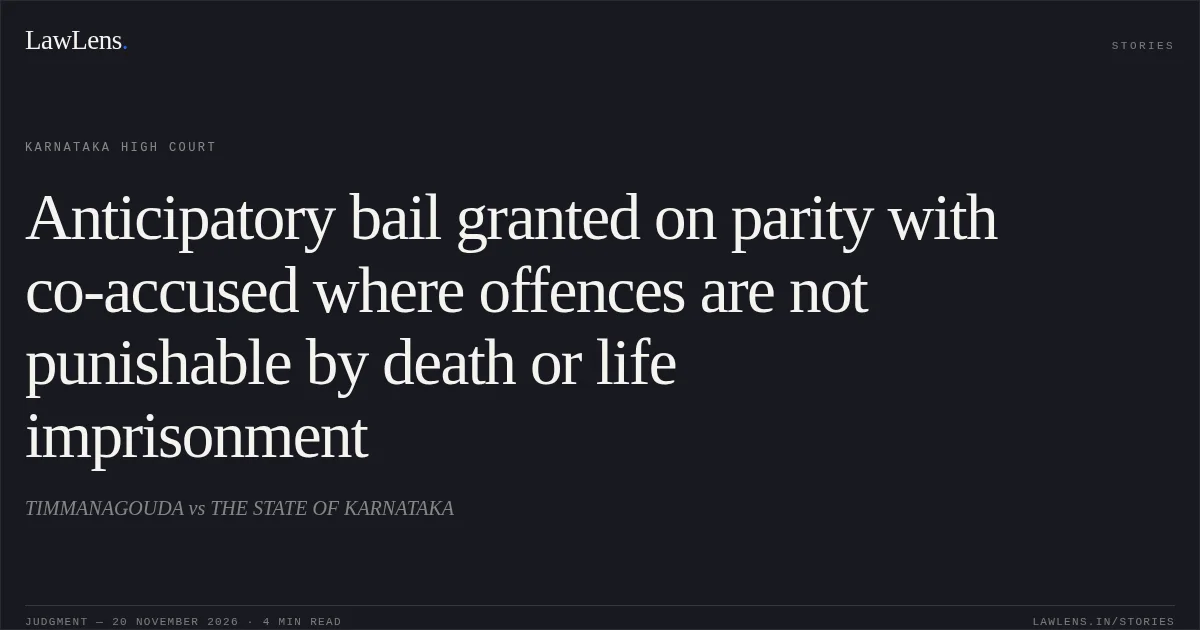
The petitioners, accused Nos. 1, 2, 3, 5, 7 and 8 in Crime No. 297/2026 of Manvi P.S., sought anticipatory bail under Section 482 BNSS in respect of offences under Sections 189(2), 191(2), 126(2), 115(2), 118(1), 133, 352, 351(2) and 109 read with 190 BNS
¶ 2The cause title lists six petitioners, but the prayer and the operative order refer only to accused Nos. 1, 2, 3, 5, 7 and 8
p. 1 · ¶ 12(ii)The prosecution alleges that on 12.08.2026, petitioner No. 1 parked his motorcycle across a road. When the complainant Chiranjeevi objected, petitioner No. 1 pushed him and assaulted him with a spade
¶ 4Later, near Ambedkar Nagar, Manvi, the accused allegedly formed an unlawful assembly and stopped the complainant's vehicle. Petitioner No. 2 allegedly assaulted with a sickle, petitioner No. 4 with a stick (fracturing the complainant's shoulder and elbow), petitioner No. 3 with a club, and petitioners 5 and 6 assaulted Shankarappa
¶ 4Accused No. 12 allegedly attempted to crush the testicles of Channabasava
¶ 4, 5The Medical Officer's wound certificates show that the injured were treated as out-patients and that their injuries were simple, posing no threat to life
¶ 6A counter-FIR (Crime No. 298/2026) was registered against the complainant's side on the complaint of the mother of accused No. 5, on 14.08.2026, after the petitioners' case was registered on 13.08.2026
¶ 7The learned Addl. Sessions Judge, in Crl.Misc. No. 517/2026 (order dated 08.10.2026), dismissed the petitioners' anticipatory bail plea but granted it to accused Nos. 4, 6 and 9 to 12
¶ 9The State (HCGP) objected that Section 109 BNS carries life imprisonment, that custodial interrogation is needed to seize weapons, and that witnesses may be tampered with
¶ 302Issues
i.1. Whether the petitioners are entitled to anticipatory bail under Section 482 BNSS, given that the offences alleged, including Section 109 BNS, are exclusively triable by the Sessions Court and carry a maximum punishment of life imprisonment
¶ 3, 8ii.2. Whether the petitioners' innocence claims, the nature of the injuries, the existence of a counter-case, the parity with co-accused who were granted bail, and the absence of antecedents justify granting anticipatory bail, despite the State's objections regarding custodial interrogation and witness tampering
¶ 5–7, 9–1103Law Applied
The court proceeded under Section 482 BNSS, the successor to Section 438 CrPC, which governs anticipatory bail
¶ 2 · p. 1It applied the offences under BNS Sections 109 (attempt to murder), 115(2) (voluntarily causing hurt), 118(1), 126(2) (wrongful restraint), 133, 189(2) and 191(2) (unlawful assembly and rioting), 190, 351(2) and 352
¶ 2It treated the maximum punishment of life imprisonment and the Sessions Court's exclusive triability as relevant factors, though it stated the offences were "not punishable with death or imprisonment for life"
¶ 8It applied the principle of parity, relying on the grant of anticipatory bail to co-accused in the same incident
¶ 9It also considered the absence of antecedents and the petitioners' permanent residence within the court's jurisdiction
¶ 10It considered the power to impose conditions to secure cooperation with investigation
¶ 11No precedent is cited in the judgment
Provisions in the judgment · 11 · Linked ones open on LawLens
Bharatiya Nagarik Suraksha Sanhita, 2023 Section 482
Bharatiya Nyaya Sanhita, 2023 10 provisions
Section 189Section 191Section 126Section 115Section 118Section 133Section 352Section 351Section 109Section 19004Reasoning
The court accepted, for argument's sake, a prima facie case against the petitioners, but held that the defence of innocence could not be decided at the investigation stage
¶ 5, 8It then weighed the seriousness of the allegations against the medical evidence. Because the injuries were simple and out-patient treatment was given, the court found no threat to life
¶ 6It treated the simultaneous counter-FIR, lodged in response to the petitioners' FIR, as showing a case-and-counter-case pattern in which the occurrence itself was undisputed
¶ 7The court relied heavily on parity, holding that the Sessions Court had granted anticipatory bail to co-accused in the counter-case and in the same proceedings
¶ 9The absence of any antecedents and the petitioners' local residence reduced the risk of flight
¶ 10The State's concerns about witness tampering and weapon recovery were addressed through conditions rather than custody
¶ 11The court's reasoning has an internal tension. Para. 8 states the offences are not punishable with life imprisonment, yet the same paragraph records that the maximum punishment is life imprisonment, and the State had relied on Section 109 BNS for exactly that reason
¶ 3, 8The court did not resolve this point explicitly. It also did not separately address the petitioners in the cause title who are not named in the operative order (accused Nos. 4 and 6)
¶ 1205Holding
The petition is allowed. The respondent police are directed to release accused Nos. 1, 2, 3, 5, 7 and 8 on bail on arrest in Crime No. 297/2026, on personal bonds of ₹2,00,000 each with two sureties of the same amount, subject to the following conditions
¶ 12(ii)(a) appear before the Investigating Officer within 15 days of receiving the order; (b) appear before the Investigating Officer as required and assist in further investigation until the final report is filed; (c) appear before the Magistrate and trial Court as directed; (d) not tamper with prosecution witnesses or hamper the investigation; (e) not commit similar offences during the pendency of the case
¶ 12(ii)(a)–(e)The order does not prevent custodial interrogation with the Magistrate's prior permission if required
¶ 12Original Court PDF
TIMMANAGOUDAvsTHE STATE OF KARNATAKA
Click to open original judgment
Original judgment, available to read, download and summarize on LawLens.in