Facts
The respondent-landlady instituted Rent Case No. 4309 of 2024 under Section 21 of the Uttar Pradesh Regulation of Urban Premises Tenancy Act, 2021 (“Act, 2021”), seeking eviction of the petitioner from three shops, arrears of rent, and mesne profits.
Source reference: paras. 4–5By order dated 19 February 2026, the Rent Authority directed eviction, awarded arrears of rent, and imposed mesne profits at Rs. 2,000 per day, together with consequential monetary liabilities.
Source reference: para. 5The petitioner preferred an appeal under Section 35 of the Act, 2021 before the Rent Tribunal and deposited Rs. 7,00,000 towards the statutory pre-deposit.
Source reference: para. 6He also paid court fee equivalent to that paid before the Rent Authority.
Source reference: para. 6The respondent objected that the appeal was deficiently stamped because court fee had not been paid on the entire decretal amount, including mesne profits.
Source reference: para. 7The Rent Tribunal accepted the objection and directed the petitioner to deposit additional court fee on the entire decretal amount.
Source reference: para. 8The petitioner challenged that direction under Article 227 of the Constitution.
Source reference: no citationIssues
1. Whether a memorandum of appeal under Section 35 of the Act, 2021 against a composite decree must be valued with reference to the subject matter in dispute in appeal, including accrued or ascertainable mesne profits?
Source reference: para. 362. Whether the court fee payable on the appeal is confined to the court fee paid on the original application before the Rent Authority?
Source reference: paras. 36, 45–503. Whether the Rent Tribunal acted illegally or without jurisdiction in directing the petitioner to make good the deficiency in court fee?
Source reference: paras. 76–78Law Applied
The Court applied Sections 35, 39 and 42 of the Act, 2021.
Source reference: no citationSection 35 requires an appellant to pre-deposit fifty per cent of the entire amount payable under the impugned order, while Section 39(1) attracts the Court Fees Act, 1870 to applications and appeals under the Act.
Source reference: para. 38Section 39(2) creates a limited statutory fiction by deeming the application for recovery of possession and the memorandum of appeal to be suits between the landlord and tenant for court-fee computation; it does not require appellate court fee to be identical to the fee paid at the original stage.
Source reference: paras. 44–48Under Section 7 and Schedule I, Article 1 of the Court Fees Act, an appeal is valued according to the subject matter in dispute in appeal.
Source reference: paras. 49–51The valuation depends on the relief or liability actually challenged, rather than the valuation adopted in the original proceeding.
Source reference: paras. 49–51In State of Maharashtra v. Mishrilal Tarachand Lodha, the Supreme Court held that an appellate court fee is determined by the liability actually brought in issue; an unchallenged component does not form part of the subject matter in dispute.
Source reference: paras. 54–57The Court distinguished contingent or future mesne profits from mesne profits that have accrued or become capable of precise arithmetical ascertainment.
Source reference: paras. 59–63It also relied on In re Kudappa Subbamma, Ragho Prasad v. B. Pratap Narain Agrawal and Alok Kumar Jain v. Indra Bhushan Sawhney regarding crystallised monetary liability, appellate valuation, and the interaction between Sections 39 and 42 of the Act, 2021.
Source reference: paras. 63–65Reasoning
The Court held that Section 39(2) only attracts the Court Fees Act and does not freeze appellate valuation at the amount of court fee paid before the Rent Authority.
Source reference: paras. 45–50The petitioner had challenged the composite decree in its entirety, including eviction, arrears of rent and mesne profits; therefore, the subject matter in dispute extended to the decretal liabilities he sought to avoid.
Source reference: paras. 68–69Although future or unascertained mesne profits may not be presently valu-able, the mesne profits in this case had been awarded at a fixed rate and had accrued or become capable of precise computation by the date of appeal.
Source reference: paras. 59, 67, 75They consequently formed part of the existing monetary burden challenged in the appeal.
Source reference: paras. 59, 67, 75The fact that the landlady’s court fee on mesne profits was directed to be recovered at execution did not exempt the petitioner from his independent obligation to pay appropriate appellate court fee.
Source reference: paras. 70–71The statutory pre-deposit under Section 35 operated independently from the court-fee requirement under Section 39.
Source reference: para. 21Since the Tribunal merely granted an opportunity to cure the deficiency rather than rejecting the appeal, its order disclosed no jurisdictional error or perversity warranting interference under Article 227.
Source reference: paras. 76–78Holding
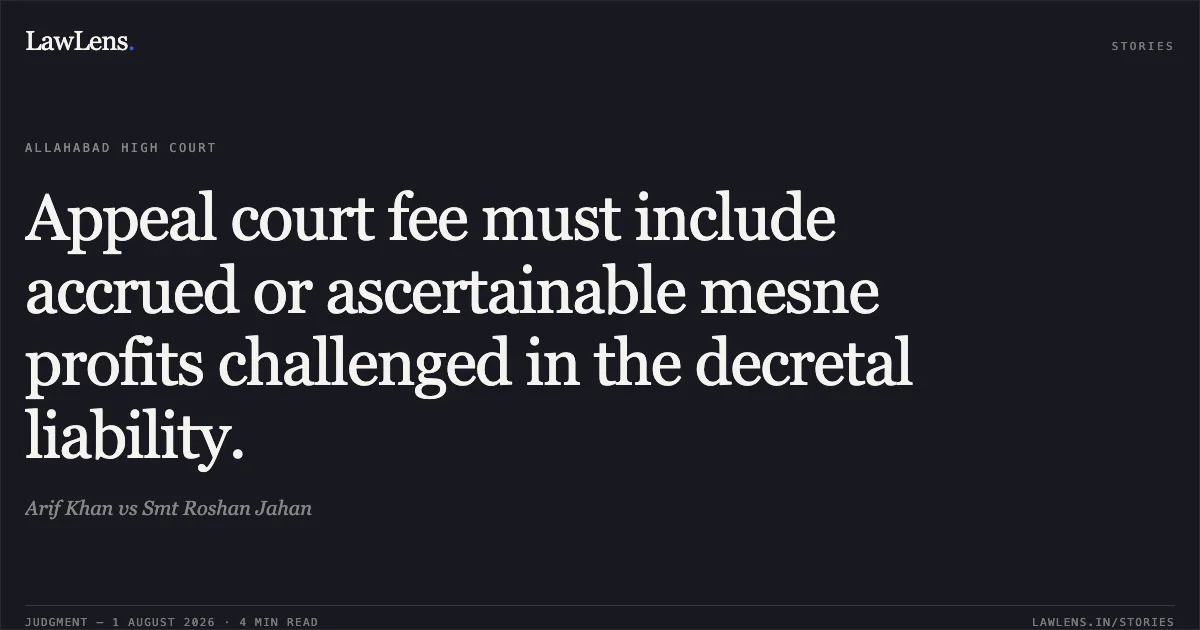
The Court held that an appeal under Section 35 of the Act, 2021 against a composite eviction decree must be valued according to the subject matter in dispute in appeal.
Accrued or ascertainable mesne profits forming part of the decretal liability must be included in the computation of appellate court fee where that liability is challenged.
Source reference: para. 79The Rent Tribunal was justified in directing the petitioner to make good the deficient court fee.
Source reference: para. 80The petition under Article 227 was dismissed, with no order as to costs.
Source reference: para. 81Acts & Sections Cited
5 provisions across 2 statutes referred to in this judgment. Each provision opens on LawLens.
Court-Fees Act, 18703
Code of Civil Procedure, 19082
Original Court PDF
Arif KhanvsSmt Roshan Jahan
Click to open original judgment
Original judgment, available to read, download and summarize on LawLens.in