Facts
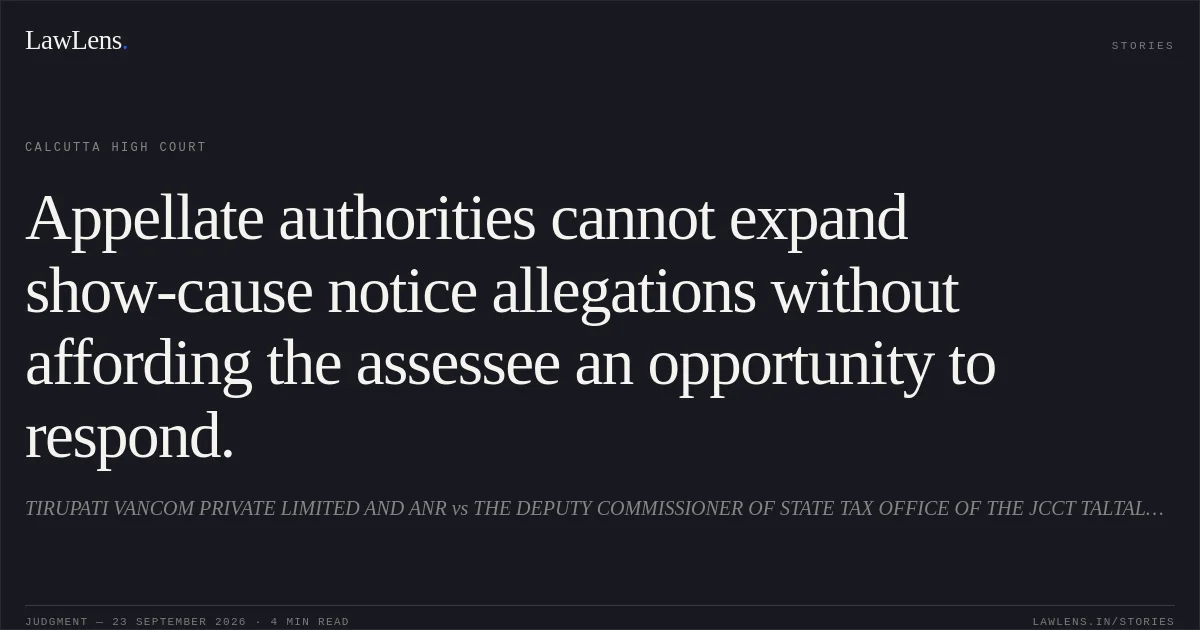
The petitioners, registered under the CGST/WBGST regime and engaged in manufacturing and exporting fly ash and fly ash bricks, claimed a refund of accumulated and unutilised ITC amounting to ₹49,60,054 for exports made without payment of IGST under a Letter of Undertaking during December 2019–March 2020.
Source reference: para. 2–3The refund application was followed by a Show Cause Notice alleging that manual shipping-bill records were not traceable in the ICEGATE system.
Source reference: para. 4The petitioners filed a summary sheet and an electronic reply, but the refund application was rejected on 23 November 2020.
Source reference: para. 5–6Their appeal was dismissed on 19 February 2022, and their subsequent rectification application under Section 161 of the CGST Act was rejected on 20 May 2022.
Source reference: para. 7–8The petitioners challenged the orders, contending that the appellate authority had introduced new grounds concerning Rules 96A, 96B and 89(4)(c), which were not contained in the Show Cause Notice and therefore had not been properly answered by them.
Source reference: para. 9–14The State opposed the writ petition on the merits and also raised the availability of an appellate remedy before the Appellate Tribunal under Section 112 of the CGST/WBGST Acts.
Source reference: para. 15–20Issues
Whether the appellate authority could rely on grounds concerning Rules 96A, 96B and 89(4)(c) of the CGST/WBGST Rules when those grounds were not set out in the Show Cause Notice, without giving the petitioners an opportunity to respond?
Source reference: para. 9–14, 21–22Whether the rejection order dated 23 November 2020 and the appellate order dated 19 February 2022 were liable to be set aside for arbitrariness, illegality, perversity and breach of natural justice?
Source reference: para. 21–23Whether the writ petition could be entertained despite the State’s objection that an appellate remedy before the Appellate Tribunal under Section 112 was available?
Source reference: para. 15–17Law Applied
The Court applied the principle that a Show Cause Notice constitutes the foundational basis of adjudicatory proceedings and that an authority cannot sustain an adverse decision on allegations or grounds beyond those contained in the notice without affording the affected party a meaningful opportunity of reply.
Source reference: para. 21–22This principle is grounded in natural justice and procedural fairness.
Source reference: no citationThe Court also considered the statutory framework governing refund of unutilised ITC and zero-rated exports, including Rules 96A, 96B and 89(4)(c) of the CGST/WBGST Rules, as well as the rectification power under Section 161 and the appellate remedy under Section 112 of the CGST/WBGST Acts.
Source reference: para. 8, 16, 24, 26The Court further referred to the limited scope of writ jurisdiction and the principles associated with Whirlpool Corporation v. Registrar of Trademarks, as raised by the State, but ultimately exercised writ jurisdiction because the impugned orders suffered from procedural illegality and denial of an effective opportunity of hearing.
Source reference: para. 16–17, 21–23Reasoning
The Court found that the original Show Cause Notice was confined principally to the alleged non-traceability of manual shipping-bill records in ICEGATE.
Source reference: para. 4However, the appellate authority introduced additional grounds relating to Rules 96A, 96B and 89(4)(c), including issues concerning export timelines, realisation of export proceeds and determination of zero-rated turnover.
Source reference: para. 10–13, 18–19Since these grounds had not formed part of the Show Cause Notice, the petitioners had not been afforded a proper opportunity to produce documents or make submissions addressing them.
Source reference: no citationThe Court therefore held that the proceedings had travelled beyond the scope of the notice and that the resulting orders were procedurally unsustainable, arbitrary and contrary to natural justice.
Source reference: para. 21–23Without adjudicating the petitioners’ substantive entitlement to refund, the Court directed a fresh consideration after permitting a comprehensive response to both the original notice and the additional grounds relied upon by the appellate authority.
Source reference: para. 24–26Holding
The Court allowed the writ petition to the extent of setting aside the adjudication order dated 23 November 2020 and the appellate order dated 19 February 2022, holding that the orders were affected by arbitrariness, illegality, perversity and expansion of the proceedings beyond the Show Cause Notice.
The petitioners were directed to file a comprehensive reply within seven days, after which the adjudicating authority was required to provide a personal hearing and pass a reasoned and speaking order within four weeks, communicating the decision within one further week.
Source reference: para. 24The Court expressly left the merits of the refund claim open and directed the authority to independently examine the relevant consignment records and the applicability of Rules 96A, 96B and 89(4)(c).
Source reference: para. 25–26If the petitioners were found entitled to the refund of ₹49,60,054, the amount was to be disbursed with interest in terms of the provision referred to by the Court as Section 66 of the CGST Act.
Source reference: para. 25–26Acts & Sections Cited
5 provisions across 2 statutes referred to in this judgment. Each provision opens on LawLens.
Central Goods and Services Tax Act, 20174
West Bengal Goods And Services Tax Act, 20171
Original Court PDF
TIRUPATI VANCOM PRIVATE LIMITED AND ANRvsTHE DEPUTY COMMISSIONER OF STATE TAX OFFICE OF THE JCCT TALTALA CHARGE AND ORS
Click to open original judgment
Original judgment, available to read, download and summarize on LawLens.in