Facts
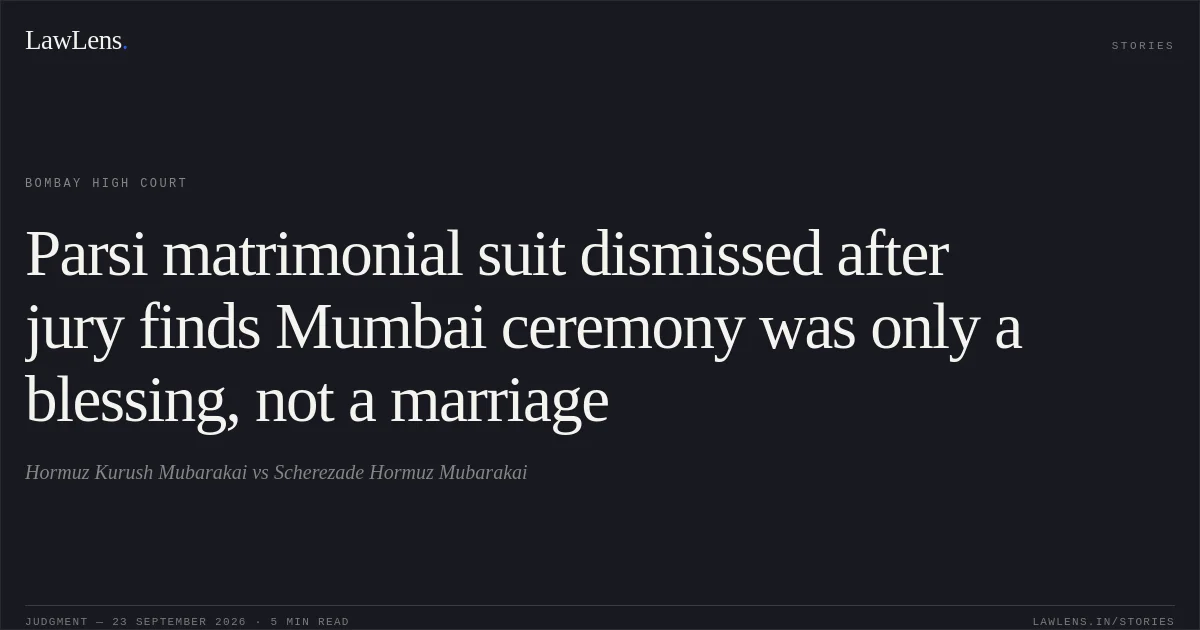
The Plaintiff-Wife instituted Parsi Suit No. 2 of 2018 seeking dissolution of marriage, permanent alimony of ₹5 crores, interim maintenance and costs, relying on a ceremony conducted in Mumbai on 20 November 2010.
Source reference: paras. 1–5The parties had earlier undergone a civil marriage in Perth, Western Australia, on 22 August 2010, and had resided there throughout their married life.
Source reference: paras. 1–5The Husband contended that the Mumbai event was merely a Tandoorasti blessing ceremony and not the Ashirvad ceremony required for solemnisation of a Parsi marriage under Section 3 of the Parsi Marriage and Divorce Act, 1936 (“PMDA”).
Source reference: paras. 1–5With the parties’ consent, the question whether the Mumbai ceremony was an Ashirvad or Tandoorasti ceremony was treated as a preliminary jurisdictional fact.
Source reference: paras. 6–12A video of the ceremony, tendered by the Wife, was viewed by the Parsi delegates.
Source reference: paras. 6–12The delegates unanimously concluded that the event was a Tandoorasti/blessing ceremony and not a complete Parsi marriage ceremony, particularly because the requisite signatures of the spouses and witnesses were absent.
Source reference: paras. 6–12The Husband thereafter sought rejection of the Suit under Order VII Rule 11(d) of the Code of Civil Procedure, 1908 (“CPC”), contending that the Suit was barred by law for want of jurisdiction.
Source reference: paras. 2, 15The Husband also relied on the divorce, custody and asset-division proceedings concluded in Western Australia and pleaded res judicata.
Source reference: paras. 50–60The Australian court had, however, expressly left the Wife’s Indian proceedings and alleged Indian assets outside its adjudication.
Source reference: paras. 50–60Issues
1. Whether the Mumbai ceremony dated 20 November 2010 was an Ashirvad ceremony solemnising a Parsi marriage, or merely a Tandoorasti/blessing ceremony?
Source reference: paras. 15–17, 24, 292. Whether the Bombay High Court had territorial jurisdiction under Sections 3 and 29 of the PMDA when the parties resided in Perth and the only alleged connecting factor was the Mumbai ceremony?
Source reference: paras. 18–20, 443. Whether the CPC, including Order VII Rule 11(d), applied to proceedings under the PMDA, and whether the Suit could be rejected for being barred by law?
Source reference: paras. 30–34, 48–494. Whether the Australian divorce, custody and asset-division proceedings operated as res judicata or otherwise barred the Indian Parsi matrimonial proceedings under Section 13 of the CPC?
Source reference: paras. 50, 58–60Law Applied
The Court applied Section 3(1)(b) of the PMDA, which renders a Parsi marriage invalid unless solemnised according to the Parsi form of ceremony called “Ashirvad” by a priest in the presence of two Parsi witnesses.
Source reference: para. 16Section 29 of the PMDA confers jurisdiction where the defendant resides within the jurisdiction or where the marriage was solemnised; therefore, where both parties reside abroad, the alleged solemnisation in India must be established as the jurisdictional fact.
Source reference: paras. 18–20Sections 19 and 46 of the PMDA allocate functions between the presiding Judge and the Parsi delegates: questions of law and procedure are for the Judge, while questions of fact are determined by the delegates.
Source reference: paras. 21–29Section 45 makes the CPC applicable to PMDA suits insofar as applicable, permitting recourse to Order VII Rule 11(d) where the proceeding is barred by law.
Source reference: paras. 30–34Section 13 of the CPC governs the conclusiveness of foreign judgments and requires that the matter relied upon must have been directly adjudicated.
Source reference: paras. 50, 58The Court also relied on Bhaurao Shankar Lokhande v. State of Maharashtra and Dolly Rani v. Manish Kumar Chanchal for the principle that a marriage is not legally solemnised without the ceremony prescribed by the applicable personal law.
Source reference: paras. 61–65The Court distinguished authorities concerning foreign divorce decrees and dual matrimonial proceedings, including R. Viswanathan, Sharmishtha and Rohinton Minoo Surty.
Source reference: paras. 61–65Reasoning
The Court held that the character of the Mumbai event was a question of fact concerning Parsi custom and ritual.
Source reference: paras. 24, 32–36, 48–49Since the parties had expressly consented to placing the video before the delegates and had participated in that procedure, neither party could subsequently object that the Court had conducted an impermissible “mini-trial” at the Order VII Rule 11 stage.
Source reference: paras. 24, 32–36, 48–49The delegates’ unanimous finding that the event was a Tandoorasti ceremony, not an Ashirvad ceremony, was therefore accepted.
Source reference: paras. 11–12, 43, 46–47The absence of the signatures of the contracting parties and one witness from each side was treated as a substantive indication that the ceremony was not a solemnisation of marriage, rather than a mere formal irregularity under Section 17 of the PMDA.
Source reference: paras. 11–12, 43, 46–47The Court declined to substitute its own view for the delegates’ finding on Parsi ritual in the absence of perversity, and rejected the Wife’s objections based on the meaning of “Ashirvad,” the alleged Irani Zoroastrian variation in custom and the asserted unreliability of the video.
Source reference: paras. 38–45Because the Mumbai event was not an Ashirvad ceremony, no Parsi marriage had been solemnised within the territorial jurisdiction of the Bombay High Court.
Source reference: paras. 19–20, 44The parties’ residence in Perth did not independently confer jurisdiction, and the only asserted jurisdictional link consequently failed.
Source reference: paras. 19–20, 44The Court therefore found the Suit barred by law under Order VII Rule 11(d), as applied through Section 45 of the PMDA.
Source reference: paras. 32, 44, 66(B), 66(G)The plea of res judicata was rejected.
Source reference: paras. 54–60Although the Australian proceedings adjudicated the parties’ civil divorce, custody and Australian financial claims, the Australian court expressly refrained from deciding the merits of the Indian proceedings or the alleged Indian assets.
Source reference: paras. 54–60Accordingly, there was no complete or direct overlap between the issues decided in Australia and those raised in the Parsi Suit for the purposes of Section 13 of the CPC.
Source reference: paras. 54–60Holding
The Court held that the Mumbai event was a Tandoorasti/blessing ceremony and not an Ashirvad ceremony solemnising a Parsi marriage.
Consequently, the jurisdictional fact required under Sections 3 and 29 of the PMDA was absent, and the Bombay High Court lacked jurisdiction to entertain the Parsi matrimonial Suit.
Source reference: paras. 43–44, 66(E)–(G)The Court further held that the CPC and Order VII Rule 11(d) were applicable to the PMDA proceedings, and that the Australian proceedings did not operate as res judicata because the relevant Indian claims had not been adjudicated there.
Source reference: paras. 32, 58–60, 66(B), 66(H)The Interim Application was accordingly allowed, and Parsi Suit No. 2 of 2018 was dismissed as barred by law for want of jurisdiction.
Source reference: paras. 67–68No order as to costs was made.
Source reference: paras. 67–68Acts & Sections Cited
16 provisions across 5 statutes referred to in this judgment. Each provision opens on LawLens.
Parsi Marriage and Divorce Act, 1936.
Code of Civil Procedure, 19081
Family Courts Act, 19841
Special Marriage Act, 19541
Original Court PDF
Hormuz Kurush MubarakaivsScherezade Hormuz Mubarakai
Click to open original judgment
Original judgment, available to read, download and summarize on LawLens.in