Facts
The petitioner, a police personnel, was subjected to departmental proceedings concerning alleged fraudulent transactions involving the sale and mortgaging of a house and the obtaining of loans, allegedly in violation of the Madhya Pradesh Conduct Rules and Police Regulations.
Source reference: para. 5The disciplinary authority found all five charges proved and imposed the punishment of compulsory retirement by order dated 4 October 2016.
Source reference: para. 5The petitioner’s departmental appeal dated 8 December 2016 was rejected.
Source reference: no citationThe petitioner challenged the appellate order under Article 226 of the Constitution, principally contending that the appellate authority had not considered the grounds raised in his appeal and had passed a non-speaking order.
Source reference: paras. 1–2The appeal order merely referred to the disciplinary authority’s note, the departmental evidence, and the finding that the charges were proved, without independently addressing the petitioner’s objections concerning the evidentiary material, prior service record, and proportionality of punishment.
Source reference: para. 5Issues
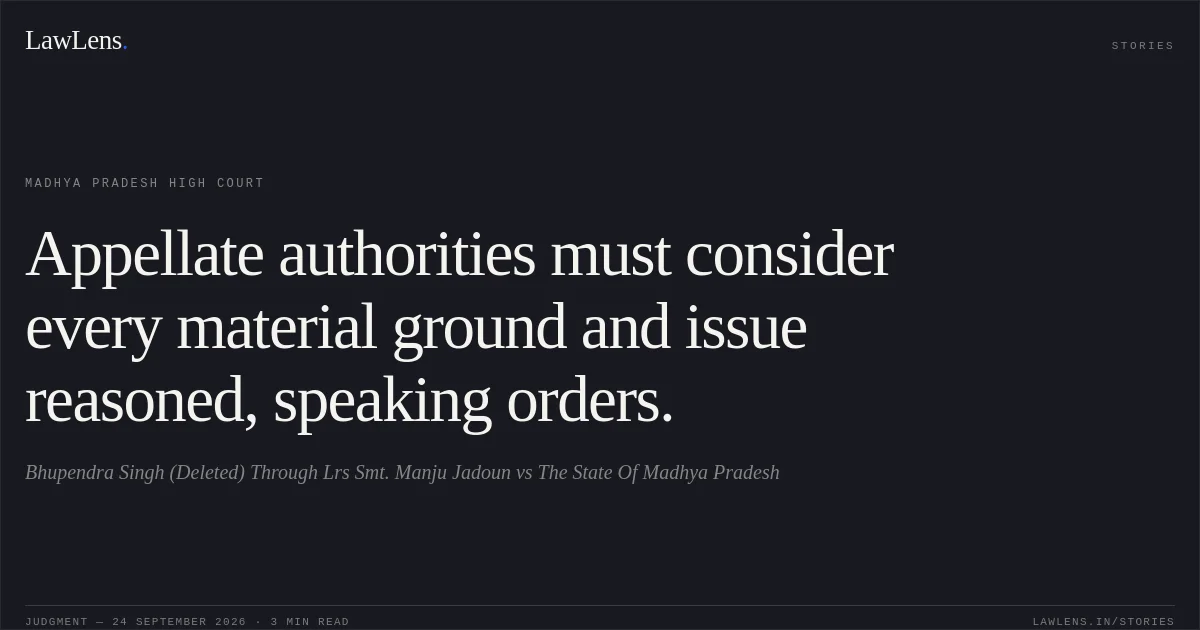
Whether the appellate authority, while deciding a departmental appeal against the punishment of compulsory retirement, was required to consider the specific grounds raised by the petitioner and pass a reasoned and speaking order?
Source reference: paras. 5–7, 11Whether the appellate order dated 8 December 2016, which did not independently address the petitioner’s grounds of appeal, was legally sustainable?
Source reference: paras. 6, 10–12Whether the High Court should itself examine the merits of the disciplinary findings and grant reinstatement and consequential benefits?
Source reference: paras. 12–14Law Applied
The Court exercised judicial review under Article 226 of the Constitution of India and applied the principle that an appellate authority exercising quasi-judicial power must consider the grounds raised before it and record cogent, clear, and intelligible reasons.
Source reference: paras. 6–7Relying on State of Punjab v. Bandip Singh, (2016) 1 SCC 724, the Court held that every administrative or executive decision affecting rights must be composite and self-contained, containing the reasons that led to the conclusion.
Source reference: paras. 8–9It also relied on Kranti Associates (P) Ltd. v. Masood Ahmed Khan, (2010) 9 SCC 496, which establishes that quasi-judicial and administrative authorities must give reasons, that reasons restrain arbitrariness, demonstrate consideration of relevant factors, facilitate judicial review, and cannot be replaced by “rubber-stamp reasons”.
Source reference: para. 10The Court further applied the settled principle that quasi-judicial orders affecting civil or service rights must be speaking orders passed after due application of mind.
Source reference: paras. 6–7Reasoning
The appellate authority recorded the charges, the disciplinary authority’s conclusion, and the petitioner’s broad objections, but did not analyse those objections or explain why they were unacceptable.
Source reference: para. 5In particular, it failed to deal with the petitioner’s contentions that the original documents relating to the alleged transactions and loans had not been produced, that only photocopies were relied upon, that his previous service record had not been considered, and that the punishment was disproportionate.
Source reference: para. 5Merely stating that the departmental inquiry was properly conducted, that the charges were proved, and that the conduct was serious did not amount to an independent appellate examination.
Source reference: no citationSince the appellate authority was exercising quasi-judicial powers and its decision adversely affected the petitioner’s service rights, it was required to give reasons demonstrating consideration of the grounds of appeal.
Source reference: paras. 6–7, 10–11The failure to do so rendered the appellate order non-speaking and unsustainable.
Source reference: no citationHowever, the defect related to the manner in which the appeal was decided; the Court therefore did not adjudicate the merits of the charges or the proportionality of the punishment.
Source reference: paras. 12–13Holding
The High Court held that the appellate order dated 8 December 2016 was not a reasoned or speaking order because the petitioner’s specific grounds of appeal had not been considered.
The appellate order was accordingly quashed.
Source reference: para. 12The petitioner was directed to submit a fresh and detailed appeal within three weeks, and the appellate authority was directed to decide it by a reasoned and speaking order, after providing the petitioner a personal hearing, within two months of receiving the certified copy of the judgment.
Source reference: para. 12The Court expressly stated that it had not expressed any opinion on the merits of the case and disposed of the writ petition without granting immediate reinstatement or consequential benefits.
Source reference: paras. 12–14Original Court PDF
Bhupendra Singh (Deleted) Through Lrs Smt. Manju JadounvsThe State Of Madhya Pradesh
Click to open original judgment
Original judgment, available to read, download and summarize on LawLens.in