Facts
The petitioner, a prison employee, was subjected to a major penalty of withholding three annual increments with cumulative effect by order dated 28 April 2001.
Source reference: p.2, para. 2The penalty followed departmental proceedings concerning alleged negligence in duty, including leaving the duty post after handing over the gate key without properly handing over charge, which allegedly contributed to a prisoner escaping from custody.
Source reference: p.2, para. 6The petitioner appealed against the disciplinary order, but the appellate authority rejected the appeal on 21 September 2001, stating that the charges were proved and that the appeal disclosed no substantial ground, without adequately addressing the petitioner’s grounds.
Source reference: p.2–3, para. 6The petitioner challenged both orders under Article 226 of the Constitution, principally contending that the appellate order was non-speaking and unreasoned.
Source reference: p.1–2, para. 2Issues
1. Whether the appellate authority’s order rejecting the petitioner’s departmental appeal was invalid for failure to provide adequate reasons and for being non-speaking.
Source reference: p.3–5, paras. 7–112. Whether the matter should be remitted to the appellate authority for fresh consideration after providing the petitioner an opportunity of hearing.
Source reference: p.6–7, para. 12Law Applied
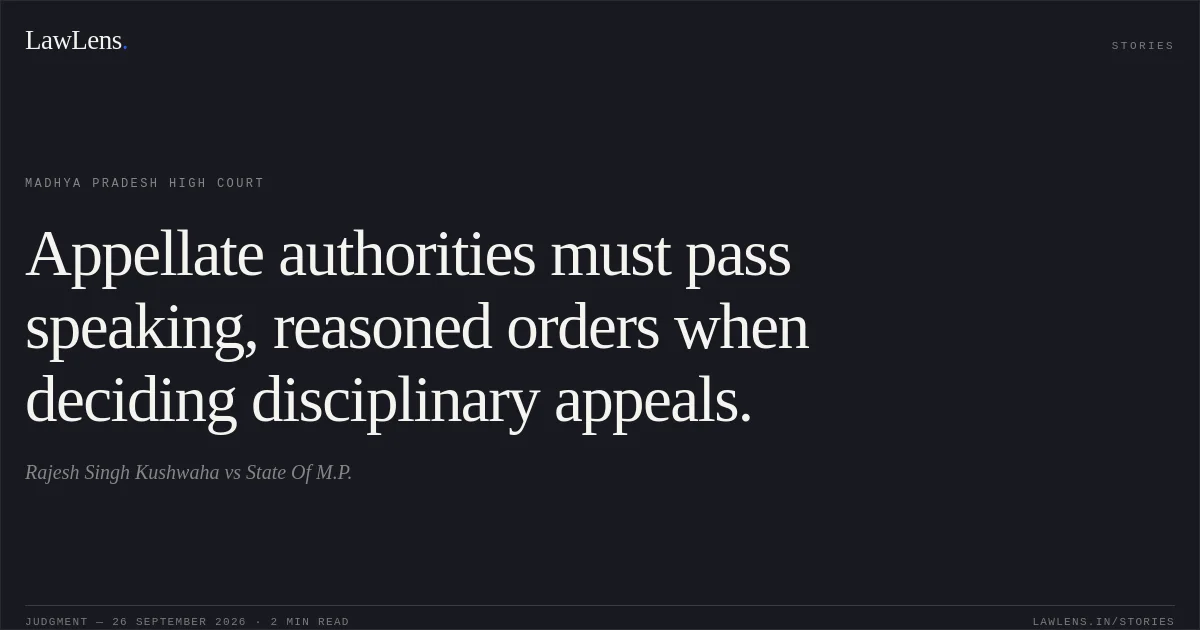
An authority exercising quasi-judicial or administrative power affecting the rights of a person must pass a reasoned and speaking order; it must apply its mind to the relevant facts, contentions, and circumstances, and record clear, cogent, and rational reasons.
Source reference: p.3–4, paras. 8–10The Court relied on State of Punjab v. Bandip Singh, (2016) 1 SCC 724, which held that administrative or executive decisions must be composite and self-sustaining and must disclose the reasons informing the decision.
Source reference: p.3–4, paras. 8–10It also relied on Kranti Associates Pvt. Ltd. v. Masood Ahmed Khan, (2010) 9 SCC 496, which recognised recording reasons as an essential component of fair decision-making, judicial accountability, transparency, and effective judicial review, and held that quasi-judicial authorities must not provide merely rubber-stamp or pretended reasons.
Source reference: p.4–6, para. 11Reasoning
The High Court held that the appellate authority was exercising quasi-judicial power while deciding the petitioner’s departmental appeal and was therefore required to independently consider the appeal grounds and provide intelligible reasons for affirming the penalty.
Source reference: p.3, para. 7Although the appellate order referred generally to the departmental evidence, the petitioner’s alleged negligence, and the escape of a prisoner, it did not demonstrate adequate consideration of the petitioner’s specific defence or explain why the appeal grounds lacked merit.
Source reference: p.2–3, para. 6Applying the principles in Bandip Singh and Kranti Associates, the Court concluded that the order did not satisfy the requirement of a speaking and reasoned decision and was consequently unsustainable, without expressing any opinion on the merits of the disciplinary charges.
Source reference: p.3–6, paras. 7–11Holding
The Court answered the principal issue in favour of the petitioner and set aside the appellate authority’s order dated 21 September 2001 rejecting the departmental appeal.
The petitioner was directed to file a fresh appeal before the appellate authority within one month, and the appellate authority was directed to decide it by a speaking and reasoned order, after granting the petitioner a personal hearing, within three months of receiving the certified copy of the judgment.
Source reference: p.6–7, para. 12(b)–(c)The Court clarified that it had expressed no opinion on the merits of the case.
Source reference: p.7, para. 13Original Court PDF
Rajesh Singh KushwahavsState Of M.P.
Click to open original judgment
Original judgment, available to read, download and summarize on LawLens.in