01Facts
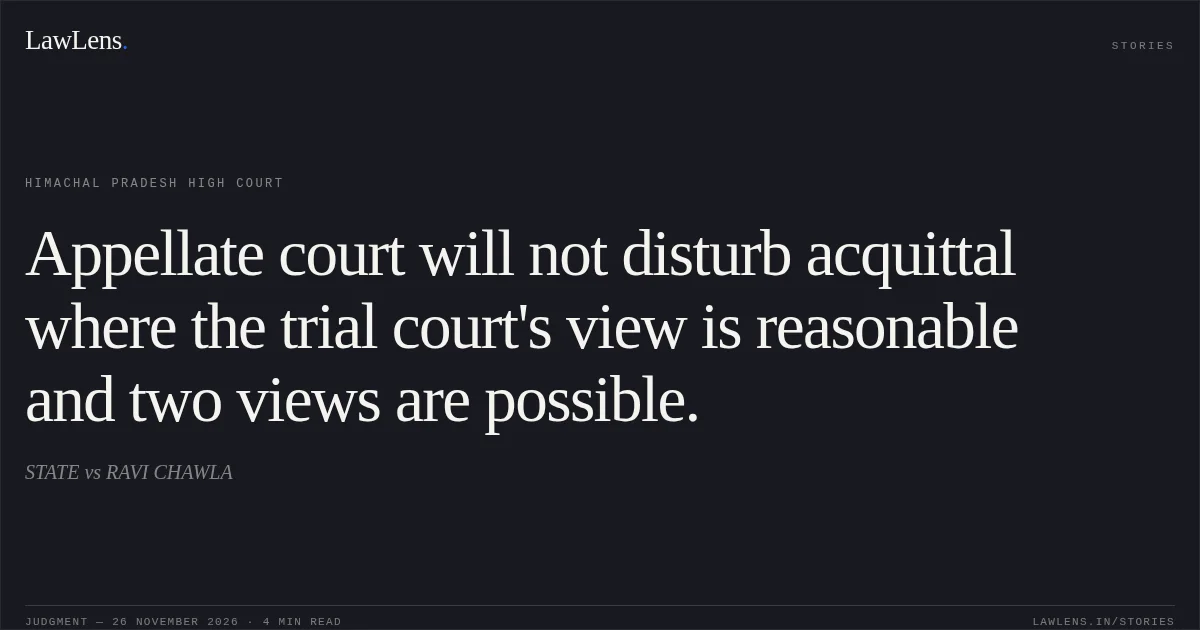
The State appealed against the judgment dated 21.01.2011 of the Additional Sessions Judge, Fast Track Court, Chamba, in Sessions Trial No. 18 of 2009, which acquitted Ravi Chawla (A-1), Salim Ali (A-2) and Daljeet Singh @ Bunty (A-3) of offences under Section 302 read with Section 34 IPC.
¶ 1Respondent No. 2 has since died, and Respondent No. 3 was declared a proclaimed offender on 25.04.2014.
The prosecution case is that during the night of 09/10.08.2008 at Chowgan No. 1, Chamba, during the Minjar Fair, the accused quarrelled with the deceased, Vijay Kumar, over gambling prize money, assaulted him, and threw him onto a table, causing head injuries; he died at Civil Hospital, Chamba.
¶ 4(i)–(ii), 19The complainant, Ashok Kumar (PW-1), a brother of the deceased, lodged FIR No. 168/2008 on 10.08.2008.
¶ 4(iii), 25The prosecution examined fourteen witnesses and relied on documentary evidence, including recovery memos for blood-stained shirts, a table and an iron rod/pipe, the post-mortem report, and SFSL reports.
¶ 6, 21The trial court acquitted the accused, holding that the sole eyewitness was unreliable, the circumstantial chain was incomplete, and there was unexplained delay in reporting.
¶ 1002Issues
i.1. Whether the trial court's acquittal is perverse or based on a wrong approach, so as to warrant interference by the appellate court in an appeal against acquittal.
¶ 12–17, 56ii.2. Whether the testimony of PW-1 and PW-2, the deceased's brothers, who were not eyewitnesses, is admissible and can establish the sequence of events and the accused's complicity.
¶ 27–34iii.3. Whether the sole eyewitness, Amarjeet Singh (PW-6), is credible enough to sustain conviction.
¶ 35–37iv.4. Whether the circumstantial evidence (recovery of weapons and blood-stained clothing, and the FSL report) forms a complete chain pointing only to the guilt of the accused.
¶ 40–5203Law Applied
The court applied Section 302 read with Section 34 IPC as the charged offence and the principles of proof beyond reasonable doubt, under which the burden never shifts and the prosecution must prove its case on acceptable evidence.
¶ 18, 53For appeals against acquittal, the court relied on Sheo Swarup v. King Emperor and related Supreme Court authority (Tulsiram Kanu, Balbir Singh, M.G. Agarwal, Muralidhar, Rajesh Prasad, H.D. Sundara, Jafarudheen, Geeta Devi, Surendra Singh), which hold that an appellate court must give due weight to the trial court's findings, that interference is warranted only where the acquittal is perverse, and that the appellate court should not disturb an acquittal where two views are possible.
¶ 13–17On hearsay, the court applied Section 60 of the Indian Evidence Act and Jagdish Narain, Balram Prasad Agrawal and Kalyan Kumar Gogoi, which hold that a witness who relays what others told him is inadmissible unless the source is examined.
¶ 29–33On circumstantial evidence, the court applied Gargi v. State of Haryana and Hanumant Govind Nargundkar, which require that all incriminating circumstances be cogently established, point unerringly to guilt, and form a chain incapable of explanation on any hypothesis of innocence.
¶ 41–44The court applied Kali Ram v. State of H.P., which requires the view favouring the accused to be adopted where two views are possible.
¶ 43The court applied Shivaji Sahabrao Bobade and State of Karnataka v. J. Jayalalithaa on the standard of "reasonable doubt".
¶ 53–54Provisions in the judgment · 5 · Linked ones open on LawLens
Indian Penal Code, 1860 Section 302Section 34Section 304
Code of Criminal Procedure, 1973 Section 154Section 161
04Reasoning
The court first held that the hearsay evidence of PW-1 and PW-2 must be excluded, since both were absent from the spot and learned of the incident from A-1.
¶ 27, 34The court examined PW-6 and found him unreliable. He was a daily wager, not a stall allottee, and could not name the allottee he worked for. He was unable to state the stall number or the number of persons present. He also did not report the incident, which the court considered unnatural. Its finding that a sole witness could not have seen the incident in a normally crowded and occupied area was also unusual.
¶ 37On the circumstantial evidence, the court found the recovery of the table and iron rod unreliable. The FIR did not mention the iron rod.
¶ 45The witness and the Investigating Officer disagreed on where the table was found.
¶ 46No blood was found on either weapon, and no forensic evidence linked them to blood.
¶ 47The shirt of the deceased was said to have been recovered from the spot, yet the post-mortem report records that he was wearing a shirt and pant when examined.
¶ 48–49The witness and the Investigating Officer also gave conflicting accounts of where A-1's shirt was taken into possession.
¶ 50The FSL finding of group 'B' blood on A-1's shirt was not conclusive, because the accused had admittedly transported the deceased to hospital, so the blood could have come from that.
¶ 51–52Having found the direct and circumstantial evidence weak, the court concluded that the prosecution had not proved guilt beyond reasonable doubt.
¶ 53–5505Holding
The court held that there was neither cogent direct nor circumstantial evidence establishing the accused's involvement.
¶ 55Finding no perversity or misappreciation warranting interference, the court held that the trial court's findings could not be faulted.
¶ 56The appeal was dismissed, and the acquittal of Ravi Chawla, Salim Ali and Daljeet Singh @ Bunty under Section 302 read with Section 34 IPC was upheld.
¶ 57Pending miscellaneous applications were disposed of.
¶ 58Original Court PDF
STATEvsRAVI CHAWLA
Click to open original judgment
Original judgment, available to read, download and summarize on LawLens.in