01Facts
The prosecution alleged that on 3 September 2012, the respondent drove a car rashly and negligently, causing it to overturn and strike a toilet wall near Karmala, Puttur. The accident allegedly injured the respondent and two passengers, grievously injured another passenger, and caused the death of Mahammad Sinan.
¶ 1, 3–7The respondent was charged under Sections 279, 337, 338 and 304-A of the IPC. The trial court acquitted him on 1 March 2017; the State appealed against that acquittal under Section 378(1) and (3) of the CrPC.
¶ 1, 3–702Issues
i.1. Whether the State established grounds for appellate interference with the trial court’s judgment of acquittal.
¶ 10ii.2. What order should follow from the Court’s determination of that issue.
¶ 1003Law Applied
Sections 279, 337, 338 and 304-A of the IPC were the provisions underlying the charges; Section 378 of the CrPC governed the State’s appeal against acquittal.
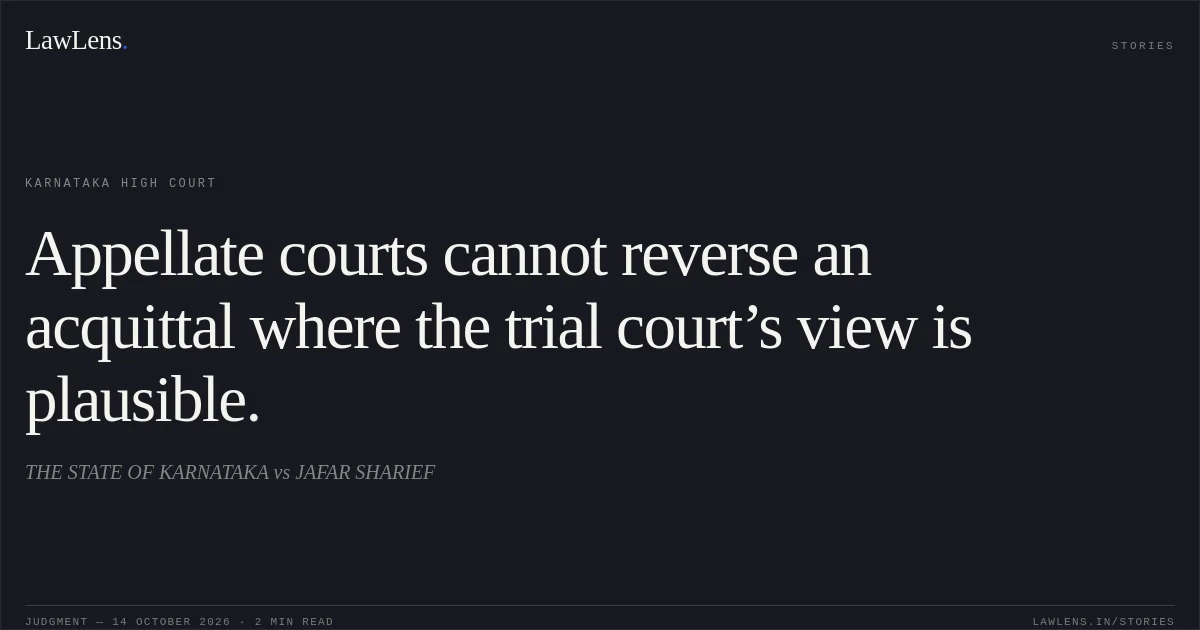
¶ 3, 10Relying on Constable 907 Surendra Singh v. State of Uttarakhand, Babu Sahebgouda Rudragoudar v. State of Karnataka, Chandrappa v. State of Karnataka and H.D. Sundara v. State of Karnataka, the Court stated that an acquittal strengthens the presumption of innocence and may be reversed only where the trial court’s view is not a plausible one—such as where the judgment is patently perverse, materially misreads or omits evidence, and the evidence permits no reasonable view other than guilt.
¶ 11Provisions in the judgment · 5 · Linked ones open on LawLens
Code of Criminal Procedure, 1973 Section 378Section 313
Indian Penal Code, 1860 Section 279Section 337Section 338
04Reasoning
The complainant, the alleged eyewitnesses and the spot-mahazar witnesses did not support the prosecution. Although they were treated as hostile and cross-examined by the prosecution, no evidence sufficient to substantiate its case was elicited.
¶ 14–17On reappraisal, the High Court found no legal or factual error in the trial court’s assessment and no basis to conclude that the acquittal was perverse or that only a finding of guilt was possible.
¶ 18–1905Holding
The Court answered the question of interference in the negative.
¶ 19–20The Court dismissed the State’s appeal, leaving the respondent’s acquittal in force.
¶ 19–20Original Court PDF
THE STATE OF KARNATAKAvsJAFAR SHARIEF
Click to open original judgment
Original judgment, available to read, download and summarize on LawLens.in