Facts
The respondent obtained an ex parte decree for recovery of possession on 10 July 2012.
Source reference: para. 1–4The predecessor-in-interest of the petitioners sought to set it aside under Order IX Rule 13 CPC, but that application was dismissed for default; a restoration application remained pending.
Source reference: para. 1–4The decree was put into execution in 2017.
Source reference: para. 1–4The petitioners later filed an appeal under Section 96 CPC with an application to condone an approximately ten-year delay, and sought a stay of execution.
Source reference: para. 1–4The appellate court refused a stay while the delay application remained undecided and the appeal had not been taken up under Order XLI Rule 11 CPC.
Source reference: para. 1–4The petitioners challenged that refusal under Article 227 of the Constitution.
Source reference: para. 1–4, 11The High Court noted the petitioners’ prior proceedings, delays, and requests for time, as well as that evidence on the delay application remained incomplete.
Source reference: para. 24–29Issues
1. Whether the appellate court was justified in refusing to stay execution solely because the application to condone delay was pending and the appeal had not been admitted under Order XLI Rule 11 CPC.
Source reference: para. 112. Whether the circumstances justified an exceptional departure from the restriction in Order XLI Rule 3A(3) CPC and an interim stay of execution.
Source reference: para. 17–23Law Applied
Order XLI Rule 3A(1)–(2) CPC requires a delayed appeal to be accompanied by an application explaining the delay and provides that the delay application must be decided before the court proceeds to deal with the appeal under Rule 11 or Rule 13.
Source reference: para. 12–18Rule 3A(3) ordinarily bars a stay of execution until, after hearing under Rule 11, the court decides to hear the appeal.
Source reference: para. 12–18The Court held that this procedural restriction is directory, not absolute: a court may depart from it and act ex debito justitiae in exceptional and extraordinary circumstances where refusing relief would produce inequitable consequences, but a stay is not available merely because an appeal has been filed.
Source reference: para. 12–18, 22The Court relied on Sushil Kumar Sen v. State of Bihar and State of Punjab v. Shamlal Murari for the principle that procedural law should aid, not obstruct, justice.
Source reference: para. 15–17The Court relied on Ram Ch. Sinha v. Sm. Protiva Dutta, Durgapada Patra v. Estate Officer, SER, and Bhagwan v. Kachrulal in considering the possibility of exceptional relief.
Source reference: para. 19–21It also considered State of West Bengal v. Somdeb Bandyopadhyay on interim orders before condonation of delay and Rahul S. Shah v. Jinendra Kumar Gandhi on expeditious disposal of execution proceedings.
Source reference: para. 30, 33Reasoning
Although Rule 3A(3) does not impose an absolute bar, the Court held that departure from the ordinary procedure requires exceptional circumstances.
Source reference: para. 24–30, 33–35The petitioners had pursued several proceedings after the decree, their predecessor’s Order IX Rule 13 application had been dismissed for default, the appeal was filed after an approximately ten-year delay, and the delay evidence was still being taken.
Source reference: para. 24–30, 33–35The petitioners had also sought repeated adjournments and applied for a stay while proceedings in execution were advanced.
Source reference: para. 24–30, 33–35In those circumstances, the Court found no inequity warranting exceptional intervention; it also emphasised that execution should not be stayed mechanically merely because an appeal is pending.
Source reference: para. 24–30, 33–35Holding
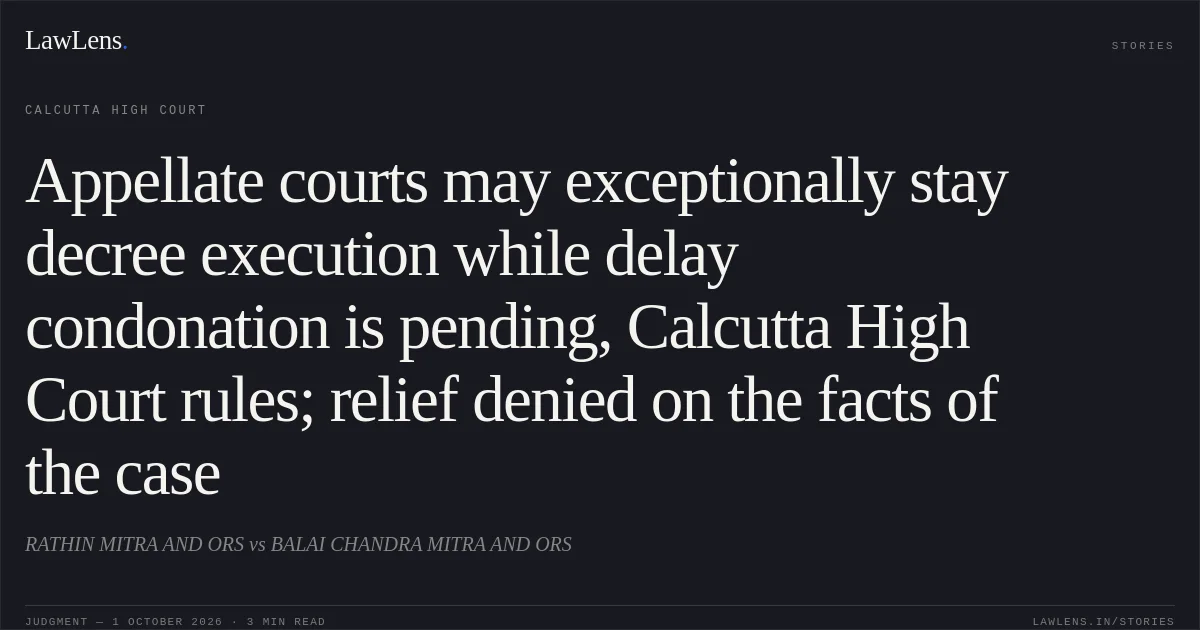
The High Court held that the appellate court was justified in refusing a stay in the circumstances of the case.
The petitioners had not established exceptional grounds for departing from Order XLI Rule 3A(3) CPC.
Source reference: para. 31–37The civil revision application was dismissed, with no order as to costs.
Source reference: para. 31–37Acts & Sections Cited
4 provisions across 2 statutes referred to in this judgment. Each provision opens on LawLens.
Code of Civil Procedure, 19083
Limitation Act, 19631
Original Court PDF
RATHIN MITRA AND ORSvsBALAI CHANDRA MITRA AND ORS
Click to open original judgment
Original judgment, available to read, download and summarize on LawLens.in