Facts
The State sought leave under Section 378(3) of the Code of Criminal Procedure to appeal the respondent’s acquittal of an offence under Section 304-A of the Indian Penal Code.
Source reference: para. 1The prosecution alleged that, on 5 March 2015, an Innova car driven by the respondent collided with a truck near Aashirwad Dhaba, causing the death of Dr. Ajay Khare.
Source reference: para. 2After trial, the JMFC, Sehore acquitted the respondent, finding that the prosecution had not proved its case beyond reasonable doubt.
Source reference: para. 2The State challenged the acquittal, alleging that the trial court had disregarded the prosecution evidence.
Source reference: para. 3Issues
Whether the trial court’s acquittal disclosed perversity, manifest illegality, or misappreciation of evidence warranting appellate interference
Source reference: para. 5, 7Whether the State had made out a case for leave to appeal against the acquittal under Section 378(3) CrPC
Source reference: para. 1, 7Law Applied
Section 378(3) CrPC requires leave of the High Court to appeal an acquittal.
Source reference: para. 1In an appeal against acquittal, the accused’s presumption of innocence is reinforced by the acquittal; where the trial court has adopted a possible and plausible view supported by the evidence, an appellate court should not interfere merely because another view is possible.
Source reference: para. 6Interference requires a compelling circumstance or substantial infirmity in the trial court’s findings.
Source reference: para. 6Reasoning
The High Court independently considered the record and the trial court’s findings, particularly those in paragraphs 18 and 19 of the trial judgment.
Source reference: para. 5It concluded that the trial court had considered the prosecution evidence and given cogent and plausible reasons for acquittal.
Source reference: para. 5The findings were supported by the record and disclosed no manifest illegality, perversity, or misreading of material evidence.
Source reference: para. 5Applying the reinforced-presumption principle, the Court held that the trial court’s view was a possible and legally sustainable one, and that no sufficient basis for appellate interference had been shown.
Source reference: para. 6Holding
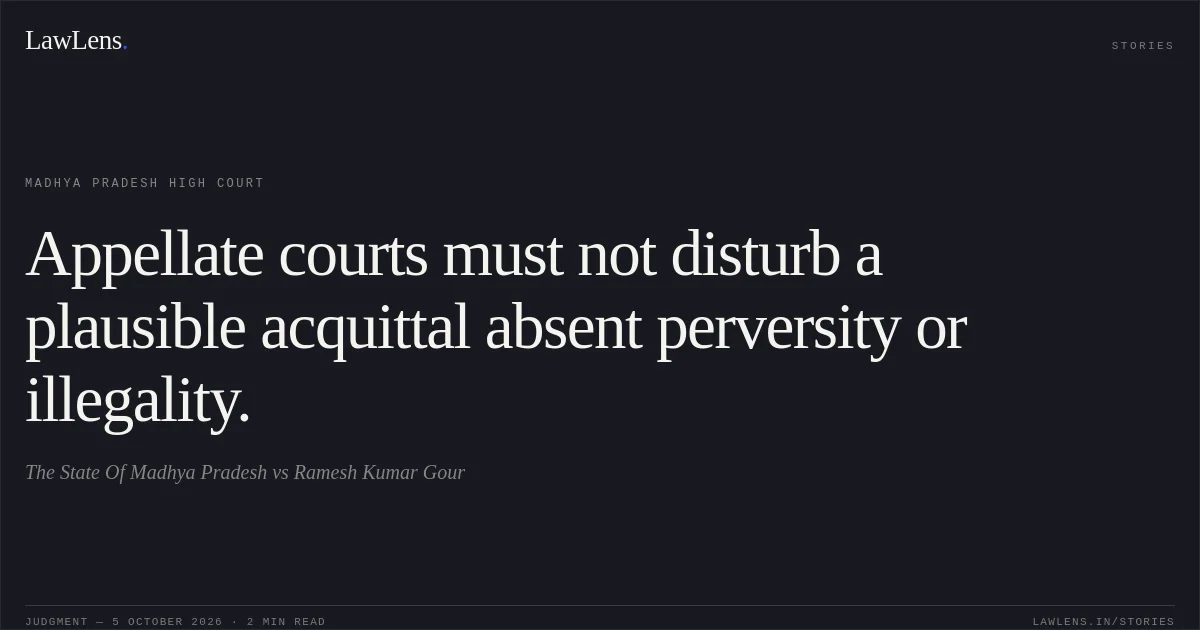
The Court held that the acquittal did not warrant interference and that the State had not established a case for leave to appeal under Section 378(3) CrPC.
The application was dismissed as devoid of merit.
Source reference: para. 8Acts & Sections Cited
3 provisions across 2 statutes referred to in this judgment. Each provision opens on LawLens.
Code of Criminal Procedure, 19731
Indian Penal Code, 18602
Original Court PDF
The State Of Madhya PradeshvsRamesh Kumar Gour
Click to open original judgment
Original judgment, available to read, download and summarize on LawLens.in