Facts
On 10.11.2018 at approximately 6:00 a.m., the prosecution alleged that Shamshad Ali @ Guddu and four associates called Brijesh outside his house and fired at him.
Source reference: para. 5Brijesh sustained firearm injuries and died; the assailants allegedly fled while firing in the air.
Source reference: para. 5On the written report of Sushil Kumar Mishra, an FIR was registered under Sections 147, 148, 302/149 and 286 IPC, followed by investigation and submission of a charge-sheet against Saddam, Sandeep, Shamshad Ali @ Guddu, Ishtiyaq and Ankur Saroj @ Habbu.
Source reference: paras. 5–8The prosecution examined ten witnesses, including the informant, an alleged eyewitness, the doctor and police officials.
Source reference: para. 9By judgment dated 05.02.2026, the Additional Sessions Judge, Pratapgarh acquitted all five accused, finding that the prosecution had failed to establish their presence and identity at the scene beyond reasonable doubt.
Source reference: paras. 10–12The State consequently sought leave to appeal under Section 378(3) CrPC against the acquittal.
Source reference: para. 4Issues
Whether the State should be granted leave under Section 378(3) CrPC to appeal against the accused persons’ acquittal.
Source reference: paras. 2–4Whether the trial court’s appreciation of the prosecution evidence was perverse, legally unsustainable, or based on a view that was not reasonably possible, warranting appellate interference with the acquittal.
Source reference: paras. 15–20Whether the prosecution had established the accused persons’ identity, presence and participation in the alleged firearm attack beyond reasonable doubt.
Source reference: paras. 11–12, 20Law Applied
The Court considered the State’s application under Section 378(3) CrPC for leave to appeal against acquittal and the alleged offences under Sections 147, 148, 302/149, 201 and 286 IPC.
Source reference: paras. 2–4, 8, 10It applied the settled principle that an appellate court has power to reappreciate evidence in an acquittal appeal, but must give due weight to the trial court’s credibility findings and the strengthened or “double” presumption of innocence following acquittal.
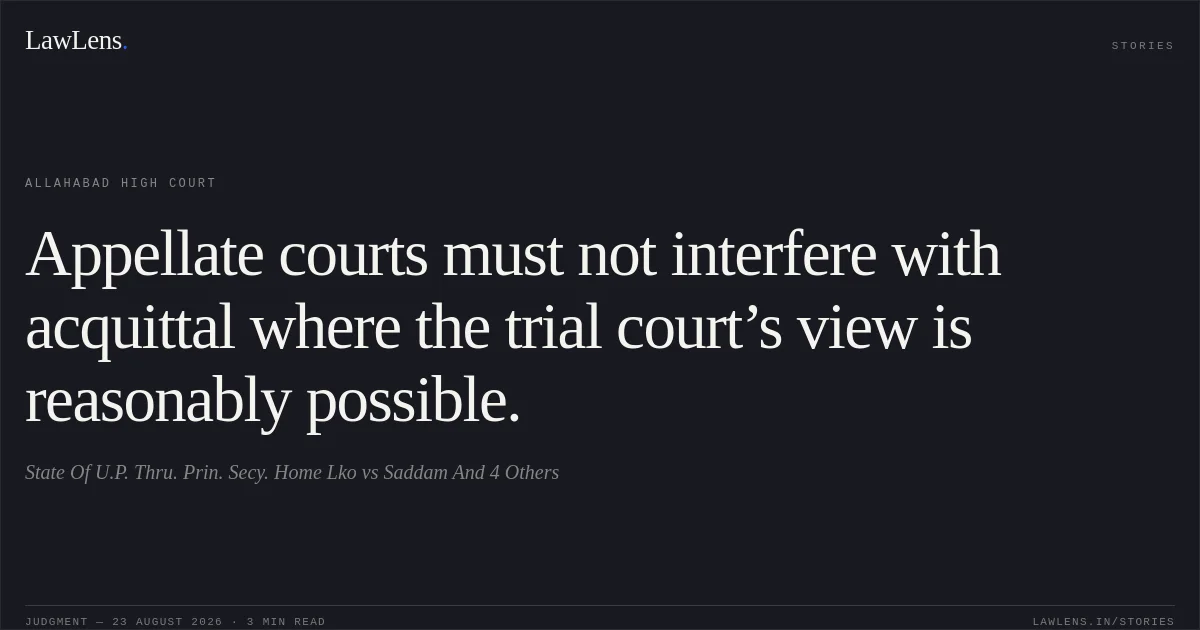
Source reference: para. 18Under Chandrappa v. State of Karnataka, although the appellate court possesses broad powers, it should not disturb an acquittal where two reasonable views are possible.
Source reference: para. 18Babu v. State of Kerala, Ramesh Babulal Doshi v. State of Gujarat, Bannareddy v. State of Karnataka, Jayamma v. State of Karnataka, Virendra Singh v. State of U.P. and Rajesh Prasad v. State of Bihar were relied upon for the rule that interference is justified only where the trial court’s approach is patently illegal, perverse, wholly untenable, or founded on a grave misreading of evidence.
Source reference: paras. 16–19The Court also applied the principle that mere availability of a more probable alternative view is insufficient to overturn an acquittal.
Source reference: paras. 17–18Reasoning
The Court found that the trial court had reasonably assessed the evidentiary deficiencies.
Source reference: para. 20PW-1, the deceased’s brother, admitted that he was physically disabled, did not come outside the house and had not seen accused Ishtiyaq at the place of occurrence; the trial court also noted uncertainty regarding his acquaintance with the other accused.
Source reference: paras. 11, 20PW-4, projected as an eyewitness, did not identify the accused persons and had not disclosed the assailants’ names to the Investigating Officer.
Source reference: para. 11The accused were allegedly identified through photographs, but no test identification parade was conducted, and they were not identified before the trial court.
Source reference: paras. 11, 20The prosecution also failed to produce relevant call-detail/location records, no incriminating article was recovered at the accused persons’ instance, and material contradictions existed in the witnesses’ testimony.
Source reference: paras. 11–12, 20Although the medical evidence supported death from antemortem firearm injuries, it did not by itself establish the identity or participation of the accused.
Source reference: para. 13In light of these deficiencies, the trial court’s conclusion that the prosecution had not proved the case beyond reasonable doubt was a possible and sustainable view, not a perverse or impossible one.
Source reference: para. 20Holding
The High Court held that the State had not demonstrated any perversity, patent illegality, or grave misappreciation of evidence in the trial court’s acquittal.
Since the trial court had adopted a reasonably possible view and the prosecution evidence failed to reliably establish the accused persons’ identity and presence at the scene, leave to appeal under Section 378(3) CrPC was refused.
Source reference: para. 21The application for leave to appeal was rejected, and consequently the government appeal was also dismissed.
Source reference: Re: Government Appeal, concluding orderActs & Sections Cited
9 provisions across 2 statutes referred to in this judgment. Each provision opens on LawLens.
Indian Penal Code, 18606
Code of Criminal Procedure, 19733
Original Court PDF
State Of U.P. Thru. Prin. Secy. Home LkovsSaddam And 4 Others
Click to open original judgment
Original judgment, available to read, download and summarize on LawLens.in