Facts
The appellants challenged notices issued under Section 4C of the West Bengal Land Reforms Act, 1955, concerning their land.
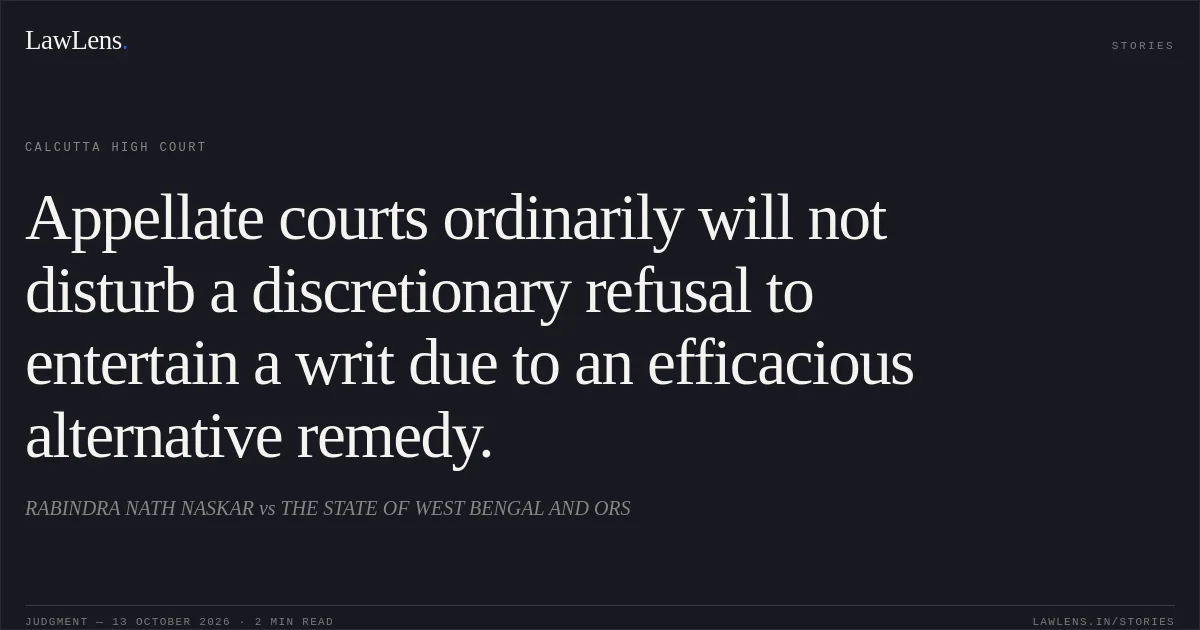
Source reference: para. 3–9A learned Single Judge dismissed the writ petitions, declining to entertain them because an equally efficacious remedy was available before the West Bengal Land Reforms and Tenancy Tribunal.
Source reference: para. 3–9The appellants argued that the notices had been issued without the hearing required by Section 4C and that, on an earlier occasion, a co-ordinate Bench had set aside a similar notice concerning the same land.
Source reference: para. 3–9They also challenged the Single Judge’s treatment of the earlier judgment as per incuriam.
Source reference: para. 3–9The appeals concerned similar circumstances but different plots of land.
Source reference: para. 20Issues
1. Whether the Division Bench should interfere in an intra-court appeal with the Single Judge’s decision not to entertain the writ petitions because an equally efficacious alternative remedy was available before the Tribunal.
Source reference: para. 13–162. Whether the earlier judgment setting aside a similar notice bound the Single Judge on maintainability, or could be treated as per incuriam.
Source reference: para. 7–11Law Applied
The availability of an alternative remedy does not absolutely bar the High Court’s writ jurisdiction; however, where an equally efficacious remedy is available, the Writ Court may either entertain the petition in exceptional circumstances or decline to entertain it.
Source reference: para. 11–16The West Bengal Land Reforms Act, 1955, Section 4C, concerns the notice challenged by the appellants.
Source reference: para. 11–16Sections 6 and 10 of the West Bengal Land Reforms and Tenancy Tribunal Act, 1997, permit the appellants to raise their natural-justice and other challenges before the Tribunal.
Source reference: para. 11–16A prior decision does not establish a ratio on an issue it did not specifically decide.
Source reference: para. 11–16Reasoning
The Division Bench accepted that the earlier Writ Court had not specifically decided maintainability, so it had laid down no ratio on that issue; accordingly, the question of that judgment being per incuriam did not arise.
Source reference: para. 11Nevertheless, the Single Judge had discretion to decline to entertain the petitions because an alternative remedy was available.
Source reference: para. 14–16The appellants could raise their natural-justice objections and other grounds before the Tribunal, and the limited scope of the intra-court appeal did not warrant interference with the Single Judge’s exercise of discretion.
Source reference: para. 14–16Holding
The Court dismissed MAT No. 1259 of 2026, preserving the appellants’ liberty to challenge the Section 4C notice before the Tribunal.
It directed that neither its observations nor those of the Writ Court be treated as a conclusive determination on the merits.
Source reference: para. 18–19MAT No. 1260 of 2026 was disposed of on the same basis, and the connected applications were also disposed of.
Source reference: para. 20–22There was no order as to costs.
Source reference: para. 20–22Acts & Sections Cited
2 provisions across 1 statute referred to in this judgment. Each provision opens on LawLens.
West Bengal Land Reforms And Tenancy Tribunal Act, 19972
Original Court PDF
RABINDRA NATH NASKARvsTHE STATE OF WEST BENGAL AND ORS
Click to open original judgment
Original judgment, available to read, download and summarize on LawLens.in