Facts
The petitioners applied in 2018 and 2021 for CL-2 retail liquor licences said to fall within an unissued 1987 quota, paying the prescribed amounts.
Source reference: pp. 3–5, 14–15Their applications were not granted; one petitioner received an endorsement stating that new licences were restricted, and the amounts were not refunded.
Source reference: pp. 3–5, 14–15In 2025, the State amended the excise rules to provide for e-auction of specified licences, including discontinued CL-2 licences and CL-2 licences yet to be granted under the 1987 quota.
Source reference: pp. 7–9, 26–27The petitioners challenged the notification and sought consideration of their applications.
Source reference: pp. 14–17The State contended that no policy permitted fresh CL-2 licences when the applications were made and that the petitioners had no enforceable entitlement to a licence.
Source reference: pp. 14–17Issues
1. Whether submitting applications for CL-2 licences when no policy permitted their grant—and the State’s acceptance and retention of the accompanying payments—created an enforceable right to obtain licences
Source reference: p. 232. Whether the subsequent amendments providing for auction took away any accrued or vested right of the petitioners
Source reference: p. 233. Whether the petitioners could claim legitimate expectation, and whether the amended rules and auction policy warranted interference under Article 226 of the Constitution
Source reference: p. 23Law Applied
The Court applied the Karnataka Excise Act, 1965, and the Karnataka Excise (General Conditions of Licences) Rules, 1967, and Karnataka Excise (Sale of Indian and Foreign Liquors) Rules, 1968, including the amended definition of “auction pool” in Rule 2(a-1) and the provision for e-auction of specified licences in Rule 3(2-A).
Source reference: pp. 26–27An application, without an existing legal framework authorising the requested grant, does not itself create an enforceable entitlement; nor does payment or retention of fees create a right to the licence, though the amount should be refunded.
Source reference: pp. 24–26Legitimate expectation requires a foundation in a consistent practice, express representation, or policy; it cannot arise solely from an applicant’s unilateral act.
Source reference: p. 28The State has broad authority to determine how excise privileges are allocated, subject to judicial review for illegality, manifest arbitrariness, discrimination, mala fides, or other constitutional or legal infirmity.
Source reference: pp. 29–30The Court also relied on the Division Bench decision in State of Karnataka v. Guruswamy (W.A. No. 541 of 2026, 15 April 2026), whose order was affirmed when the Supreme Court dismissed SLP(C) No. 22937 of 2026 on 17 July 2026.
Source reference: pp. 17–22Reasoning
The Court found that no policy permitting fresh CL-2 licences existed when the petitioners applied; their applications therefore could not oblige the State to grant licences or create priority over applicants participating in a later process.
Source reference: pp. 24–26Retaining the application amounts did not alter that conclusion, although it entitled the petitioners to a refund.
Source reference: p. 26Because the licences had not been granted and no accrued right existed, applying the amended auction regime to future grants was not retrospective deprivation of a vested right.
Source reference: pp. 27–28Nor was there a basis for legitimate expectation: no representation or policy promised that the applications would result in licences.
Source reference: p. 28The petitioners did not establish that the auction policy or amended rules were unlawful, discriminatory, or manifestly arbitrary; the Court therefore declined to substitute its view for the State’s policy choice.
Source reference: pp. 29–31Holding
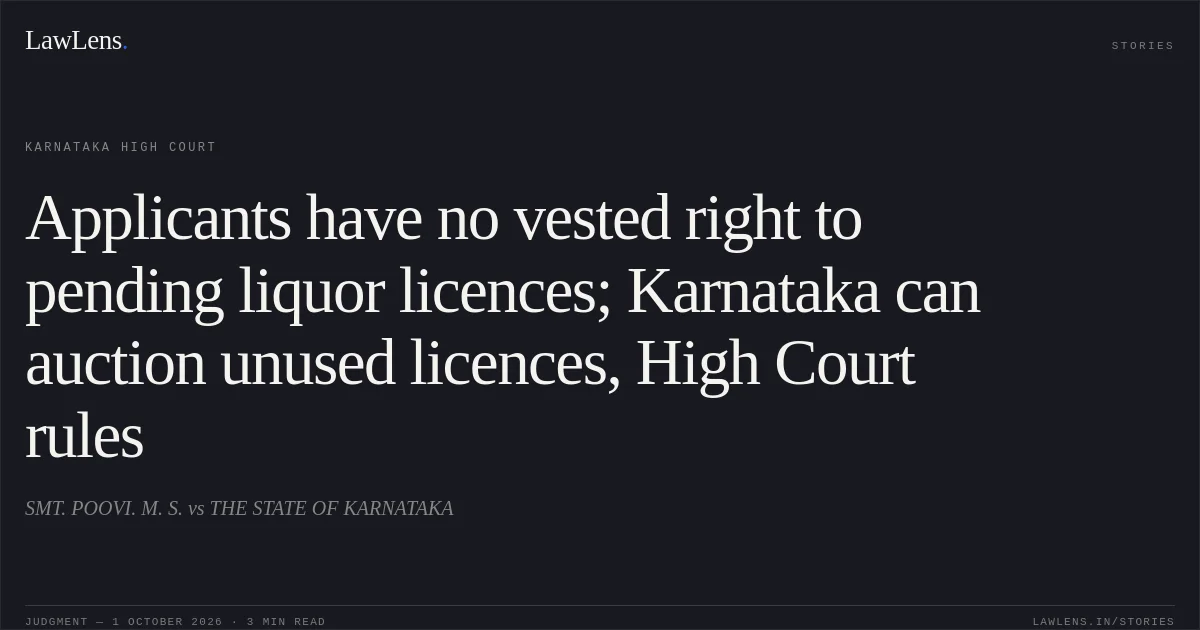
The Court held that the applications and payment of fees created no right to CL-2 licences, that the auction amendments did not deprive the petitioners of an accrued or vested right, and that neither legitimate expectation nor any ground for interference under Article 226 was established.
The writ petition was dismissed; the respondents were directed to refund the amounts paid by the petitioners in accordance with law, and the interlocutory applications were closed.
Source reference: p. 31Acts & Sections Cited
1 provisions across 1 statute referred to in this judgment. Linked provisions open on LawLens.
Karnataka Excise Act, 19651
Original Court PDF
SMT. POOVI. M. S.vsTHE STATE OF KARNATAKA
Click to open original judgment
Original judgment, available to read, download and summarize on LawLens.in