Facts
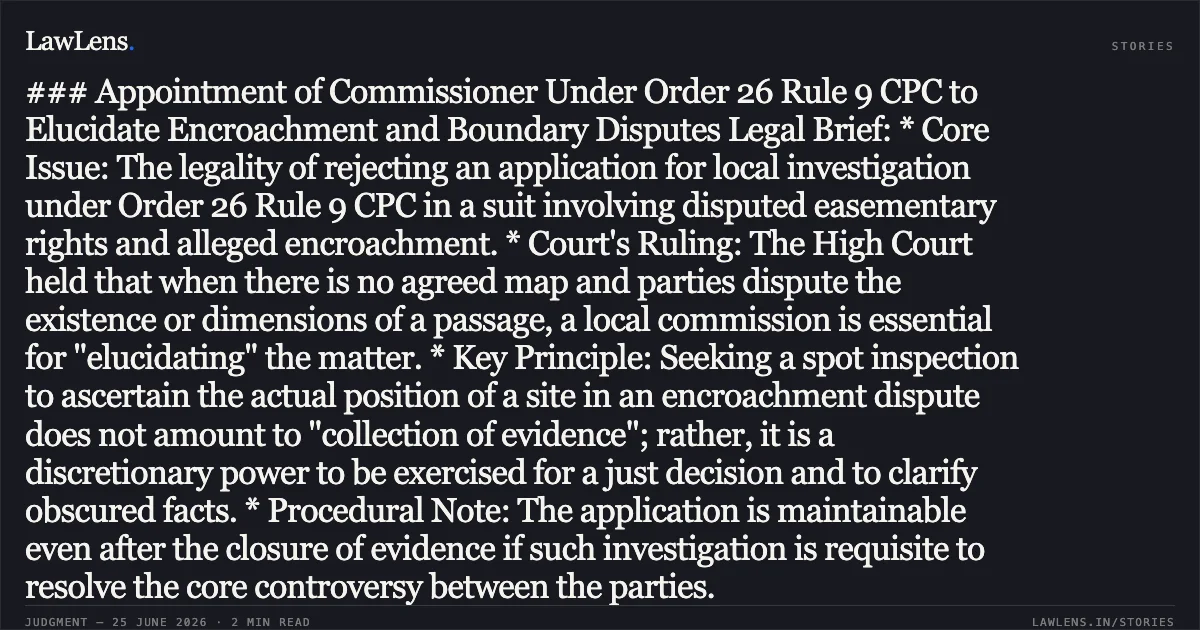
The respondents (plaintiffs) filed a civil suit seeking a declaration and permanent injunction regarding easementary rights over a passage allegedly 10 feet 6 inches wide, claiming the petitioners (defendants) were attempting to build upon it.
Source reference: para. 2.1The petitioners denied the existence and dimensions of said passage.
Source reference: para. 2.1After the closure of evidence, defendant No. 4 (later deceased and deleted from the petition) filed an application under Order 26 Rule 9 and Order 39 Rule 7 of the CPC for a local commission to inspect the site.
Source reference: para. 2.1The trial Court rejected the application on December 4, 2025, holding it was an attempt to collect evidence after the trial was nearly complete.
Source reference: para. 2.1The petitioners challenged this rejection under Article 227 of the Constitution.
Source reference: para. 1Issues
1. Whether a local commission can be appointed under Order 26 Rule 9 CPC to ascertain the existence and dimensions of a disputed site when there is no agreed map, even after the closure of evidence.
Source reference: para. 3 / para. 102. Whether the petition is maintainable despite the death of the original applicant (petitioner No. 4) during the pendency of the proceedings.
Source reference: para. 6 / para. 11Law Applied
Order 26 Rule 9 of the CPC, which empowers the Court to issue a commission for local investigation to "elucidate any matter in dispute".
Source reference: para. 8Anurag Jaiswal v. Collector Khandwa and Ors. (2019), which established that in cases of boundary disputes, encroachments, or absence of an agreed map, a commission is necessary to render the facts intelligible.
Source reference: para. 9 / para. 10The principle that legal heirs with a common interest and common written statement can maintain a petition even if the original applicant has expired.
Source reference: para. 11Reasoning
The High Court reasoned that the dispute centered on the specific location and width of a lane, which remained unclear as there was no agreed-upon map between the parties.
Source reference: para. 3 / para. 10Applying the interpretation of "elucidating" from Anurag Jaiswal, the Court found that a spot inspection was not "collecting evidence" for a party, but rather a tool for the Court to clarify the actual physical status of the property to reach a just decision.
Source reference: para. 9 / para. 10The Court noted that even though evidence had been led—including an alleged admission by petitioner No. 1—the dispute regarding encroachment required technical clarification.
Source reference: para. 5 / para. 10Regarding maintainability, the Court held that since petitioners 1, 2, and 3 were the son and grandsons of the deceased petitioner and shared a common defense, the right to sue survived with them.
Source reference: para. 11Holding
The Court answered the issues in the affirmative, holding that the trial Court's refusal to appoint a commissioner constituted a failure to exercise jurisdiction necessary for resolving the dispute.
The High Court set aside the order dated December 4, 2025, and allowed the application under Order 26 Rule 9 CPC. The trial Court was directed to appoint a competent Revenue Officer to conduct a spot inspection and demarcation of the disputed lane in the presence of both parties and submit a report.
Source reference: para. 12Acts & Sections Cited
2 provisions across 1 statute referred to in this judgment. Each provision opens on LawLens.
Code of Civil Procedure, 19082
Original Court PDF
Harish SharmavsJitendra Kumar
Click to open original judgment
Original judgment, available to read, download and summarize on LawLens.in