Facts
The petitioners challenged the Punjab Government’s policy instructions dated 19 August 1999 and 24 September 1999, which provided appointments against Class I and Class II posts to dependants of “War Heroes” and excluded such posts from the ordinary recruitment process through the Punjab Public Service Commission.
Source reference: p. CWP-16037-1999-2, paras. 1–4Petitioner No. 1, a Commerce Graduate, sought consideration for appointment to a Class I or Class II post.
Source reference: p. CWP-16037-1999-2, para. 3Petitioner No. 2, whose father, a Government Lecturer, had been killed by terrorists, had earlier sought compassionate appointment and was appointed as a Clerk pursuant to an order of the Court.
Source reference: p. CWP-16037-1999-2, para. 3The petitioners contended that the policy permitted relaxation of qualifications, bypassed regular recruitment, and discriminated against dependants of terrorist victims.
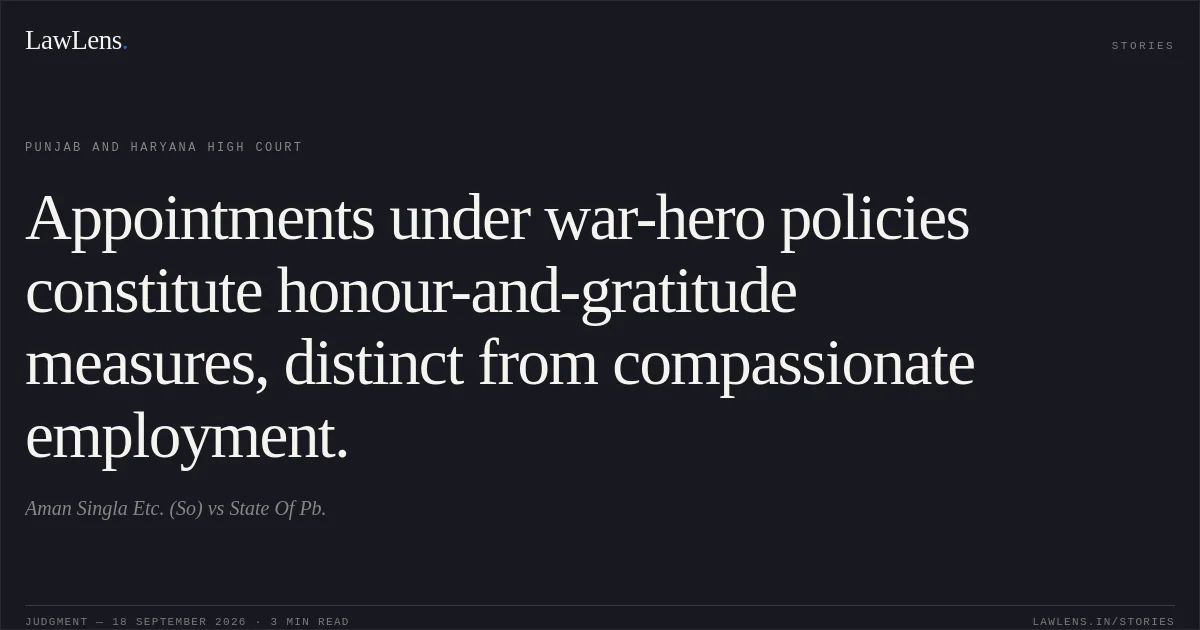
Source reference: p. CWP-16037-1999-3, paras. 6–7The State maintained that the policy was framed under the Punjab Civil Services (General and Common Services) (Second Amendment) Rules, 1999, and constituted a distinct “honour and gratitude” scheme rather than ordinary compassionate appointment.
Source reference: p. CWP-16037-1999-3, para. 8Issues
1. Whether the petitioners could simultaneously seek quashing of the policy granting Class I and Class II appointments to dependants of War Heroes and seek appointment under that very policy as an alternative relief.
Source reference: p. CWP-16037-1999-4, para. 102. Whether the principles governing compassionate appointment, particularly those stated in Umesh Kumar Nagpal v. State of Haryana, invalidated the separate policy framed for dependants of War Heroes.
Source reference: p. CWP-16037-1999-4, paras. 11–153. Whether the petitioners established an enforceable entitlement to appointment against a Class I or Class II post on the basis of their qualifications or family circumstances.
Source reference: p. CWP-16037-1999-6, para. 16Law Applied
The Court applied the principle that compassionate appointment is an exceptional measure intended to provide immediate financial assistance to the family of an employee who dies in harness and to enable it to overcome a sudden financial crisis, as held in Umesh Kumar Nagpal v. State of Haryana, (1994) 4 SCC 138.
Source reference: p. CWP-16037-1999-4, para. 11It distinguished that doctrine from a policy granting appointment to dependants of War Heroes as an expression of national “honour and gratitude” for the sacrifice or disability suffered by the War Hero.
Source reference: p. CWP-16037-1999-4, paras. 12–15Relying on Captain Janmej Singh v. State of Punjab and Others, decided on 6 October 2010, the Court held that such a policy is not governed by the ordinary principle of dependency applicable to compassionate appointment and represents a distinct policy regime.
Source reference: pp. CWP-16037-1999-4–6, paras. 12–15The Court further applied the procedural principle that mutually inconsistent reliefs cannot ordinarily be granted where one prayer seeks annulment of the very policy forming the basis of the alternative prayer.
Source reference: p. CWP-16037-1999-4, para. 10Reasoning
The Court held that the petitioners’ prayers were self-contradictory: they sought both to invalidate the policy and to obtain consideration under it.
Source reference: p. CWP-16037-1999-4, para. 10Consequently, the alternative claim could not survive if the foundational policy were quashed.
Source reference: p. CWP-16037-1999-4, para. 10The Court rejected the petitioners’ reliance on Umesh Kumar Nagpal, reasoning that the impugned policy was not designed merely to relieve the immediate financial distress of a deceased employee’s family.
Source reference: pp. CWP-16037-1999-4–6, paras. 11–15Instead, it was framed to honour the sacrifice of War Heroes and to express national gratitude; therefore, the limitations applicable to ordinary compassionate appointment could not automatically be imported into that policy.
Source reference: pp. CWP-16037-1999-4–6, paras. 11–15The Court also noted that Petitioner No. 1 had no automatic right to appointment merely because he possessed a graduation qualification, while Petitioner No. 2 had already been considered under the applicable compassionate-appointment policy, which provided for Class III and Class IV posts rather than Class I or Class II posts.
Source reference: p. CWP-16037-1999-6, para. 16In view of the contradictory reliefs and the absence of a demonstrated legal entitlement, no ground for interference under writ jurisdiction was made out.
Source reference: p. CWP-16037-1999-6, para. 17Holding
The Court held that the petitioners could not simultaneously challenge the War Heroes appointment policy and claim appointment under it.
It further held that the principles governing ordinary compassionate appointment did not invalidate the distinct “honour and gratitude” policy for dependants of War Heroes.
Source reference: p. CWP-16037-1999-7, paras. 18–20As the petitioners failed to establish any legal ground for interference or an entitlement to Class I or Class II appointment, the writ petitions were dismissed.
Source reference: p. CWP-16037-1999-7, paras. 18–20Pending applications, if any, were also disposed of.
Source reference: p. CWP-16037-1999-7, paras. 18–20Original Court PDF
Aman Singla Etc. (So)vsState Of Pb.
Click to open original judgment
Original judgment, available to read, download and summarize on LawLens.in