Facts
Mahanadi Coalfields Ltd. issued a tender for hiring heavy earth-moving machinery for works at its Kulda Open Cast Project and adjoining areas in Sundargarh. GSCO was the successful bidder, and the parties entered into a contract containing no arbitration clause.
Source reference: paras. 3–4On the parties’ alleged mutual consent, the High Court of Orissa appointed a sole arbitrator under Section 11(6) of the Arbitration and Conciliation Act, 1996 (“the Act”), but the order did not designate Cuttack as the seat of arbitration.
Source reference: paras. 5–8, 26The arbitral proceedings were conducted at Cuttack, and an award was passed in favour of GSCO on 25.10.2021. Mahanadi Coalfields filed petitions under Section 34 of the Act before the District Judge, Sundargarh, on 08.12.2021, within three months of the award.
Source reference: paras. 9–10The High Court accepted both objections and dismissed the Section 34 petitions. Mahanadi Coalfields appealed to the Supreme Court.
Source reference: paras. 12–18Issues
Whether the courts at Sundargarh had territorial jurisdiction to entertain the petitions under Section 34 of the Act, or whether Cuttack was the juridical seat of arbitration merely because the proceedings were conducted there and the arbitrator was appointed by the High Court at Cuttack?
Source reference: paras. 14–16, 26–31Whether the petitions under Section 34 of the Act were barred by limitation under Section 34(3)?
Source reference: paras. 17, 19–21Whether Section 42 of the Act conferred exclusive jurisdiction on the High Court at Cuttack merely because the Section 11(6) proceedings had been instituted there?
Source reference: paras. 15–16, 30–31Law Applied
Section 2(1)(e) of the Act identifies the competent “Court” for applications under Part I, including Section 34 proceedings, by reference to the court having jurisdiction over the subject matter of the dispute.
Source reference: para. 22Section 34(3) prescribes a limitation period of three months from receipt of the arbitral award, extendable by a further period of thirty days upon sufficient cause, but not thereafter.
Source reference: paras. 17, 19–21Section 42 applies where an application under Part I is made before a court having jurisdiction under the Act; subsequent applications must ordinarily be made before that same competent court.
Source reference: paras. 15–16The Court relied on the distinction between the juridical “seat” and the physical “venue” of arbitration, as recognised in Bharat Aluminium Co. v. Kaiser Aluminium Technical Services Inc., Indus Mobile Distribution Pvt. Ltd. v. Datawind Innovations Pvt. Ltd., and BGS SGS Soma JV v. NHPC Ltd.
Source reference: para. 29Mere conduct of hearings at a particular place does not, absent an express or implied designation, establish that place as the juridical seat.
Source reference: paras. 26–29Reasoning
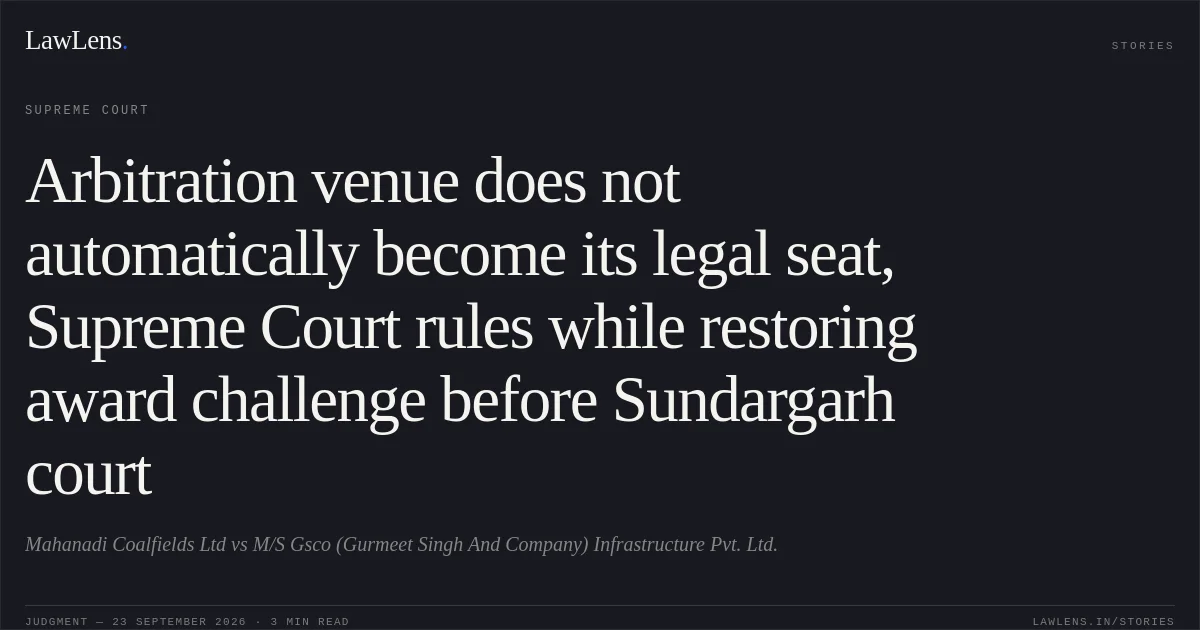
The Supreme Court held that the High Court incorrectly treated Cuttack as the seat merely because the arbitrator was appointed by the High Court at Cuttack and the hearings took place there.
Source reference: paras. 26–30Neither the reference order nor any agreement between the parties designated Cuttack as the juridical seat; Cuttack was, at most, the venue selected for administrative convenience.
Source reference: paras. 26–30The contractual clauses expressly subjected disputes to the jurisdiction of the District Court where the work was executed, and the work was undisputedly performed in Sundargarh.
Source reference: paras. 22–25Since no Commercial Court had been constituted for Sundargarh at the relevant time, the Section 34 petitions could properly be presented before the District Judge, Sundargarh.
Source reference: para. 25Section 42 did not alter this result because the Section 11 application before the High Court at Cuttack did not establish Cuttack as the competent court or seat of arbitration; the High Court’s territorial jurisdiction over the State could not be equated with the jurisdiction of courts situated at Cuttack.
Source reference: paras. 30–31On limitation, the award was dated 25.10.2021 and the Section 34 petitions were filed on 08.12.2021, well within the statutory three-month period; the respondent also conceded that the High Court’s contrary finding was erroneous.
Source reference: paras. 19–21Holding
The Supreme Court allowed the appeal and set aside the High Court’s judgment dated 20.06.2025.
It held that the District Judge, Sundargarh had jurisdiction to entertain the Section 34 petitions and that the petitions were not barred by limitation.
Source reference: para. 32The petitions were restored to the file of the District Judge, Sundargarh, with a direction to decide them in accordance with law and expeditiously.
Source reference: para. 32Acts & Sections Cited
5 provisions across 2 statutes referred to in this judgment. Each provision opens on LawLens.
Arbitration and Conciliation Act, 19964
Code of Civil Procedure, 19081
Original Court PDF
Mahanadi Coalfields LtdvsM/S Gsco (Gurmeet Singh And Company) Infrastructure Pvt. Ltd.
Click to open original judgment
Original judgment, available to read, download and summarize on LawLens.in