Facts
The State sought leave to appeal under Section 378(3) of the Code of Criminal Procedure, 1973, against the respondent’s acquittal by the Sessions Court of charges under Sections 9(m)/10 of the Protection of Children from Sexual Offences Act, 2012, and Section 506 of the Indian Penal Code, 1860
Source reference: p.1The prosecution alleged that the respondent, who lived in the same house as the 10-year-old victim, touched and pressed her breast while she was washing utensils, and threatened her during a subsequent quarrel with her mother
Source reference: p.2The Trial Court relied, among other matters, on inconsistencies between the victim’s statements, contradictions between her evidence and her mother’s, the absence of independent witnesses, and the possibility of false implication
Source reference: pp.2–3The State argued that the acquittal warranted appellate scrutiny; the respondent opposed leave, relying on the acquittal and the alleged material contradictions and motive to falsely implicate him
Source reference: pp.3–5Issues
Whether the State had made out a prima facie case or raised arguable points warranting leave to appeal against the acquittal under Section 378(3) CrPC
Source reference: pp.5–6Whether the victim’s and her mother’s evidence, together with the questions concerning corroboration and the presumption under Section 29 of the POCSO Act, required consideration in an appeal on the merits
Source reference: p.7Law Applied
Section 378(3) CrPC requires the State to obtain the High Court’s leave before an appeal against acquittal can be entertained
Source reference: p.5Under State of Maharashtra v. Sujay Mangesh Poyarekar, (2008) 9 SCC 475, the leave court must consider whether a prima facie case or arguable points exist; it should not conduct a minute assessment of the evidence at that stage, and leave should be granted where the record warrants deeper scrutiny or reappreciation
Source reference: pp.5–6The Court also cited Manoj Rameshlal Chhabriya v. Mahesh Prakash Ahuja, 2025 SCC OnLine SC 451, as reiterating that approach
Source reference: p.7The Court noted that the charge under Section 9 of the POCSO Act attracted the presumption under Section 29 of that Act
Source reference: p.7Reasoning
Applying the leave-stage standard, the Court found that the victim’s testimony, considered alongside her mother’s statement, disclosed a prima facie case warranting appellate consideration
Source reference: p.7Whether the evidence was properly discredited for inconsistencies, whether independent corroboration was necessary, and the effect of the Section 29 presumption required examination in the appeal; the Court did not resolve those matters on their merits at the leave stage
Source reference: p.7Holding
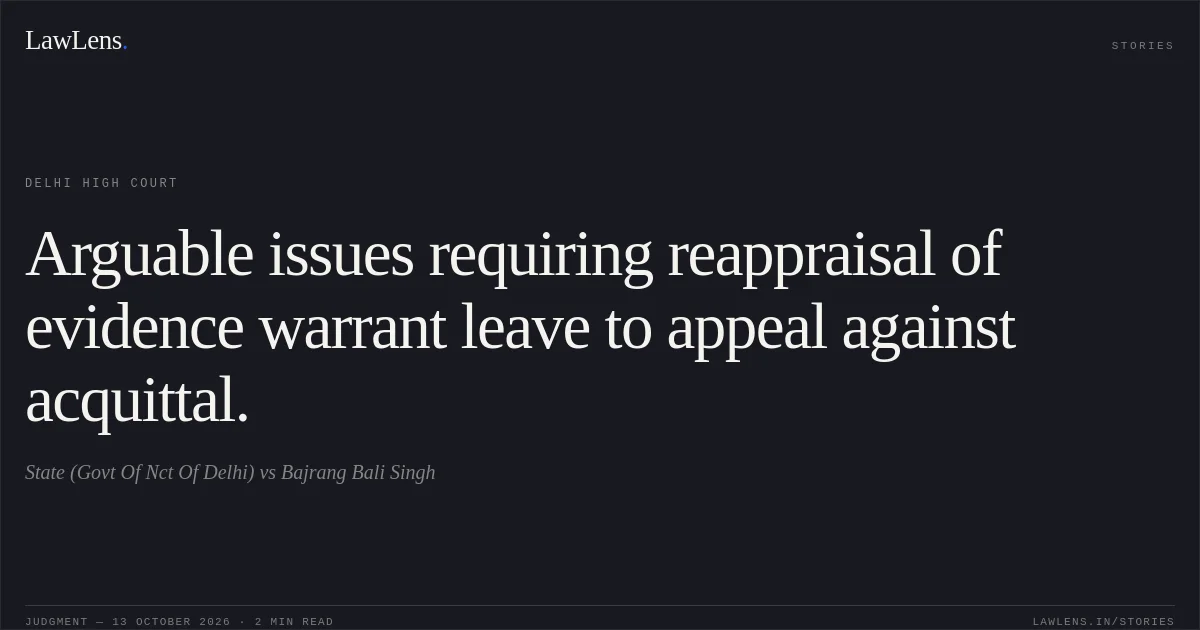
The Court allowed the State’s petition and granted leave to appeal against the acquittal
It directed the Registry to register and renumber the matter as a criminal appeal and listed it before the Roster Bench on 28 October 2026
Source reference: p.7Acts & Sections Cited
7 provisions across 3 statutes referred to in this judgment. Each provision opens on LawLens.
Code of Criminal Procedure, 19732
Protection of Children from Sexual Offences Act, 20123
Indian Penal Code, 18602
Original Court PDF
State (Govt Of Nct Of Delhi)vsBajrang Bali Singh
Click to open original judgment
Original judgment, available to read, download and summarize on LawLens.in
![Pension must be recalculated on the Passenger Attendant Grade-I scale, not merely the Group-C Porter scale.. DINESHWAR PRASAD TIWARI vs NORTH CENTRAL RAILWAY. CAT - ['Allahabad']. LawLens](/stories/thumbnails/pension-must-be-recalculated-on-the-passenger-attendant-grade-i-scale-not-merely-the-group-97c58c85243d433bb520084af94a02bd.webp)
![Delayed IPR filing cannot independently disqualify an employee from promotion absent an applicable rule.. Bhupendra Kumar vs DELHI DEVELOPMENT AUTHORITY. CAT - ['Delhi']. LawLens](/stories/thumbnails/delayed-ipr-filing-cannot-independently-disqualify-an-employee-from-promotion-absent-an-ap-da80816741284e10afeaa1e45c382f9b.webp)