Facts
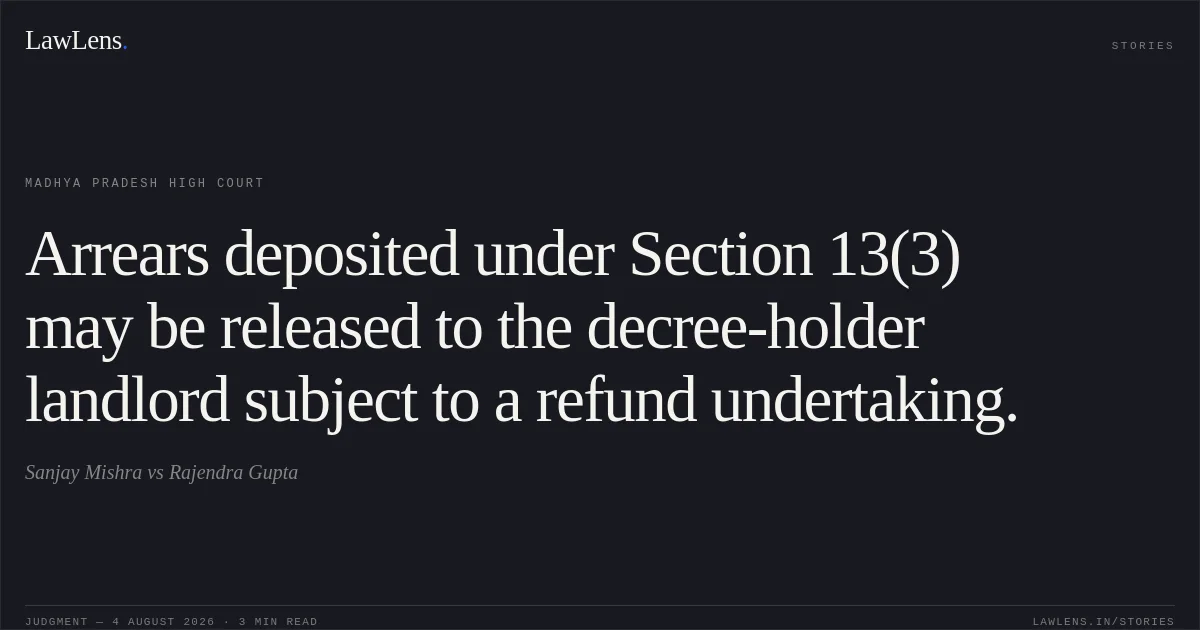
The petitioner invoked Article 227 of the Constitution challenging the order dated 11 June 2026 passed by the 34th District Judge, Indore, in RCA No. 65/2026, whereby he was directed to deposit arrears of rent during the pendency of his first appeal.
Source reference: para. 1He further sought an order restraining disbursement of the deposited amount to the respondent-landlord.
Source reference: para. 1The petitioner contended that Section 13(3) of the M.P. Accommodation Control Act, 1961 prohibited withdrawal of the deposited rent until the dispute regarding the person entitled to receive it was decided.
Source reference: para. 4The respondent asserted that he was a 79-year-old senior citizen holding a registered sale deed executed by the petitioner, that the trial court had decreed the suit in his favour, and that the High Court had earlier recognised the parties’ relationship as landlord and tenant in M.P. No. 3438/2023.
Source reference: para. 5A separate civil suit challenging the sale deed was pending, but no interim relief had been granted therein.
Source reference: para. 5Issues
Whether the appellate court was justified in directing the petitioner to deposit arrears of rent under Section 13 of the M.P. Accommodation Control Act, 1961, during the pendency of the appeal.
Source reference: paras. 4, 7–9Whether the amount deposited as arrears of rent could be disbursed to the respondent while the first appeal and the separate suit challenging the sale deed remained pending.
Source reference: paras. 4, 7–9Whether interference under Article 227 of the Constitution was warranted against the appellate court’s order.
Source reference: paras. 1, 6, 9–10Law Applied
The Court applied Article 227 of the Constitution, under which supervisory interference is warranted only where the subordinate court has acted unlawfully or committed a jurisdictional error.
Source reference: paras. 1, 9–10It relied on Section 13(3) of the M.P. Accommodation Control Act, 1961, which permits the court, where there is a dispute regarding the person to whom rent is payable, to direct the tenant to deposit the rent in court and provides that no person may withdraw the amount until the dispute is decided and an order for payment is made.
Source reference: para. 8The Court also applied the principle that a subsisting decree remains operative and binding unless set aside, and that the established landlord-tenant relationship and the respondent’s registered sale deed entitled the respondent to seek the benefit of the decree.
Source reference: para. 7Reasoning
The Court held that the respondent possessed a valid trial-court decree founded on a registered sale deed, and that the parties’ status as landlord and tenant had already been recognised in the earlier proceedings before the High Court.
Source reference: para. 7Although the petitioner had instituted a separate suit challenging the sale deed, the absence of any interim order meant that the respondent’s ownership claim and the existing decree continued to operate.
Source reference: para. 7Consequently, the appellate court was justified in requiring deposit of the arrears of rent under Section 13.
Source reference: para. 7The Court declined to prevent disbursement of the amount, finding that the respondent was entitled to the fruits of the subsisting decree.
Source reference: para. 9To balance the equities arising from the pending appeal and title challenge, it required the respondent to furnish an undertaking to refund the amount if an adverse order was ultimately passed.
Source reference: para. 9Holding
The petition was disposed of without interference with the appellate court’s order.
The Court directed that the amount deposited by the petitioner towards arrears of rent be disbursed to the respondent within fifteen days after due verification by the trial court, either directly or by bank transfer.
Source reference: para. 9Before withdrawal, the respondent was directed to file an undertaking within seven days before the trial court stating that he would refund the withdrawn amount if an adverse order was passed in the pending civil suit or appeal.
Source reference: para. 9Acts & Sections Cited
1 provisions across 1 statute referred to in this judgment. Linked provisions open on LawLens.
M.P. Accommodation Control Act, 19611
Original Court PDF
Sanjay MishravsRajendra Gupta
Click to open original judgment
Original judgment, available to read, download and summarize on LawLens.in