Facts
NTPC Ltd. and its subsidiary, BRBCL, entered into a Memorandum of Agreement dated 6 November 2020 with SSRVM Trust for establishing and managing an English-medium CBSE-affiliated school at BRBCL Township, Nabinagar, Aurangabad.
Source reference: para. 4The petitioners were appointed as teachers by the Trust, and their service conditions were governed by the Trust’s rules and the terms of the agreement.
Source reference: paras. 4–5BRBCL subsequently entered into a fresh agreement dated 10 April 2026 with Child Education Society, which operates Bal Bharati Public School, for running the school from the academic session 2026–27. The predecessor Sri Sri Academy was consequently discontinued with effect from 31 March 2026.
Source reference: para. 2The petitioners alleged that the school was closed and their services discontinued without notice, settlement of statutory and contractual dues, or lawful termination of the earlier agreement.
Source reference: paras. 2–3, 5The respondents challenged the maintainability of the writ petition, contending that the dispute concerned a private contractual relationship between the petitioners and SSRVM Trust and involved no public-law element.
Source reference: paras. 6–7Issues
Whether a writ petition under Article 226 is maintainable against a private educational institution or trust merely because it performs the public function of imparting education and is affiliated with CBSE?
Source reference: paras. 12–15Whether the petitioners could invoke writ jurisdiction to challenge the termination of their employment and seek reinstatement, dues, and continuity of service where their employment was governed by a non-statutory contract with a private trust?
Source reference: paras. 7, 12–16Whether the petitioners, who were not parties to the agreement dated 10 April 2026 between BRBCL and Child Education Society, had locus to seek its quashing?
Source reference: paras. 6, 16Law Applied
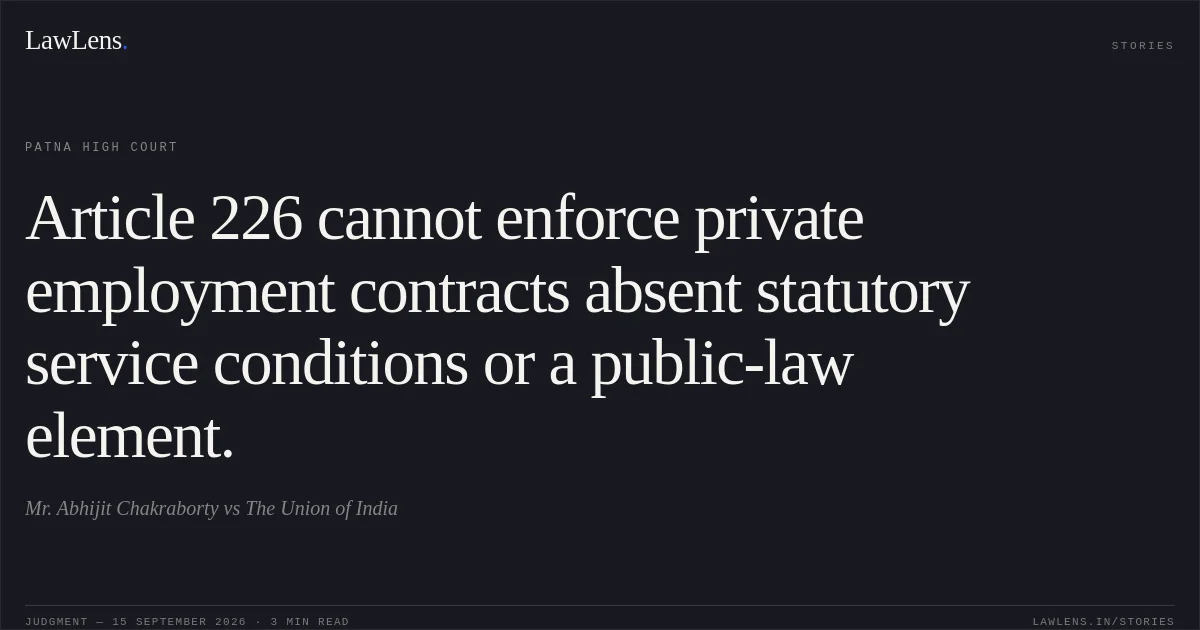
Article 226 permits judicial review of a private person or body discharging a public duty or public function where the challenged action has a direct nexus with a public-law element; however, individual disputes and breaches of private contracts cannot ordinarily be enforced through mandamus.
Source reference: paras. 12–13Relying principally on St. Mary’s Education Society v. Rajendra Prasad Bhargava, (2023) 4 SCC 498, the Court held that although an educational institution may perform a public function, its employees cannot invoke Article 226 for service disputes not governed by statutory provisions, unless the employer is “State” under Article 12 or the impugned action contains a public-law element.
Source reference: para. 13The Court also relied on Army Welfare Education Society v. Sunil Kumar Sharma, (2024) 16 SCC 598, which held that the employment relationship between a private educational institution and its employees remains contractual and falls within private law, notwithstanding the public nature of imparting education.
Source reference: para. 14The petitioners’ reliance on Ajay Hasia, Kumari Shrilekha Vidyarthi, ABL International, and Marvari Balika Vidyalaya was considered, but the Court distinguished cases involving State instrumentalities, statutory service conditions, or an identifiable public-law element.
Source reference: paras. 8–10Reasoning
The Court accepted that imparting education is a public function and that a CBSE-affiliated institution may, in an appropriate case, be subject to Article 226 jurisdiction.
Source reference: para. 12However, the petitioners’ claims concerned their termination, reinstatement, payment of salary and statutory dues, and enforcement of notice provisions contained in the agreement between BRBCL and SSRVM Trust. Their service conditions were not governed by statutory rules but by the contractual arrangement with the Trust.
Source reference: para. 16Applying St. Mary’s Education Society and Army Welfare Education Society, the Court held that the alleged termination and non-payment of dues were matters arising from a private contract of service and had no independent public-law element.
Source reference: paras. 13–16The Court also found the challenge to the fresh agreement misconceived because the petitioners were neither parties nor intended claimants under that agreement.
Source reference: paras. 6, 16Consequently, allegations of violation of contractual notice provisions, CBSE norms, or employment-related rights could not convert the private service dispute into an actionable public-law claim under Article 226.
Source reference: paras. 9–10, 15–16Holding
The High Court held that the writ petition was not maintainable under Article 226.
Although the school performed the public function of imparting education, the petitioners’ employment dispute arose from a non-statutory private contract with SSRVM Trust and lacked the requisite public-law element.
Source reference: paras. 12–16The petitioners also lacked a proper basis to challenge the BRBCL–Child Education Society agreement, to which they were not parties.
Source reference: para. 16The writ petition was accordingly dismissed, with liberty to the petitioners to pursue any other appropriate remedy available in law.
Source reference: paras. 17–18Acts & Sections Cited
1 provisions across 1 statute referred to in this judgment. Linked provisions open on LawLens.
Industrial Disputes Act, 19471
Original Court PDF
Mr. Abhijit ChakrabortyvsThe Union of India
Click to open original judgment
Original judgment, available to read, download and summarize on LawLens.in