Facts
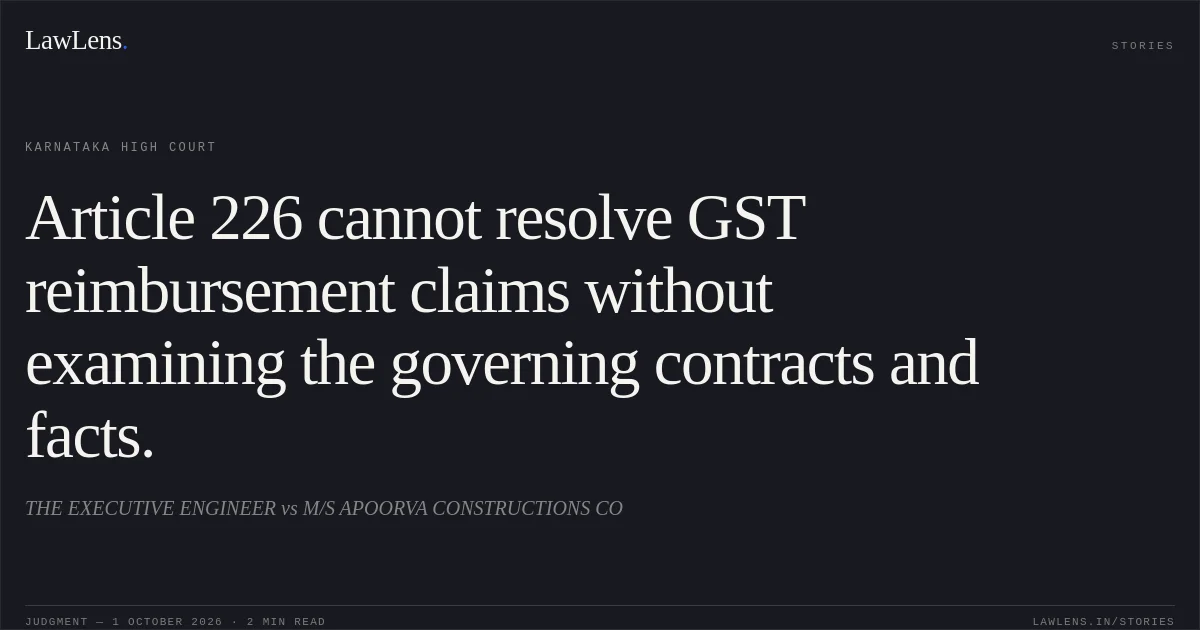
M/s Apoorva Constructions Co. (ACC) sought reimbursement of alleged differential GST on works performed under contracts with various public authorities, including KSRTC.
Source reference: no citationACC classified the contracts by when they were entered into and claimed that some contract prices were based on pre-GST rates.
Source reference: p. 4–5, 10–11The writ petition did not include the individual contracts, though it listed the relevant works.
Source reference: p. 4The Single Judge allowed the petition by applying directions issued in Sri Chandrashekaraiah v. State of Karnataka, without examining the specific contracts.
Source reference: p. 5–7, 10–11KSRTC appealed, relying on tender terms that stated the quoted rates were inclusive of taxes and on the fact that ACC had raised GST-inclusive bills and accepted payment before claiming the differential.
Source reference: p. 8–10Issues
1. Whether the Single Judge could direct consideration and reimbursement of differential GST without examining the relevant contracts and transaction-specific facts.
Source reference: p. 10–122. Whether ACC’s contractual GST claims were suitable for determination in proceedings under Article 226 of the Constitution.
Source reference: p. 12Law Applied
The Court applied the principle that contractual disputes requiring examination of the particular contract and relevant facts cannot be determined in a factual vacuum in proceedings under Article 226.
Source reference: p. 11–12It considered the tender terms, which addressed the treatment of taxes, and the parties’ conduct, including the GST-inclusive bills and payments.
Source reference: p. 8–10The Court did not determine the substantive effect of the GST legislation or decide whether ACC was entitled to reimbursement; it noted that the directions made in Sri Chandrashekaraiah had been followed without scrutiny of the contracts in this case.
Source reference: p. 5–7, 10–11Reasoning
The ACC’s claim depended on whether each contract’s price and terms entitled it to additional payment following the introduction of GST.
Source reference: p. 8–11The contracts were not before the Single Judge, and the tender terms cited by KSRTC indicated that rates were inclusive of taxes; ACC had also raised GST-inclusive bills and accepted payment before making its later claims.
Source reference: p. 8–11The Court held that these matters, along with KSRTC’s objection that the claims were an afterthought, required contract-specific examination.
Source reference: p. 10–12The Single Judge’s blanket reliance on Sri Chandrashekaraiah did not undertake that examination, making it inappropriate to sustain the order against KSRTC in writ proceedings.
Source reference: p. 10–12Holding
The appeal was allowed, and the Single Judge’s order was set aside insofar as it concerned KSRTC.
The Court did not decide the merits of ACC’s reimbursement claim.
Source reference: p. 12The order was limited to KSRTC; the other respondents could challenge the Single Judge’s order in accordance with law, and ACC remained free to pursue its available remedies.
Source reference: p. 12Acts & Sections Cited
2 provisions across 2 statutes referred to in this judgment. Each provision opens on LawLens.
Indian Partnership Act, 19321
KARNATAKA HIGH COURT ACT, 19611
Original Court PDF
THE EXECUTIVE ENGINEERvsM/S APOORVA CONSTRUCTIONS CO
Click to open original judgment
Original judgment, available to read, download and summarize on LawLens.in