Facts
The petitions concerned Government land bearing Khasra No. 570/1/A at Shankar Nagar, Khamhardih, Raipur.
Source reference: paras. 1–4By order dated 19 July 2020, subsequently amended on 13 February 2026, 0.250 hectare was allotted for construction of the Khamhardih Police Station.
Source reference: paras. 1–4The petitioners, local residents who claimed that the land was being used as an open green space or “oxy-zone”, challenged the allotment and sought to restrain tree-felling and construction, alleging that the site contained approximately 200 trees.
Source reference: paras. 2–3, 6In WPC No. 3873 of 2026, they additionally sought consideration of their representation proposing Government land bearing Khasra No. 481 as an alternative site.
Source reference: para. 4The State contended that the allotment was made by the competent authority for an essential public purpose under the Chhattisgarh Land Revenue Code, 1959, that the existing police station was inadequate, and that only five trees had been felled while approximately fifty trees had been planted as a mitigating measure.
Source reference: paras. 8–10The respondents further stated that construction would be undertaken pursuant to sanctioned plans and that any tree-felling would occur only after obtaining the requisite statutory permissions.
Source reference: paras. 10–11Issues
1. Whether the allotment of 0.250 hectare of Government land for construction of the Khamhardih Police Station was illegal, arbitrary, mala fide, or otherwise liable to be quashed under Article 226 of the Constitution.
Source reference: paras. 13–16, 26–272. Whether the alleged environmental impact and proposed felling of trees required the Court to restrain construction or invalidate the allotment.
Source reference: paras. 14–19, 273. Whether the Court should direct the authorities to allot alternative Government land bearing Khasra No. 481 for construction of the police station.
Source reference: paras. 23–24, 274. Whether the allotment stood automatically cancelled because construction was not completed within the stipulated period.
Source reference: para. 20Law Applied
The Court applied Article 21 of the Constitution, under which the right to a clean and healthy environment forms part of the right to life, alongside the public obligation to provide adequate police infrastructure and maintain public safety.
Source reference: para. 14It exercised judicial review under Article 226, emphasising that administrative decisions concerning public facilities are not to be disturbed unless they are arbitrary, mala fide, illegal, colourable, or contrary to statutory requirements.
Source reference: paras. 15–16, 24The allotment was considered under the Chhattisgarh Land Revenue Code, 1959 and applicable Government instructions governing Government land.
Source reference: para. 8The Court relied on Raj Kumar Soni v. State of U.P., (2007) 10 SCC 635, for the principle that Article 226 relief is discretionary and that a petitioner must establish a legally enforceable right; on Sanjay Kumar Jha v. Prakash Chandra Chaudhary, (2019) 2 SCC 499, for the rule that the High Court does not ordinarily reappreciate disputed facts or substitute its view for that of an administrative authority; and on Gadde Venkateswara Rao v. Government of A.P., AIR 1966 SC 828, as discussed in M.C. Mehta v. Union of India, (1999) 6 SCC 237, for the principle that the Court may decline to quash an order where doing so would not serve the interests of justice.
Source reference: paras. 21–22Tree-felling was required to comply with applicable statutory procedures, permissions, and compensatory-plantation requirements.
Source reference: paras. 17, 19, 27Reasoning
The Court found that the land was Government land, that the allotment had been made by the competent authority for the legitimate public purpose of constructing an adequately equipped police station, and that the petitioners had no proprietary or other independent legal interest in it.
Source reference: paras. 13, 16Nevertheless, their environmental grievance was considered maintainable in view of Article 21.
Source reference: para. 14The material showed a genuine administrative need for a new police station and no evidence of mala fides, extraneous considerations, colourable exercise of power, or statutory violation.
Source reference: para. 16The allegation that approximately 200 trees would necessarily be felled was not established; the respondents stated that only five trees had been felled and that compensatory plantation had been undertaken.
Source reference: paras. 8, 17–18The Court therefore declined to invalidate the allotment, while protecting the environmental interest by directing that only the minimum number of trees necessary for construction could be felled, and only after obtaining all requisite permissions and complying with statutory safeguards.
Source reference: paras. 19, 27The alleged non-completion of construction within the original period did not justify cancellation because the allotment had subsequently been amended and further administrative steps had been taken.
Source reference: para. 20As to Khasra No. 481, the Court held that its suitability involved factual, technical, accessibility, security, connectivity, and administrative considerations, and that the material indicated it was not an unencumbered, readily available vacant site.
Source reference: paras. 23–24Holding
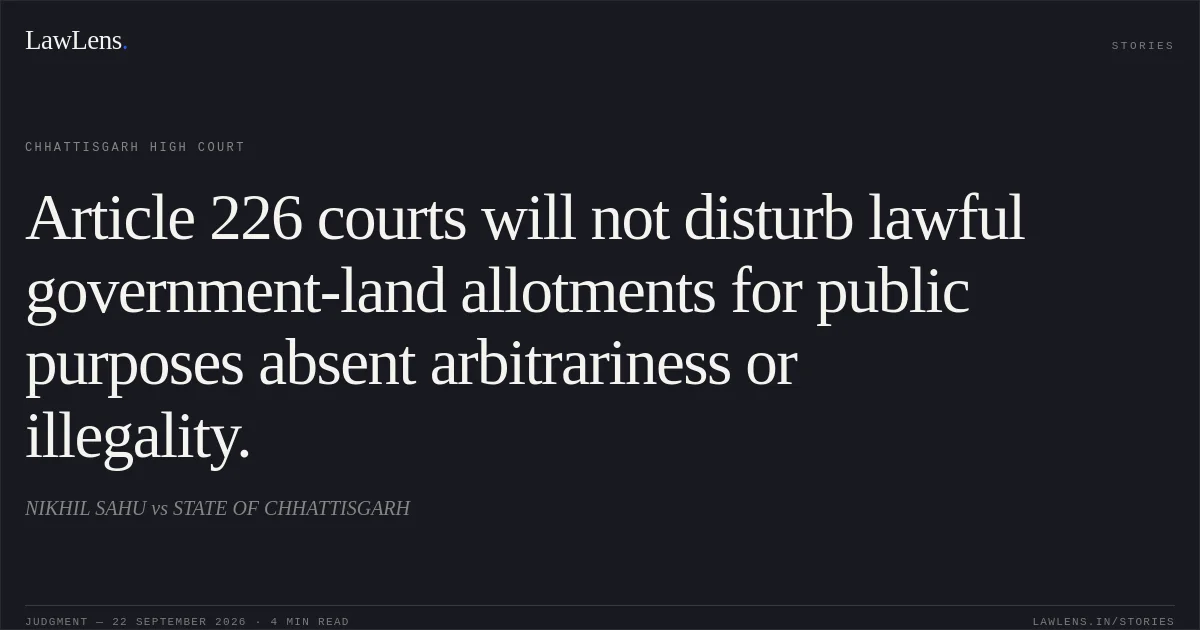
The Court dismissed/disposed of both writ petitions without quashing the allotment of 0.250 hectare for construction of the Khamhardih Police Station, holding that the allotment was made by the competent authority for a legitimate public purpose and did not warrant interference under Article 226.
The respondents were directed to undertake construction strictly in accordance with law and the sanctioned plan; no tree could be felled except to the extent absolutely necessary, after obtaining requisite permissions and complying with all applicable environmental safeguards and compensatory-plantation requirements.
Source reference: para. 27The representation dated 9 July 2026 seeking consideration of Khasra No. 481 was directed to be considered by the competent authority in accordance with law, but no direction for allotment of that alternative site was issued.
Source reference: para. 27The Court expressed no opinion on title or independent rights concerning Khasra No. 481 or any other land.
Source reference: para. 24Original Court PDF
NIKHIL SAHUvsSTATE OF CHHATTISGARH
Click to open original judgment
Original judgment, available to read, download and summarize on LawLens.in