Facts
Respondent No. 1 applied under Sections 59(5) and 178 of the Madhya Pradesh Land Revenue Code, 1959, for partition of jointly recorded ancestral agricultural land.
Source reference: para. 1The petitioner, a co-sharer, objected principally that the proposed partition omitted several survey numbers forming part of the joint holding.
Source reference: para. 1–7The Tahsildar rejected the objection and allowed the partition; the SDO and Additional Commissioner affirmed that decision, and the petitioner’s review application was also rejected.
Source reference: para. 1–7The petitioner challenged those orders under Article 226, alleging, among other things, partial partition, defects in the Fard Batwara, lack of consent, and inadequate notice and opportunity to be heard.
Source reference: para. 1–7Issues
Whether the Revenue Authorities’ decision to proceed with partition despite the objection that certain survey numbers were omitted was unlawful.
Source reference: para. 18–19Whether the alleged defects in the Fard Batwara, absence of co-sharer consent, or violation of natural justice warranted interference under Article 226.
Source reference: para. 20–23Whether the decision in Smt. Vimla Bai & Others v. Ramsnehi & Others required the impugned orders to be set aside.
Source reference: para. 15–16, 22Law Applied
Section 178 of the Madhya Pradesh Land Revenue Code, 1959, governs partition proceedings before the competent Revenue Authority; the proceedings in this case were initiated under that provision read with Section 59(5).
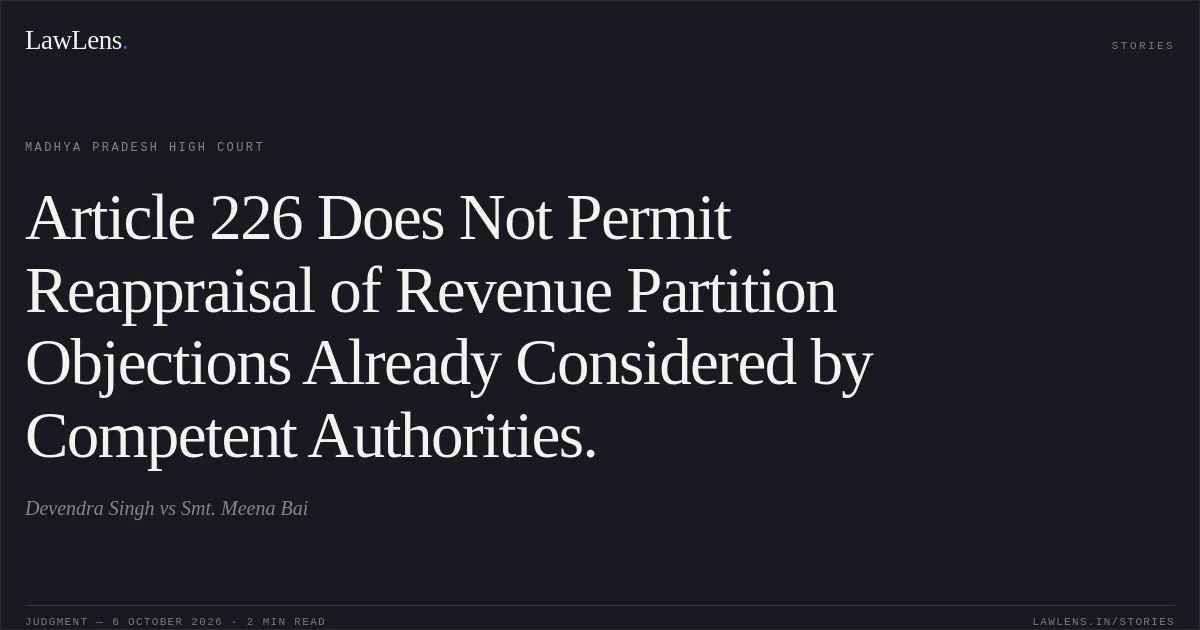
Source reference: para. 1, 3In exercising jurisdiction under Article 226, the High Court does not act as an appellate authority to reappreciate factual aspects of partition proceedings; interference requires a demonstrated jurisdictional error, perversity, or violation of natural justice.
Source reference: para. 23The Court considered Smt. Vimla Bai & Others v. Ramsnehi & Others, W.P. No. 5151/2025, where relief had been granted on facts involving inadequately established notice and lack of effective participation in preparation of the Fard Batwara.
Source reference: para. 15–16, 22Reasoning
The Court found that the petitioner had appeared before the Tahsildar and that his principal objection—non-inclusion of other survey numbers—had been considered and decided by the Revenue Authorities.
Source reference: para. 18The petitioner did not establish a subsisting claim by respondent No. 1 over the omitted lands, so their exclusion did not, by itself, invalidate the partition.
Source reference: para. 19The Court declined to consider further factual objections to the Fard Batwara that had not been effectively raised before the Tahsildar, and held that disagreement with the partition or lack of consent did not establish invalidity or a material irregularity causing failure of justice.
Source reference: para. 20–21It distinguished Vimla Bai because, unlike the petitioners there, this petitioner had appeared and had his objection considered.
Source reference: para. 22No ground for writ interference was established.
Source reference: para. 23Holding
The High Court held that the petitioner had not demonstrated jurisdictional error, perversity, or a violation of natural justice warranting intervention under Article 226.
It dismissed the writ petition and declined to interfere with the Revenue Authorities’ orders.
Source reference: para. 23–24Acts & Sections Cited
2 provisions across 1 statute referred to in this judgment. Each provision opens on LawLens.
MP Land Revenue Code 19592
Original Court PDF
Devendra SinghvsSmt. Meena Bai
Click to open original judgment
Original judgment, available to read, download and summarize on LawLens.in