01Facts
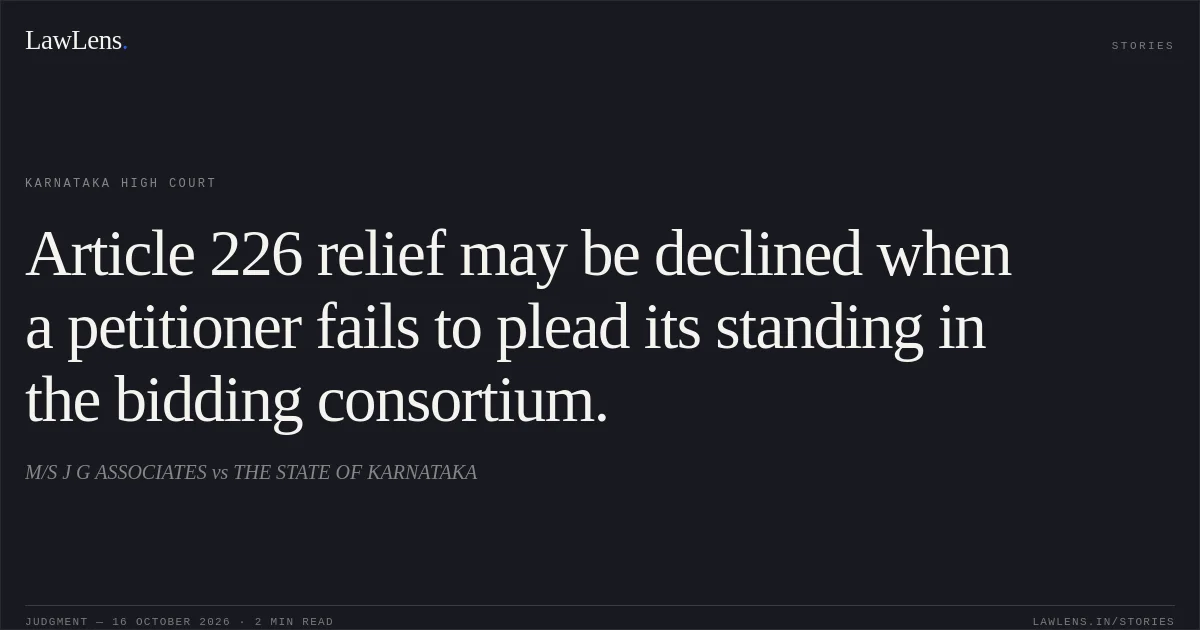
The petitioner, described as M/s. J.G. Associates represented by its proprietor, claimed to have submitted bids for Packages 2 and 21 in a tender for solid-waste collection and transportation services covering 33 packages
¶ 2It sought to quash the rejection of its technical bids and appellate orders dated 4 March 2026, and also sought relief affecting the evaluation and tendering of all 33 packages
¶ 1, 3The appellate order placed before the Court concerned an appeal by M/s. Lava Kusha Transport; the record also referred to J.G. Associates as a consortium member of that bidder
¶ 4The petitioner’s bid document was not produced, and the petition did not identify the consortium members, the entity that appealed, or the petitioner’s basis for asserting rights on the bidder’s behalf
¶ 5–702Issues
i.Whether the petitioner had pleaded and established sufficient facts concerning its relationship to the bidder and its interest in the tender to invoke the High Court’s discretionary jurisdiction under Article 226
¶ 7–8ii.Whether the Court should entertain the petitioner’s challenges to the rejection of bids and the wider tender process when the petition omitted essential details and supporting bid documents
¶ 3, 5–803Law Applied
The Court applied the discretionary nature of the High Court’s extraordinary jurisdiction under Article 226 of the Constitution of India: a petition may be declined where the pleadings omit essential facts necessary to establish the petitioner’s interest and the basis for the relief sought
¶ 8The Court stated no separate statutory procurement rule or precedent as the basis for its decision; it did not determine the merits of the tender evaluation or the petitioner’s procurement-law claims
¶ 8–904Reasoning
The Court found that the petition did not clarify whether J.G. Associates itself was the bidder or was claiming through a consortium, and the appellate order concerned a different entity, M/s. Lava Kusha Transport
¶ 4, 6–7The petitioner’s counsel described J.G. Associates as a consortium member, but the petition did not identify the consortium members, the entity that presented the appeal, or the petitioner’s right or interest in pursuing relief for the bidder; the bid document was also absent
¶ 5, 7Because those omissions left the petitioner’s standing and asserted interest unclear, the Court declined to exercise its discretionary Article 226 jurisdiction and did not reach the substantive tender challenges
¶ 8–905Holding
The Court dismissed the writ petition because essential facts concerning the petitioner’s relationship to the bidder and its interest in the matter had not been pleaded
¶ 8–9Pending applications were also disposed of
¶ 10Original Court PDF
M/S J G ASSOCIATESvsTHE STATE OF KARNATAKA
Click to open original judgment
Original judgment, available to read, download and summarize on LawLens.in