Facts
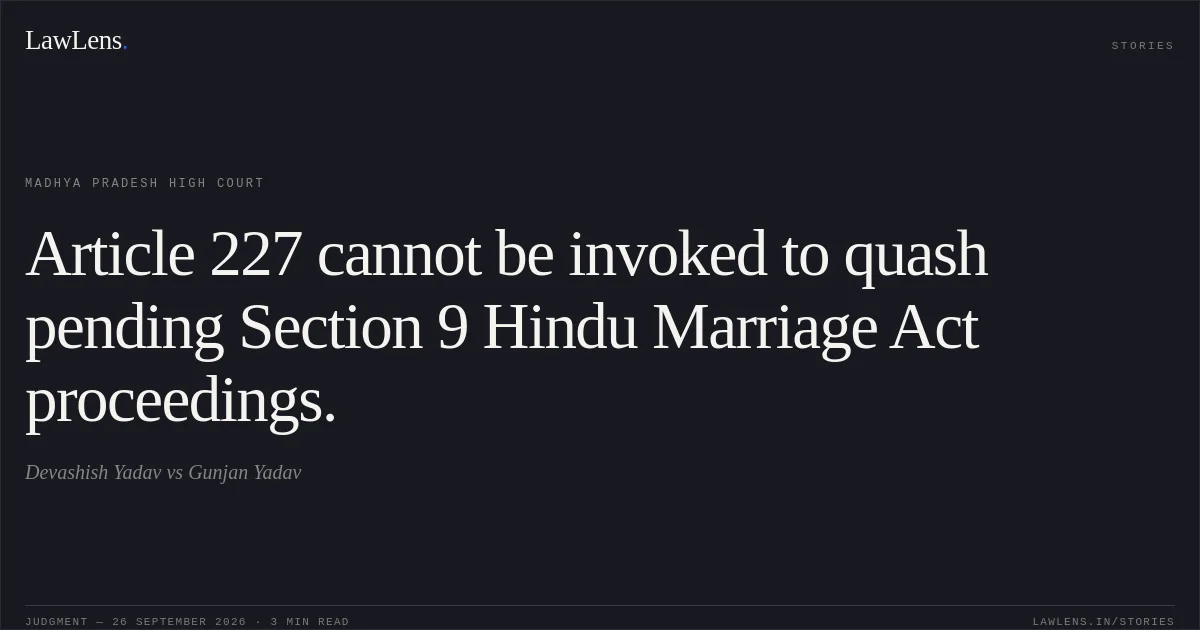
The petitioner-husband invoked Article 227 of the Constitution seeking quashing of the respondent-wife’s proceedings under Section 9 of the Hindu Marriage Act, 1955 (“HMA”), pending before the Family Court, Gwalior, in Case No. 848A/2023.
Source reference: paras. 2–4He alleged that the wife’s petition for restitution of conjugal rights was an abuse of process and a counterblast to his divorce proceedings, particularly because she had allegedly refused to reside with him in earlier proceedings under Section 9 HMA initiated by him in 2018.
Source reference: paras. 2–4The respondent objected to maintainability, contending that Article 227 confers supervisory—not original—jurisdiction and cannot be used to bypass statutory remedies or quash a plaint/proceeding in a private civil dispute.
Source reference: para. 5An earlier order dated 18 June 2025 allowing the petition had subsequently been recalled in review by a Coordinate Bench on 13 August 2025, relying on K. Valarmathi v. Kumaresan; that order had attained finality between the parties.
Source reference: para. 6; para. 16Issues
1. Whether a petition under Article 227 of the Constitution can be invoked to quash proceedings under Section 9 of the HMA pending before a Family Court?
Source reference: para. 92. Whether the High Court, in exercise of its supervisory jurisdiction under Article 227, can reject or quash a plaint or analogous civil proceeding on allegations that it is not maintainable, abusive, or instituted to harass the opposite party?
Source reference: paras. 9, 11–143. Whether the petitioner’s allegations that the respondent’s Section 9 proceedings were a counterblast and an abuse of process could be adjudicated in the Article 227 proceedings?
Source reference: para. 13Law Applied
Section 10 of the Family Courts Act, 1984 makes the Code of Civil Procedure, 1908 applicable to proceedings before a Family Court, while Section 9 HMA provides for a decree of restitution of conjugal rights and Section 28 HMA makes decrees and orders under the Act appealable.
Source reference: para. 10Article 227 confers supervisory jurisdiction to ensure that subordinate courts act within the bounds of their authority; it does not confer original jurisdiction to determine private civil disputes or bypass statutory procedures.
Source reference: paras. 5, 11In Jacky v. Tiny Alias Antony, (2014) 6 SCC 508, the Supreme Court held that Article 226/227 cannot be used to question or quash a plaint merely on the ground that the suit is not maintainable; such issues must be addressed in appropriate proceedings.
Source reference: para. 11In K. Valarmathi v. Kumaresan, 2025 INSC 606, the Supreme Court reiterated that the High Court cannot usurp the trial court’s original jurisdiction to reject a plaint and cautioned against circumventing procedural safeguards.
Source reference: para. 12The Court also noted that Surya Dev Rai v. Ram Chander Rai, AIR 2003 SC 3044, had been partly overruled by Radhey Shyam v. Chhabi Nath, (2015) 5 SCC 423, particularly regarding the amenability of judicial orders of civil courts to writ jurisdiction under Article 226.
Source reference: para. 15Reasoning
The Court treated proceedings under Section 9 HMA before the Family Court as civil proceedings resulting in an appealable decree.
Source reference: para. 10Applying Jacky and K. Valarmathi, it held that the petitioner’s assertions—that the respondent had earlier refused to cohabit, that her petition was a counterblast, and that it was intended to harass him—were disputed questions of fact requiring adjudication and evidence, not matters that could be determined in Article 227 proceedings.
Source reference: para. 13The petition sought to have the High Court exercise original jurisdiction by quashing the underlying proceeding, rather than correct a jurisdictional error or supervise the Family Court’s exercise of jurisdiction.
Source reference: paras. 11–14The Court further held that the earlier review order dated 13 August 2025, passed between the same parties and attaining finality, independently supported dismissal of the petition on maintainability grounds.
Source reference: para. 16Holding
The Court answered the maintainability issue against the petitioner and held that an Article 227 petition seeking quashing of the respondent’s Section 9 HMA proceedings before the Family Court was not maintainable.
The miscellaneous petition was dismissed on the ground of maintainability, with liberty to the petitioner to pursue any remedy permissible in law.
Source reference: paras. 17–18Any pending applications were ordered to stand closed.
Source reference: para. 19Acts & Sections Cited
5 provisions across 3 statutes referred to in this judgment. Each provision opens on LawLens.
Hindu Marriage Act, 19552
Family Courts Act, 19841
Code of Civil Procedure, 19082
Original Court PDF
Devashish YadavvsGunjan Yadav
Click to open original judgment
Original judgment, available to read, download and summarize on LawLens.in