Facts
The first respondent initiated proceedings under the Protection of Women from Domestic Violence Act against the petitioners, who are her in-laws, her husband (the second respondent), and another party, seeking various reliefs.
Source reference: p.3, paras. 4–5The petitioners alleged that they had been joined only to harass them and sought, under Article 227 of the Constitution, to strike off the proceedings against them.
Source reference: p.3, paras. 4–5The High Court considered whether their grievance should be addressed in the pending proceedings before the Magistrate.
Source reference: pp. 3–5, paras. 6–7Issues
1. Whether the High Court should strike off the Domestic Violence Act proceedings against the petitioners under Article 227 of the Constitution.
Source reference: p.5, para. 72. Whether the petitioners could seek deletion of their names from the array of respondents by applying to the Magistrate.
Source reference: pp. 4–5, paras. 6–7Law Applied
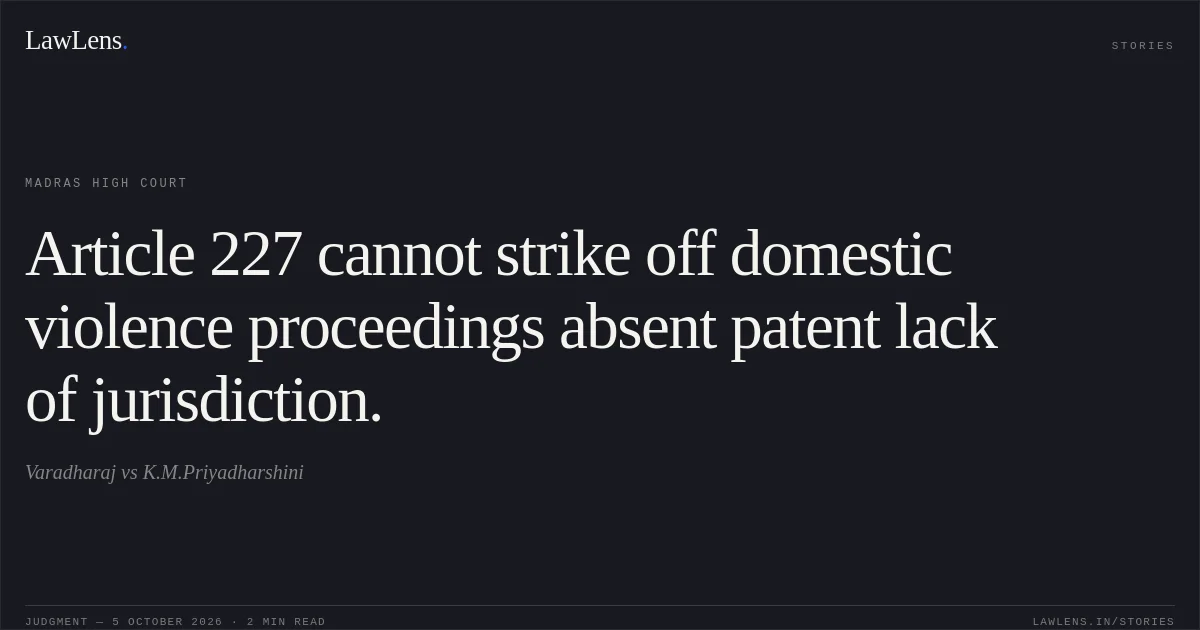
Article 227 permits the High Court to strike off proceedings where the subordinate court suffers from a patent lack of jurisdiction; it is not the appropriate route for resolving the petitioners’ complaint in the circumstances presented.
Source reference: p.5, para. 7In Arul Daniel & others v. Suganya & others, 2022 (6) CTC 833, the Full Bench held that a respondent in proceedings under the Domestic Violence Act may apply to the Magistrate, at any stage, for deletion from the array of parties if improperly joined.
Source reference: p.4, para. 6The Magistrate may exercise the power under Order I, Rule 10(2) of the Code of Civil Procedure to prevent abuse of process and harassment through improper joinder.
Source reference: p.4, para. 6The Court also referred to Kunapareddy as supporting the procedural flexibility of applications under the Act.
Source reference: p.4, para. 6Reasoning
The petitioners’ allegation that they were improperly joined did not establish a patent lack of jurisdiction in the Magistrate, so the exceptional basis for striking off the proceedings under Article 227 was absent.
Source reference: p.5, para. 7Applying the Full Bench guidance in Arul Daniel, the Court held that the petitioners could pursue their grievance through an application to the Magistrate for deletion of their names, where the issue could be decided on its merits after hearing both parties.
Source reference: pp. 4–5, paras. 6–8Holding
The Court disposed of the revision petition without striking off the proceedings and left it open to the petitioners to apply to the Special Court for deletion of their names from the array of respondents.
Any such application is to be decided on its merits and in accordance with law after giving both parties an opportunity to be heard; the petitioners may appear through counsel, and their personal presence was dispensed with.
Source reference: p.5, para. 8Acts & Sections Cited
1 provisions across 1 statute referred to in this judgment. Each provision opens on LawLens.
Protection of Women from Domestic Violence Act, 20051
Original Court PDF
VaradharajvsK.M.Priyadharshini
Click to open original judgment
Original judgment, available to read, download and summarize on LawLens.in