Facts
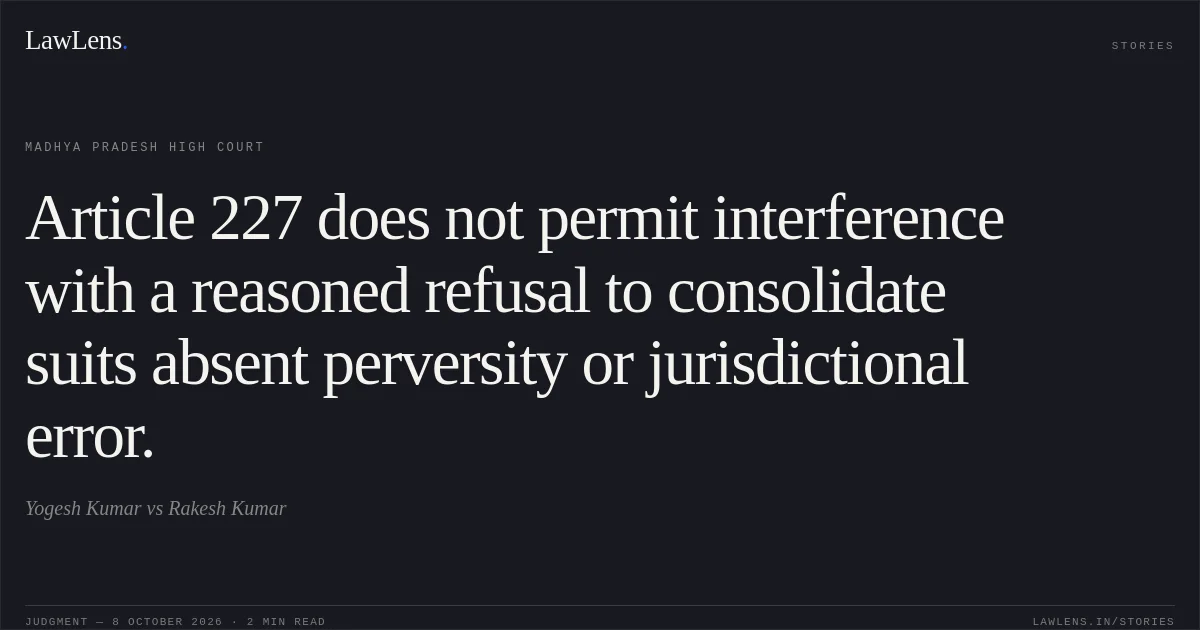
The petitioners sought consolidation under Section 151 CPC of RCSA No. 11-A/2016 and RCSA No. 32-A/2022, contending that both suits concerned the same property.
Source reference: p.1The trial court rejected the application, finding that the causes of action, matters for adjudication, and reliefs differed, and that separate evidence would be required.
Source reference: p.1The petitioners challenged that order under Article 227 of the Constitution, relying on Chitivalasa Jute Mills v. Jaypee Rewa Cement.
Source reference: p.1Issues
Whether the trial court erred in rejecting the application to consolidate the two suits, given that they concerned the same property
Source reference: p.1–3Whether the trial court’s order disclosed a jurisdictional error or perversity warranting interference under Article 227 of the Constitution
Source reference: p.3Law Applied
Section 151 CPC preserves the civil court’s inherent power to make orders necessary to secure the ends of justice or prevent abuse of process; it may support consolidation where the issues in separate suits are completely or substantially similar, avoiding duplicated evidence, delay, and expense (Chitivalasa Jute Mills v. Jaypee Rewa Cement, (2004) 3 SCC 85, para. 12).
Source reference: p.2–3Consolidation is not automatic and depends on the facts and the trial court’s judicious exercise of discretion.
Source reference: p.3Under Article 227, the High Court does not act as a court of first appeal; supervisory interference is limited, including where the impugned finding is perverse or unsupported by the record (M/s Garment Craft v. Prakash Chand, SLP (C) No. 13941/2021, judgment dated 11 January 2022).
Source reference: p.3–4Reasoning
Although the suits concerned the same property, the trial court had considered the distinct causes of action, issues for adjudication, reliefs sought, and evidence required.
Source reference: p.2–4The High Court held that the trial court had exercised its discretion judiciously and that the record disclosed neither perversity nor illegality.
Source reference: p.2–4The principle in Chitivalasa Jute Mills did not require consolidation where the suits’ material issues and evidentiary requirements differed; nor could the High Court reappraise the order as if hearing an appeal.
Source reference: p.2–4Holding
The High Court answered the consolidation issue against the petitioners and found no ground for supervisory interference under Article 227.
It dismissed the petition as meritless, leaving the trial court’s refusal to consolidate the suits undisturbed.
Source reference: p.4Acts & Sections Cited
1 provisions across 1 statute referred to in this judgment. Each provision opens on LawLens.
Code of Civil Procedure, 19081
Original Court PDF
Yogesh KumarvsRakesh Kumar
Click to open original judgment
Original judgment, available to read, download and summarize on LawLens.in