01Facts
The opposite party/pre-emptor’s father purchased 3 decimals from plot no. 76, Jikra Mouza, in 1983 and thereby became a co-sharer.
¶ 1–5 · pp. 1–3After his death, the opposite party inherited his interest.
¶ 1–5 · pp. 1–3The co-sharer, Arejan Khanam, subsequently transferred 33/10 decimals from the same plot to the petitioner/pre-emptee by a registered sale deed dated 24 April 2007.
¶ 1–5 · pp. 1–3Alleging that the petitioner was a stranger purchaser and that the sale had taken place without notice, the opposite party instituted a proceeding under Sections 8 and 9 of the West Bengal Land Reforms Act, 1955.
¶ 1–5 · pp. 1–3The Trial Court allowed the pre-emption application on 25 April 2017.
¶ 1–5 · pp. 1–3The Appellate Court dismissed the petitioner’s appeal on 6 February 2025 and affirmed that decision.
¶ 1–5 · pp. 1–3The petitioner thereafter invoked Article 227 of the Constitution, challenging the findings on limitation, non-joinder, the alleged transfer of the vendor’s entire share, and the conduct of the proceeding.
¶ 6, 10, 13–15 · pp. 3–502Issues
i.1. Whether the pre-emption proceeding was barred by limitation, having regard to the date on which registration of the impugned deed was completed.
¶ 9 · p. 3ii.2. Whether the pre-emption proceeding was defective for non-joinder of the vendor/transferor of the impugned sale deed.
¶ 10–11 · pp. 3–4iii.3. Whether the pre-emption application was maintainable when the vendor allegedly transferred her entire share in the plot, or whether only a portion of the unpartitioned plot had been transferred.
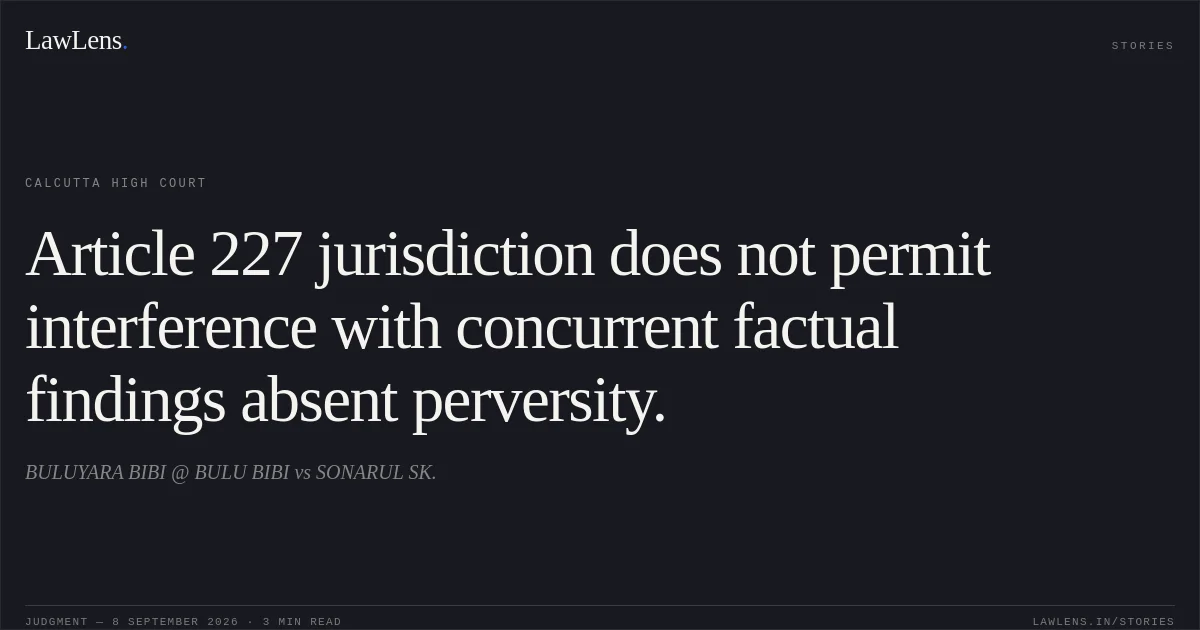
¶ 13 · p. 4iv.4. Whether the concurrent factual findings of the Trial Court and the Appellate Court warranted interference under Article 227 of the Constitution.
¶ 16–20 · pp. 5–603Law Applied
The Court applied Sections 8 and 9 of the West Bengal Land Reforms Act, 1955, which permit a co-sharer to seek pre-emption of a transfer of a portion of a plot to a stranger purchaser, subject to the statutory requirements.
It held that the vendor or transferor is not a necessary party to such a pre-emption proceeding.
¶ 10–11 · p. 4Where registration of the impugned deed is completed during the pendency of the proceeding, the proceeding is not barred by limitation on that ground.
¶ 9 · pp. 3–4The Court further applied the principle governing Article 227 jurisdiction that the High Court does not ordinarily re-appreciate evidence or substitute its conclusions for concurrent findings of fact, absent perversity, grave dereliction of duty, or flagrant violation of fundamental legal principles.
¶ 7, 16–18 · p. 3, 5In support, it relied on Tapashi Mondal v. Binoy Kumar Biswas, reported at (2015) 1 CHN (Cal) 267.
¶ 7, 16–18 · p. 3, 504Reasoning
The Trial Court had framed a specific limitation issue and, on examining the impugned deed, found that its registration was completed on 29 June 2015 during the pendency of the proceeding; consequently, the pre-emption application was treated as within limitation.
¶ 9 · p. 3The High Court upheld the finding that the transferor was not a necessary party.
¶ 10–11 · p. 4It also accepted the concurrent factual findings that the pre-emptor acquired co-sharer status through inheritance from his father, that the plot measured 40 decimals, that the vendor transferred only 33/10 decimals, and that the petitioner failed to prove any prior partition or that the vendor had transferred her entire share.
¶ 12–15 · pp. 4–5Since the plot remained unpartitioned and only a portion had been transferred to the petitioner, the statutory basis for pre-emption was established.
The alleged procedural shortcomings and evidentiary challenges did not disclose perversity or any exceptional circumstance justifying supervisory interference under Article 227.
¶ 16–20 · pp. 5–605Holding
The Court answered the issues against the petitioner.
¶ 17–21 · pp. 5–6It held that the pre-emption proceeding was not barred by limitation, that non-joinder of the vendor was not fatal, and that the opposite party had established the status of a co-sharer in respect of an unpartitioned plot from which only a portion had been transferred to the petitioner.
¶ 17–21 · pp. 5–6Finding no grave dereliction, perversity, or violation of fundamental legal principles, the Court declined to interfere under Article 227 and dismissed C.O. 3874 of 2025.
¶ 17–21 · pp. 5–6There was no order as to costs.
¶ 17–21 · pp. 5–6Original Court PDF
BULUYARA BIBI @ BULU BIBIvsSONARUL SK.
Click to open original judgment
Original judgment, available to read, download and summarize on LawLens.in