Facts
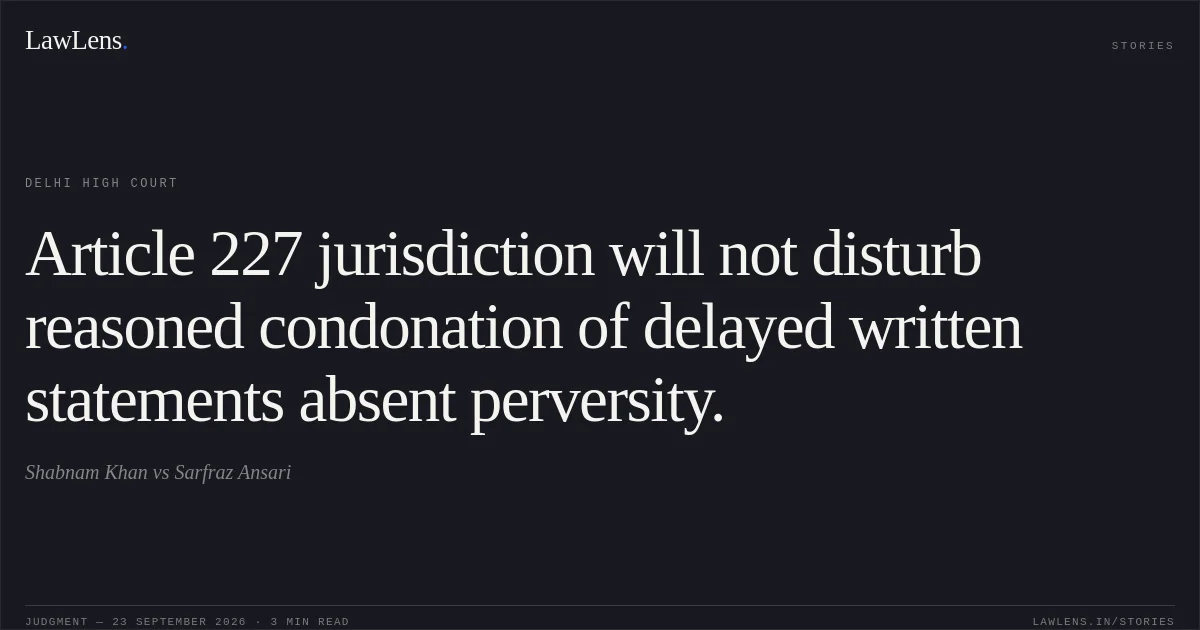
The Petitioner challenged, under Article 227 of the Constitution, the order dated 25.08.2023 passed by the Family Court-01, Shahdara, Delhi, in ML No. 57/2019.
Source reference: p.1By that order, the Family Court allowed the Respondent’s application under Order IX Rule 7 read with Section 151 CPC, condoned the delay in filing his Written Statement, and took it on record subject to payment of costs of ₹3,000 to the Petitioner.
Source reference: pp.6–7The Respondent had failed to appear or file his Written Statement, resulting in his defence being struck off by an earlier order dated 07.12.2022.
Source reference: pp.6–7He subsequently filed the application dated 15.05.2023 after a delay of 174 days.
Source reference: p.2The Family Court noted that although the Respondent, an advocate, had failed to remain vigilant, the proceedings concerned dissolution of marriage and denial of an opportunity to defend would cause serious prejudice.
Source reference: p.6Issues
1. Whether the Family Court erred in condoning the Respondent’s 174-day delay in filing the Written Statement and in taking it on record subject to costs?
Source reference: pp.2–3, 6–7, 11–132. Whether the Family Court’s exercise of discretion disclosed a patent jurisdictional error, perversity, manifest illegality, or gross failure of justice warranting interference under Article 227 of the Constitution?
Source reference: pp.3–6, 21–23Law Applied
The Court applied the supervisory jurisdiction under Article 227, which is limited to keeping subordinate courts within the bounds of their authority and does not permit appellate reappreciation of facts or substitution of another possible view; interference is justified only for patent perversity, manifest illegality, grave dereliction of duty, violation of natural justice, or gross failure of justice, as stated in Shalini Shyam Shetty v. Rajendra Shankar Patil and Garment Craft v. Prakash Chand Goel.
Source reference: pp.3–6It relied on Kailash v. Nanhku, which holds that Order VIII Rule 1 CPC is directory and that extension beyond the prescribed period may be granted exceptionally for recorded reasons, although procedural timelines must ordinarily be respected and delay cannot be condoned routinely.
Source reference: pp.7–11Bharat Kalra v. Raj Kishan Chhabra establishes that delay in filing a Written Statement may, in an appropriate case, be compensated through costs rather than by denying the defence altogether.
Source reference: p.12In matrimonial proceedings, Shraddha Ashish Deshbhratar v. Ashish Ramchandra Deshbhratar and WG CDR (Retd.) Rakesh Lal Kapur v. Sumeeta Tuli Kapur recognise that procedural rules must be applied flexibly and balanced against the need for adjudication on merits and preservation of an effective defence.
Source reference: pp.13–15The Court also referred to Smt. K.S. Sumi Mol v. Suresh Kumar E.K. concerning procedural timelines in Family Courts, and Komal Gupta v. Amrendra Kumar Gupta, which holds that Family Courts should adopt a comparatively liberal approach in family disputes while imposing conditions to prevent intentional delay.
Source reference: pp.2–3, 15–16Reasoning
The Court acknowledged that procedural timelines serve the important purposes of preventing delay, ensuring expeditious disposal, and avoiding prejudice to the opposite party, particularly in matrimonial proceedings.
Source reference: p.7However, delay alone was not treated as determinative.
Source reference: no citationApplying Kailash, the Court held that the Family Court retained a limited discretion to permit a delayed Written Statement where the circumstances justified preserving a fair opportunity of defence.
Source reference: pp.7–11The Family Court had expressly noticed the Respondent’s lack of vigilance and the fact that he was an advocate, but balanced that lapse against the matrimonial nature of the proceedings and the serious prejudice that would result if his defence were permanently shut out.
Source reference: p.12The delay was addressed by imposing costs of ₹3,000, thereby compensating the Petitioner while allowing the dispute to be decided on its merits.
Source reference: pp.12–13, 16–19Since the Family Court’s decision was based on relevant considerations, was neither mechanical nor arbitrary, and did not contravene the governing principles, the High Court held that no ground for supervisory interference under Article 227 was made out.
Source reference: pp.20–22Holding
The High Court held that the Family Court acted within its discretion in condoning the 174-day delay and taking the Respondent’s Written Statement on record subject to payment of ₹3,000 as costs.
The Impugned Order did not suffer from perversity, manifest illegality, jurisdictional error, or gross failure of justice.
Source reference: no citationAccordingly, the petition was dismissed, and the pending applications were also disposed of.
Source reference: pp.22–23Acts & Sections Cited
1 provisions across 1 statute referred to in this judgment. Each provision opens on LawLens.
Code of Civil Procedure, 19081
Original Court PDF
Shabnam KhanvsSarfraz Ansari
Click to open original judgment
Original judgment, available to read, download and summarize on LawLens.in