Facts
The appellant was prosecuted in connection with Dergaon P.S. Case No. 137/2021 after the 12/13-year-old victim’s mother lodged an FIR alleging that the victim went missing while proceeding to school on 02.04.2021. The victim was traced and recovered from Howly, Barpeta, after approximately 15–16 days, and the appellant was arrested.
Source reference: paras. 3–4The victim’s birth certificate contained overwriting, creating uncertainty as to whether her date of birth was 02.02.2008 or 02.02.2003. During the appellate proceedings, comparison with the original birth register and counterfoil established 02.02.2008 as the correct date of birth, making her approximately 13 years old at the time of the incident.
Source reference: paras. 4, 28, 35The victim’s statement under Section 164 Cr.P.C. stated that she had been in love with the appellant for two years and had gone to Guwahati to meet him. In her trial testimony, however, she stated that the appellant induced her to accompany him by threatening to commit suicide, subsequently threatened her, and forcibly had sexual intercourse with her.
Source reference: paras. 13–18The Special Judge, POCSO, Golaghat, convicted the appellant under Section 366 IPC and Section 6 of the POCSO Act and sentenced him to five years’ rigorous imprisonment under Section 366 IPC and twenty years’ rigorous imprisonment under Section 6 of the POCSO Act, with fines.
Source reference: paras. 2, 5Issues
1. Whether the prosecution proved beyond reasonable doubt that the appellant kidnapped or took the minor victim in circumstances attracting Section 366 IPC, despite the evidence indicating that she accompanied him willingly.
Source reference: paras. 19–23, 39–412. Whether the prosecution proved the appellant’s culpable mental state and knowledge that the victim was a child for sustaining conviction under Section 6 of the POCSO Act.
Source reference: paras. 27–38, 413. Whether the inconsistencies between the victim’s Section 164 Cr.P.C. statement and her trial testimony, together with the uncertainty surrounding the birth certificate, entitled the appellant to the benefit of doubt.
Source reference: paras. 22, 30–35, 39–414. Whether the recording of the victim’s evidence as PW-5, although she was not listed as a prosecution witness, affected the evidentiary basis of the conviction.
Source reference: para. 40Law Applied
The court applied Section 366 IPC concerning kidnapping, abducting or inducing a woman to compel marriage or illicit intercourse, and Sections 5(l) and 6 of the POCSO Act concerning aggravated penetrative sexual assault.
Source reference: paras. 2, 5, 19It relied on Satish Kumar Jayanti Lal Dabgar v. State of Gujarat, (2015) 7 SCC 359, for the principle that a minor is incapable of giving legally valid consent.
Source reference: para. 20Sections 29 and 30 of the POCSO Act were considered: Section 29 creates a statutory presumption regarding commission of specified POCSO offences, while Section 30 presumes the existence of a culpable mental state but permits the accused to establish absence of such mental state.
Source reference: paras. 36–38Under Reena Hazarika v. State of Assam, (2019) 13 SCC 289, the accused’s explanation under Section 313 Cr.P.C. is a valuable component of the right to a fair trial and must be considered by the court.
Source reference: para. 24Jai Prakash Tiwari v. State of Madhya Pradesh, 2022 SCC OnLine SC 966, establishes that an accused need prove a defence only on a preponderance of probabilities, while Parminder Kaur v. State of Punjab, (2020) 8 SCC 811, holds that once a plausible defence is raised under Section 313 Cr.P.C., the prosecution must negate it.
Source reference: paras. 25–26, 29Reasoning
The court accepted that the victim was in fact a minor and that the appellant had sexual intercourse with her, relying on her testimony, the absence of the hymen and the parties’ prolonged stay together.
Source reference: paras. 23, 28However, it found that the circumstances—travelling together by bus, staying at several locations, and interacting with the appellant’s relatives—indicated that the victim had accompanied the appellant willingly, although the appellant allegedly used emotional blackmail and threats.
Source reference: paras. 21–23More significantly, the court treated the appellant’s uncontroverted Section 313 Cr.P.C. explanation—that the victim had represented herself as a major and had altered the birth certificate—as a plausible defence raising doubt about his knowledge of her minority.
Source reference: paras. 30–35Although the court observed that the correct date of birth was 02.02.2008, it held that the appellant could not be conclusively attributed knowledge of that fact because the certificate contained overwriting and was not shown to have been manipulated by him.
Source reference: paras. 28, 34–35Applying Section 30 POCSO and the principles governing Section 313 statements, the court held that the prosecution had failed to establish the requisite mens rea beyond reasonable doubt.
Source reference: paras. 36–38, 41The inconsistency between the victim’s Section 164 statement—that she went alone to the address in Guwahati—and her trial testimony that they travelled together further undermined the reliability of her evidence, such that she was not considered a “sterling witness”.
Source reference: para. 39The court also noted the unexplained procedure by which the victim’s evidence had been recorded as PW-5 despite her absence from the charge-sheet witness list.
Source reference: para. 40Holding
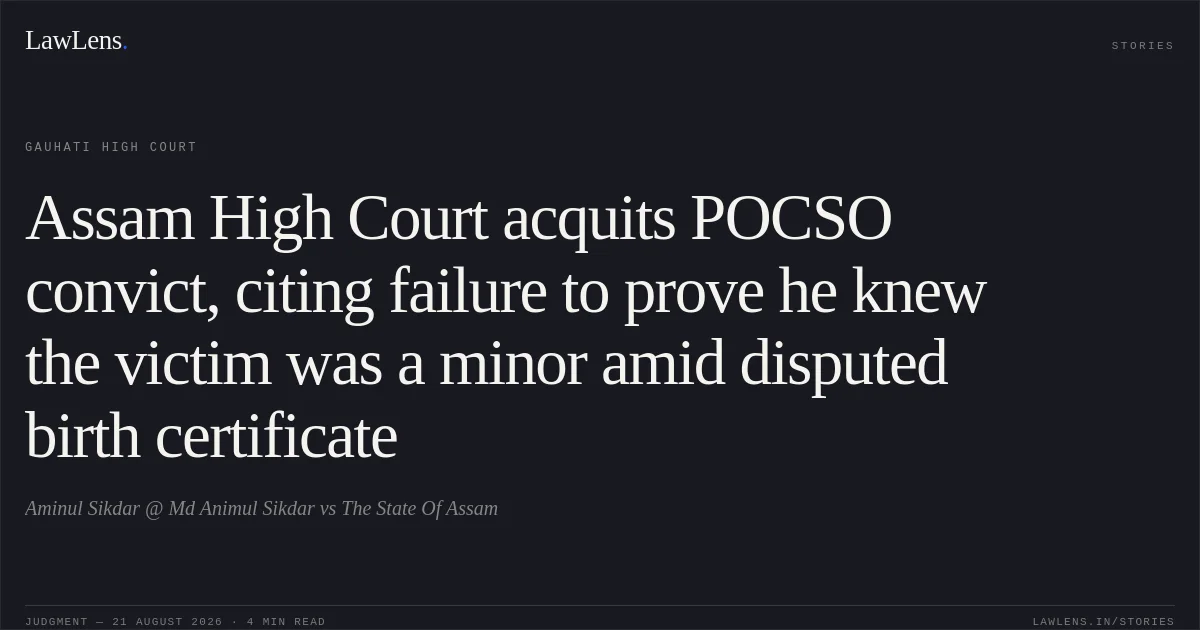
The Gauhati High Court held that the prosecution failed to prove beyond reasonable doubt the essential elements of the offences under Section 366 IPC and Section 6 of the POCSO Act, particularly the appellant’s knowledge that the victim was a minor and the requisite culpable mental state under the POCSO Act.
The appellant was therefore acquitted by giving him the benefit of doubt.
Source reference: para. 42The appeal was allowed, the judgment of conviction and sentence dated 21.12.2021 was set aside, and the appellant was directed to be released immediately from judicial custody. The trial court record was ordered to be returned.
Source reference: paras. 43–45Acts & Sections Cited
13 provisions across 3 statutes referred to in this judgment. Each provision opens on LawLens.
Indian Penal Code, 18603
Protection of Children from Sexual Offences Act, 20128
Code of Criminal Procedure, 19732
Original Court PDF
Aminul Sikdar @ Md Animul SikdarvsThe State Of Assam
Click to open original judgment
Original judgment, available to read, download and summarize on LawLens.in