Facts
On 15 February 2026, at approximately 9:00 p.m., a confrontation occurred near Village Hanspur after villagers intercepted a bauxite-loaded truck allegedly involved in illegal mining.
Source reference: para. 2The prosecution alleged that appellant Karun Dahariya, then posted as Sub-Divisional Magistrate, Kusmi, along with appellants Sudeep Yadav and Manjeet Yadav, assaulted villagers during the ensuing scuffle. Ramnaresh sustained injuries and later died during treatment due to excessive internal haemorrhage.
Source reference: para. 2An FIR was initially registered for offences under Sections 103(1), 115(2) and 3(5) of the Bharatiya Nyaya Sanhita, 2023, and further offences under Sections 109(1), 115, 296 and 238 of the BNS and Sections 3(1)(R), 3(1)(S) and 3(2)(v) of the SC/ST (Prevention of Atrocities) Act were added during investigation.
Source reference: para. 2The appellants were arrested on 16 February 2026. The investigation was completed, the charge-sheet was filed, and some prosecution witnesses had been examined.
Source reference: paras. 1–2Their regular bail applications under Section 483 of the Bharatiya Nagarik Suraksha Sanhita, 2023 were rejected by the Special Judge, SC/ST Act, Balrampur-Ramanujganj. The appellants consequently preferred appeals under Section 14-A(2) of the SC/ST (Prevention of Atrocities) Act.
Source reference: paras. 1–2Issues
1. Whether the appellants were entitled to regular bail under Section 483 of the BNSS in view of the allegations of assault resulting in death and the offences under the SC/ST (Prevention of Atrocities) Act?
Source reference: paras. 1, 7–102. Whether the Court could rely, at the bail stage, on defence-supported testimony and an inquiry report allegedly favouring the appellants to negate the prima facie prosecution case?
Source reference: paras. 3, 7–9Law Applied
The Court applied Section 14-A(2) of the Scheduled Castes and Scheduled Tribes (Prevention of Atrocities) Act, 1989, which provides for an appeal against an order granting or refusing bail by a Special Court or Exclusive Special Court.
Source reference: paras. 1–2It considered the appellants’ bail applications under Section 483 of the Bharatiya Nagarik Suraksha Sanhita, 2023.
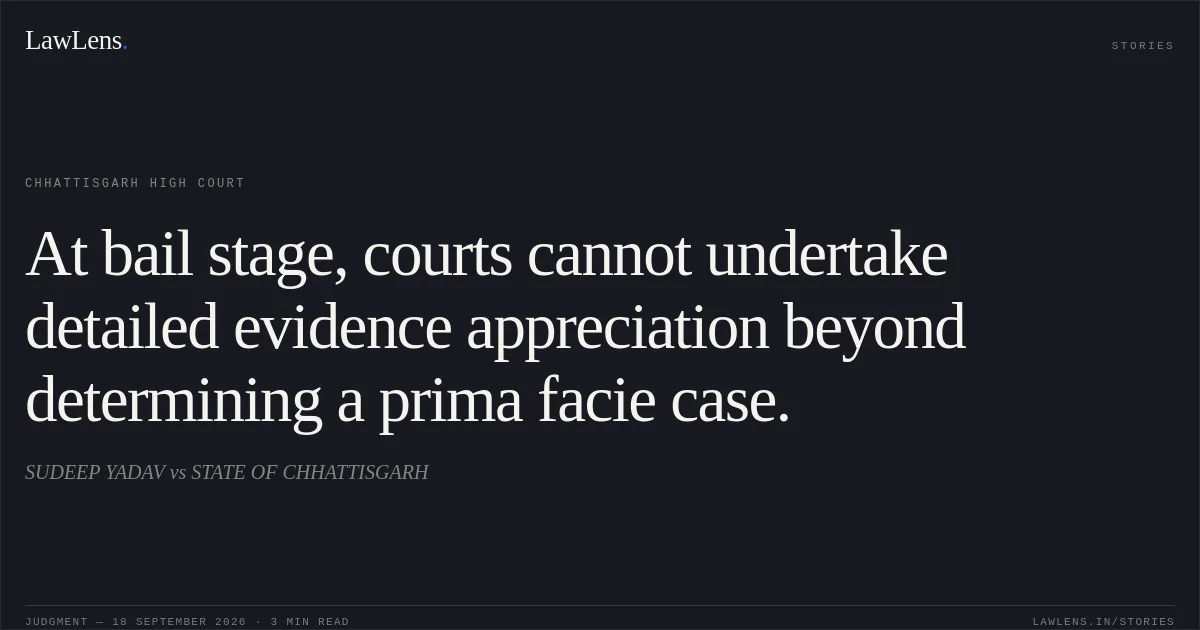
Source reference: paras. 1–2The Court proceeded on the settled principle that, at the stage of bail, the Court is primarily required to ascertain whether a prima facie case exists and should not undertake a detailed assessment of the reliability, credibility or probative value of prosecution and defence evidence, as those matters fall within the domain of the trial court.
Source reference: paras. 7–8The Court also considered the offences alleged under Sections 103(1), 109(1), 115(2), 115, 238, 296 and 3(5) of the BNS and Sections 3(1)(R), 3(1)(S) and 3(2)(v) of the SC/ST (Prevention of Atrocities) Act.
Source reference: paras. 1–2Reasoning
The Court found that statements recorded during investigation from injured witnesses, police personnel and other witnesses specifically alleged that the appellants assaulted Ramnaresh with their hands and fists.
Source reference: para. 7The FIR, lodged by a police official, also contained specific allegations of verbal abuse and physical assault against the villagers, including the deceased, thereby disclosing a prima facie case.
Source reference: para. 8Although some witnesses examined before the trial court supported the defence, the Court held that their evidence could not be weighed conclusively at the bail stage because questions of credibility and evidentiary reliability must be determined at trial.
Source reference: para. 7Similarly, the District Collector’s inquiry report, which allegedly favoured the appellants, was not part of the charge-sheet and its evidentiary relevance could not be adjudicated in the bail proceedings.
Source reference: para. 9The seriousness of the allegations, the resulting death, and the existence of prima facie material therefore outweighed the appellants’ arguments concerning the defence evidence, absence of recovery and the likely delay in conclusion of trial.
Source reference: paras. 3, 7–10Holding
The Court answered the bail issue against the appellants and held that the case was not fit for grant of regular bail at that stage.
It dismissed Criminal Appeals Nos. 1381, 1712 and 1555 of 2026, thereby affirming the orders of the Special Judge rejecting the appellants’ bail applications.
Source reference: para. 10The trial court was, however, directed to proceed with and conclude the trial expeditiously.
Source reference: para. 11Acts & Sections Cited
9 provisions across 3 statutes referred to in this judgment. Each provision opens on LawLens.
Scheduled Castes and the Scheduled Tribes (Prevention of Atrocities) Act, 19891
Bharatiya Nyaya Sanhita, 20236
Bharatiya Nagarik Suraksha Sanhita, 20232
Original Court PDF
SUDEEP YADAVvsSTATE OF CHHATTISGARH
Click to open original judgment
Original judgment, available to read, download and summarize on LawLens.in