Facts
The revisionist, a Deputy Commissioner in the Commercial Tax/GST Department, was competent to process refund claims of an assessee. The complainant, an accountant of Ardem Data Services Pvt. Ltd., alleged that the revisionist demanded ₹2,00,000 for clearing refund claims aggregating approximately ₹19,47,787.
Source reference: paras. 3–5A vigilance inquiry was conducted, after which a trap team was constituted. On 19 March 2024, the complainant handed over phenolphthalein-treated currency notes to the revisionist in his office. The revisionist was allegedly apprehended while placing the marked currency in a drawer; the currency notes were recovered and chemical examination supported the trap proceedings.
Source reference: paras. 3–5After investigation, a charge-sheet was filed under Section 7 of the Prevention of Corruption Act, 1988. The Special Judge rejected the revisionist’s discharge application under Section 227 Cr.P.C. on 6 February 2026 and framed a charge under Section 7 of the Act on 13 February 2026.
Source reference: para. 2The revisionist challenged both orders, contending that there was no reliable evidence of demand, that the refund claims had already been rejected or were not pending, and that the independent witnesses had not heard the alleged conversation.
Source reference: paras. 6–7Issues
Whether the material collected during investigation disclosed a prima facie case under Section 7 of the Prevention of Corruption Act, 1988, including the requisite elements of demand and acceptance or attempted obtaining of undue advantage?
Source reference: paras. 14–18Whether the Special Judge erred in refusing discharge under Section 227 Cr.P.C. and in framing a charge when the defence disputed the pendency of the refund claims, the timing of the alleged demand, and the credibility of the trap evidence?
Source reference: paras. 10–13, 19–21Whether the High Court, in revision, could undertake a detailed evaluation of the prosecution evidence to determine the likelihood of conviction at the stage of discharge or framing of charge?
Source reference: paras. 19–21Law Applied
The Court applied Section 227 Cr.P.C., under which an accused may be discharged where, upon consideration of the prosecution record and hearing the parties, there is no sufficient ground for proceeding against him.
Source reference: para. 10It applied Section 7 of the Prevention of Corruption Act, 1988, as amended in 2018, which criminalises a public servant’s obtaining, accepting, or attempting to obtain an undue advantage with the requisite improper or dishonest intent; the obtaining or acceptance itself may constitute the offence even if the public duty is not ultimately performed improperly.
Source reference: para. 14Relying on V. Kannan v. State, (2009) 9 SCC 87, the Court recognised that demand and acceptance of illegal gratification are ordinarily essential elements.
Source reference: para. 15It also referred to A. Subair v. State of Kerala, (2009) 6 SCC 587 regarding acceptance of gratification as a motive or reward for an official act.
Source reference: para. 17The Constitution Bench decision in Neeraj Dutta v. State (Government of NCT of Delhi), (2023) 4 SCC 731, permits an inferential finding of culpability from other prosecution evidence where direct evidence of the complainant is unavailable.
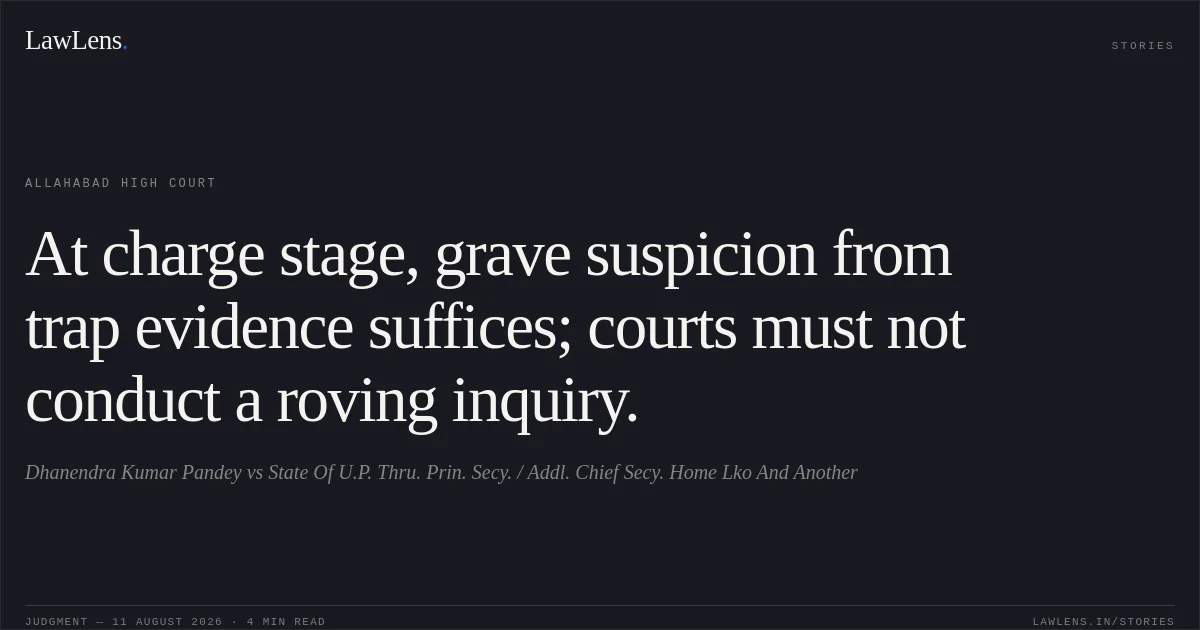
Source reference: para. 18Under Amit Kapoor v. Ramesh Chander, (2012) 9 SCC 460, at the stage of framing charge the court need not conduct a meticulous evaluation of evidence; a strong or grave suspicion sufficient to proceed is adequate, and the court must not determine whether the case will ultimately result in conviction.
Source reference: paras. 20–21Reasoning
The Court held that the prosecution material, viewed at the prima facie stage, disclosed both the revisionist’s status as a public servant and evidence connecting him with the demand and acceptance of ₹2,00,000. The trap proceedings, recovery of the marked currency from the revisionist’s drawer, and the chemical test constituted material capable of raising a strong suspicion of the offence under Section 7.
Source reference: para. 16The fact that the independent witnesses did not hear the private conversation between the complainant and the revisionist was not decisive because they had participated in the pre-trap proceedings and witnessed the revisionist being apprehended while placing the bribe money in the drawer.
Source reference: para. 13The Court further rejected the revisionist’s attempt to rely on disputed matters concerning the rejection or pendency of the refund claims, observing that the prosecution case was that a deficiency memo had been issued and that the complainant could submit a fresh claim; therefore, the alleged demand could not be treated as inherently impossible at the threshold.
Source reference: para. 9The Court declined to conduct a roving inquiry into the timing of the demand, the twelve-day interval before the trap, the witness statements, or the alleged absence of mens rea, as these matters concerned appreciation and reliability of evidence for trial rather than discharge.
Source reference: paras. 19–21Holding
The High Court answered the issues against the revisionist. It held that the prosecution material raised a strong suspicion and disclosed sufficient grounds to proceed under Section 7 of the Prevention of Corruption Act, 1988.
The Special Judge committed no illegality, irregularity, or perversity in rejecting the discharge application and framing the charge.
Source reference: para. 12The criminal revision was accordingly dismissed, and the orders dated 6 February 2026 and 13 February 2026 were upheld.
Source reference: paras. 22–23Acts & Sections Cited
8 provisions across 2 statutes referred to in this judgment. Each provision opens on LawLens.
Prevention of Corruption Act, 19882
Code of Criminal Procedure, 19736
Original Court PDF
Dhanendra Kumar PandeyvsState Of U.P. Thru. Prin. Secy. / Addl. Chief Secy. Home Lko And Another
Click to open original judgment
Original judgment, available to read, download and summarize on LawLens.in