Facts
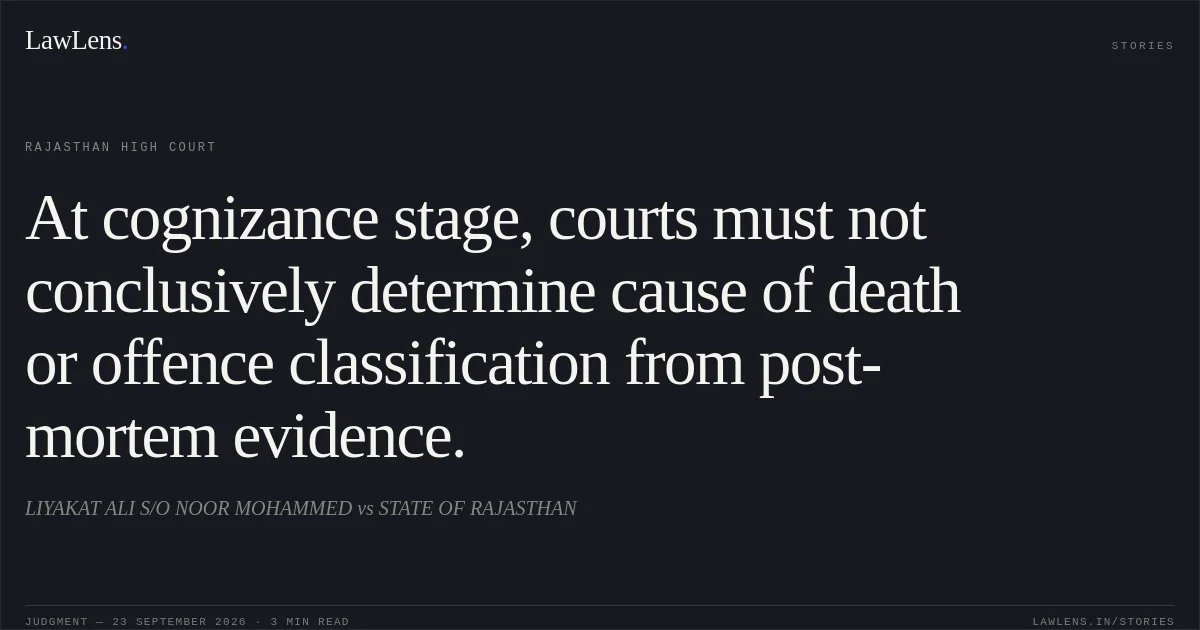
An incident allegedly occurred on 20 September 2022, during which Vijay Singh was assaulted and sustained injuries. He died on 28 September 2022. The complainant lodged an FIR alleging offences by Liyakat Ali, Mohd. Vashim, Sahil Khan, Ashif and Sanjay Singh; a cross-case was also registered by the accused side.
Source reference: paras. 11–13The police conducted an investigation and submitted a negative final report, principally on the basis that the post-mortem report attributed the death to cardiac arrest occurring four to five days before death.
Source reference: paras. 5, 11The complainant filed a protest petition. On 7 February 2024, the Chief Judicial Magistrate rejected the final report and took cognizance against the accused under Sections 147, 148, 149, 458 and 304 Part II IPC. While doing so, the Magistrate observed that the injuries were not on vital parts and were not sufficient in the ordinary course of nature to cause death.
Source reference: paras. 4, 12, 17The accused and the complainant separately filed revision petitions. The Additional Sessions Judge No. 2, Jhunjhunu rejected both revisions and affirmed the Magistrate’s order on 11 September 2024. Both sides thereafter approached the High Court under Section 482 CrPC.
Source reference: paras. 3–5, 7Issues
Whether the Magistrate, while taking cognizance, could assess the medical evidence and conclusively determine whether the injuries caused the deceased’s death or whether the case attracted culpable homicide under Section 304 Part II IPC?
Source reference: paras. 12–19Whether the orders dated 7 February 2024 and 11 September 2024 were liable to be quashed on the ground that the Magistrate had prematurely appreciated the evidence and conducted a mini-trial at the cognizance stage?
Source reference: paras. 14, 18–20Whether the post-mortem opinion that the cause of death was cardiac arrest conclusively negatived the nexus between the alleged assault and the death at the preliminary stage?
Source reference: paras. 13–16Law Applied
The Court considered Sections 147, 148, 149, 458 and 304 Part II IPC, along with the definitions of culpable homicide and murder under Sections 299 and 300 IPC.
Source reference: paras. 4, 12, 17, 19The governing principle is that, at the stage of taking cognizance, the court is required to determine only whether a prima facie case exists and must not undertake meticulous appreciation of evidence or conduct a mini-trial.
Source reference: paras. 14, 18Relying on Ghulam Hassan Beigh v. Mohammad Maqbool Magrey, (2022) 12 SCC 657, the Court held that a post-mortem report is not substantive evidence by itself; the nexus between the alleged assault and the cause of death must ordinarily be examined through the testimony of eyewitnesses and the medical officer during trial.
Source reference: para. 16The question whether the offence is murder, culpable homicide, or a lesser offence must be determined after evaluation of the complete oral and documentary evidence, not merely from the post-mortem report at the preliminary stage.
Source reference: para. 16Reasoning
The High Court found prima facie material showing that Vijay Singh had been assaulted and had suffered multiple injuries.
Source reference: para. 14Although the post-mortem report referred to cardiac arrest and the police had submitted a negative final report, the medical opinion alone could not conclusively establish, at the cognizance stage, that the death had no connection with the alleged assault.
Source reference: paras. 11, 13–16The Magistrate therefore exceeded the permissible scope of preliminary examination by assessing whether the injuries were sufficient to cause death, whether they affected vital parts, and whether the accused possessed the requisite intention for culpable homicide.
Source reference: paras. 12, 17–19Those questions required evidence from eyewitnesses and the medical expert, followed by a full trial. The Magistrate’s reasoning consequently amounted to premature appreciation of evidence and was inconsistent with the rule against conducting a mini-trial at the cognizance stage.
Source reference: paras. 14, 16, 18–19Holding
The High Court allowed the challenge to the orders dated 7 February 2024 and 11 September 2024 by quashing and setting aside both orders.
The matter was remitted to the Chief Judicial Magistrate, Jhunjhunu, for passing a fresh order in accordance with law.
Source reference: para. 20Both connected criminal miscellaneous petitions—filed by the accused and the complainant—were disposed of accordingly.
Source reference: para. 21The Court clarified that it had expressed no opinion on the merits or on the ultimate nature of the offence, which must be decided by the trial court on the basis of evidence led by the parties.
Source reference: para. 23Acts & Sections Cited
9 provisions across 2 statutes referred to in this judgment. Each provision opens on LawLens.
Code of Criminal Procedure, 19731
Indian Penal Code, 18608
Original Court PDF
LIYAKAT ALI S/O NOOR MOHAMMEDvsSTATE OF RAJASTHAN
Click to open original judgment
Original judgment, available to read, download and summarize on LawLens.in