01Facts
The petitioner, Triveni Pattern Glass Ltd., filed a petition under Section 11(6) of the Arbitration and Conciliation Act, 1996, seeking appointment of a sole arbitrator under Article 24 of the Business Transfer Agreement dated 29 March 2019, read with Clause 15 of the Tripartite Assignment Agreement dated 8 May 2019.
p. 1The agreements provided for reference of unresolved disputes to a sole arbitrator, with New Delhi as the seat/place of arbitration.
p. 2The petitioner asserted claims amounting to Rs. 4,36,03,064/-.
p. 3Respondent No. 2 objected that he was not a party to either agreement and was therefore not a necessary party.
p. 2The parties were agreed regarding reference of disputes to arbitration insofar as Respondents Nos. 1 and 3 were concerned.
p. 302Issues
i.Whether the petition disclosed the prima facie existence of a valid arbitration agreement between the petitioner and Respondents Nos. 1 and 3 so as to warrant appointment of a sole arbitrator under Section 11(6) of the Act?
pp. 2–3ii.Whether Respondent No. 2, who claimed not to be a party to the relevant agreements, was required to be treated as a necessary party to the Section 11 proceedings?
p. 2, 403Law Applied
The Court applied Section 11(6) of the Arbitration and Conciliation Act, 1996, under which the Court may appoint an arbitrator where the agreed appointment procedure has failed.
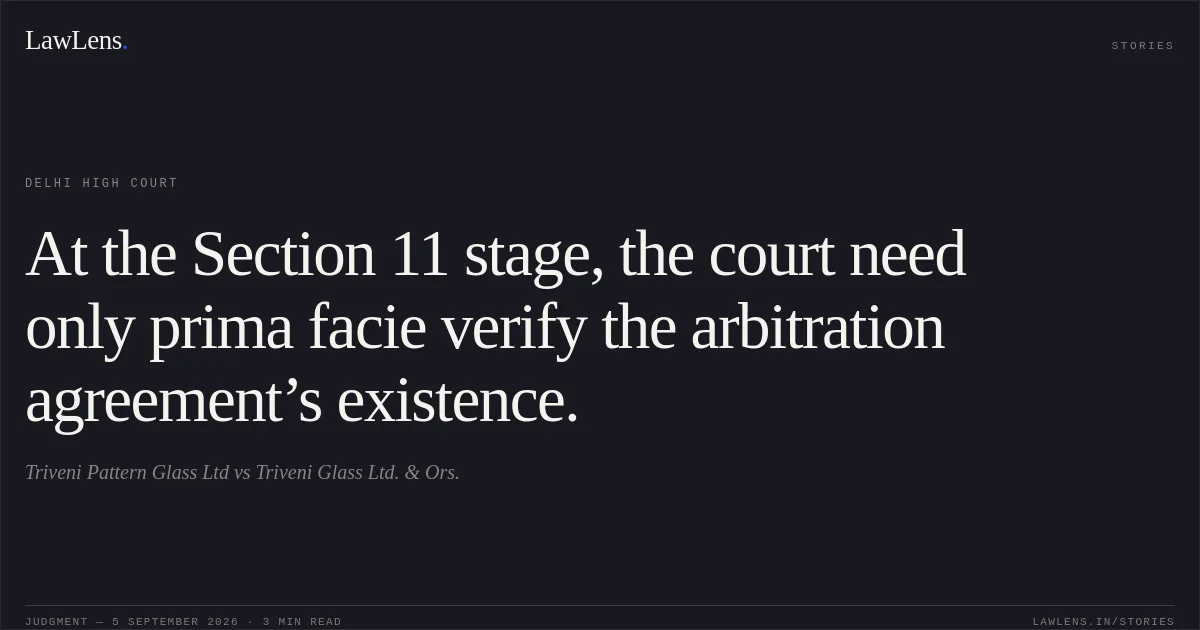
It reiterated that, at the Section 11 stage, the scope of judicial enquiry is confined to examining the prima facie existence of an arbitration agreement.
p. 2Article 24 of the Business Transfer Agreement and Clause 15 of the Tripartite Assignment Agreement required unresolved disputes arising under the agreements to be referred to arbitration before a sole arbitrator, with New Delhi as the seat/place of arbitration.
p. 2The Court also directed compliance with the disclosure requirement under Section 12(2) of the Act and preserved the parties’ right to raise objections concerning arbitrability and jurisdiction before the arbitral tribunal.
p. 3Provisions in the judgment · 2 · Linked ones open on LawLens
Arbitration and Conciliation Act, 1996 Section 11Section 12
04Reasoning
The Court found no dispute regarding the existence of the arbitration agreement between the petitioner and Respondents Nos. 1 and 3, and noted that the parties were ad idem on referring their disputes to arbitration.
p. 3Applying the limited prima facie review applicable under Section 11, the Court held that there was no impediment to appointing a sole arbitrator pursuant to the contractual arbitration clauses.
pp. 2–3The objection of Respondent No. 2 was not finally adjudicated at this stage; instead, the Court permitted the petitioner to seek his impleadment before the appointed arbitrator.
p. 4All questions concerning arbitrability, jurisdiction, and the merits were left open for determination by the arbitral tribunal.
p. 305Holding
The petition was disposed of by appointing Mr. K. Parameshwar, Senior Advocate, as the sole arbitrator to adjudicate the disputes between the petitioner and the concerned respondents.
p. 3The arbitrator was directed to enter upon the reference within two weeks and furnish the disclosures required under Section 12(2) of the Act.
p. 3The arbitration was directed to be conducted under the rules and aegis of the Delhi International Arbitration Centre, with fees payable according to the DIAC schedule.
p. 3The parties were permitted to raise all objections, including those relating to arbitrability and jurisdiction, before the arbitrator, and the petitioner was given liberty to move an impleadment application concerning Respondent No. 2 before the arbitral tribunal.
pp. 3–4Original Court PDF
Triveni Pattern Glass LtdvsTriveni Glass Ltd. & Ors.
Click to open original judgment
Original judgment, available to read, download and summarize on LawLens.in