Facts
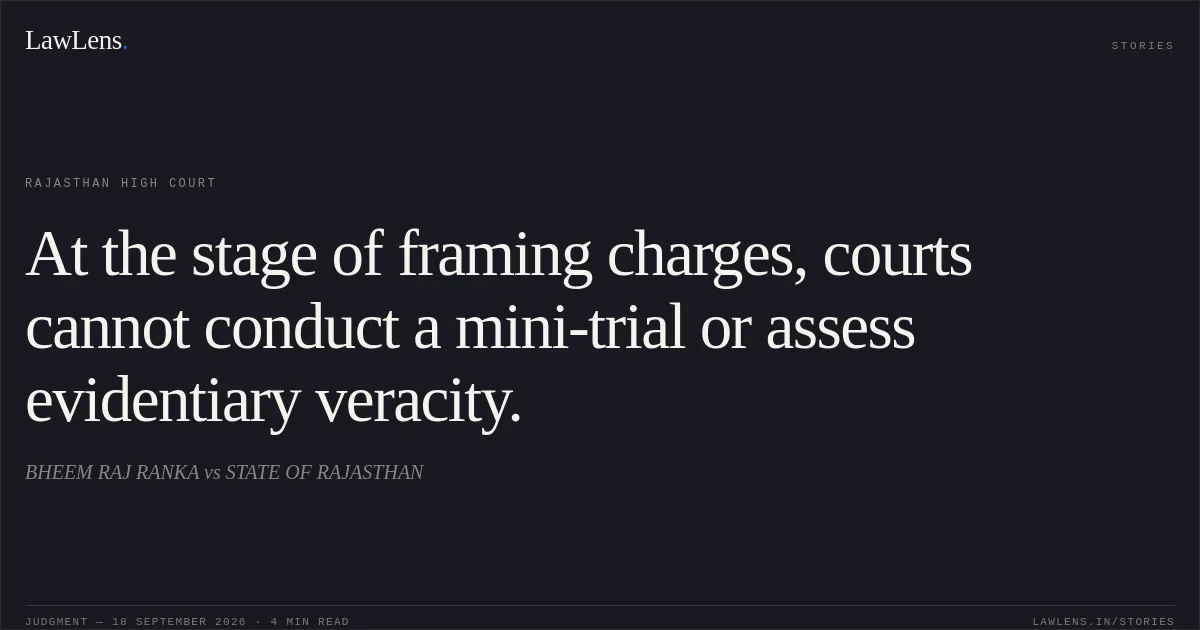
The petitioners, Ramesh Chandra and Bheem Raj Ranka, challenged the order dated 05.08.2025 passed by the Special Judge, Prevention of Corruption Act Cases, Rajsamand, directing framing of charges against them and other accused under Sections 13(1)(d) and 13(2) of the Prevention of Corruption Act, 1988, and Sections 420, 467, 468, 471 and 120-B of the IPC.
Source reference: para. 1The Anti-Corruption Bureau had investigated allegations of embezzlement and corruption in the implementation of Integrated Rural Development Schemes, including the preparation of forged vouchers and withdrawal of Government funds through various cooperative societies.
Source reference: para. 7The petitioners were Members of the Panchayat Samiti during the relevant period, when the schemes were operational.
Source reference: para. 7Following a preliminary enquiry, FIR No. 331/2006 was registered, investigation was conducted, and a charge-sheet was filed against the petitioners and others.
Source reference: para. 8The petitioners contended that the allegations were general and omnibus, that no specific role or act of forgery or embezzlement was attributed to them, and that the trial court had framed charges without proper application of mind.
Source reference: paras. 2–4The prosecution opposed the revisions, submitting that the truthfulness and evidentiary value of the allegations could not be assessed at the stage of charge.
Source reference: para. 5Issues
Whether the material collected during investigation disclosed a prima facie or grave suspicion sufficient to frame charges against the petitioners under the Prevention of Corruption Act and the IPC, including through Section 120-B of the IPC?
Source reference: paras. 10–15, 17–19Whether the trial court exceeded its jurisdiction or acted perversely in refusing to discharge the petitioners under Section 227 of the Cr.P.C. and in directing framing of charges?
Source reference: paras. 9, 16–19Whether the High Court, in revision under Sections 397 and 401 of the Cr.P.C., could reassess the veracity and probative value of the prosecution material at the stage of framing of charge?
Source reference: paras. 16–19Law Applied
At the stage of framing of charge or considering discharge, the court must determine whether the prosecution material, taken at face value, gives rise to a strong or grave suspicion that the accused committed the alleged offence; it is not required to determine whether the evidence will ultimately result in conviction.
Source reference: para. 10, relying on State of Bihar v. Ramesh Singh, (1977) 4 SCC 39; Union of India v. Prafulla Kumar Samal, (1979) 3 SCC 4; and P. Vijayan v. State of Kerala, (2010) 2 SCC 398In proceedings under the Prevention of Corruption Act, the court must assume the prosecution material to be true for the limited purpose of examining whether the ingredients of the alleged offences are disclosed, without conducting a mini-trial or assessing the ultimate reliability of the evidence.
Source reference: para. 11, relying on State by Karnataka Lokayukta Police Station v. M.R. Hiremath, (2019) 7 SCC 515Neither a roving enquiry nor consideration of the defence on merits is permissible at this stage.
Source reference: paras. 12–15, relying on State of Rajasthan v. Ashok Kumar Kashyap, (2021) 11 SCC 191; Sajjan Kumar v. CBI, (2010) 9 SCC 368; and other cited authoritiesSections 227 and 239 of the Cr.P.C. permit discharge where the ingredients of the alleged offences are not disclosed, but the court cannot evaluate the truthfulness or evidentiary weight of witness statements at that stage.
Source reference: para. 18The revisional jurisdiction under Sections 397 and 401 of the Cr.P.C. is limited to correcting patent illegality, jurisdictional error, material irregularity or perversity, and cannot be used to conduct a reassessment of the prosecution case on merits.
Source reference: para. 16Reasoning
The High Court found that the ACB had investigated the alleged scheme-related transactions, collected material concerning forged vouchers and diversion of Government funds, recorded witness statements, and specified the roles and involvement of persons connected with the transactions.
Source reference: paras. 7, 17Since the petitioners were Members of the Panchayat Samiti during the operation of the schemes, and their alleged involvement was linked to the material collected during investigation, the Court held that the prosecution case raised sufficient grounds for proceeding against them, particularly in view of the allegation of conspiracy under Section 120-B of the IPC.
Source reference: para. 19The petitioners’ assertions that they had no direct role, that the amounts were small or not credited to them, and that no direct forgery was attributed to them were matters of defence and evidentiary assessment, which could not be determined at the charge stage.
Source reference: paras. 2–4, 18The trial court was required only to apply its mind to the prosecution material and determine whether the ingredients of the alleged offences were prima facie disclosed; it was not required to decide whether the material would ultimately sustain a conviction.
Source reference: paras. 11–15, 18As no perversity, illegality or jurisdictional error was demonstrated, the revisional court declined to interfere.
Source reference: para. 19Holding
The High Court held that the material collected by the ACB disclosed the petitioners’ alleged involvement sufficient to justify framing of charges and that the trial court had not committed any illegality or perversity in passing the impugned order.
The Court therefore dismissed both criminal revision petitions challenging the order dated 05.08.2025 and permitted the criminal trial to proceed; any pending applications were also disposed of.
Source reference: paras. 20–21Acts & Sections Cited
10 provisions across 3 statutes referred to in this judgment. Each provision opens on LawLens.
Prevention of Corruption Act, 19881
Indian Penal Code, 18604
Code of Criminal Procedure, 19735
Original Court PDF
BHEEM RAJ RANKAvsSTATE OF RAJASTHAN
Click to open original judgment
Original judgment, available to read, download and summarize on LawLens.in