Facts
On 15 December 2016, Ravi Parcha, the deceased, possessed a valid journey ticket from Shivaji Bridge to Ghaziabad and was therefore accepted as a bona fide passenger by the Railway Claims Tribunal (“Tribunal”).
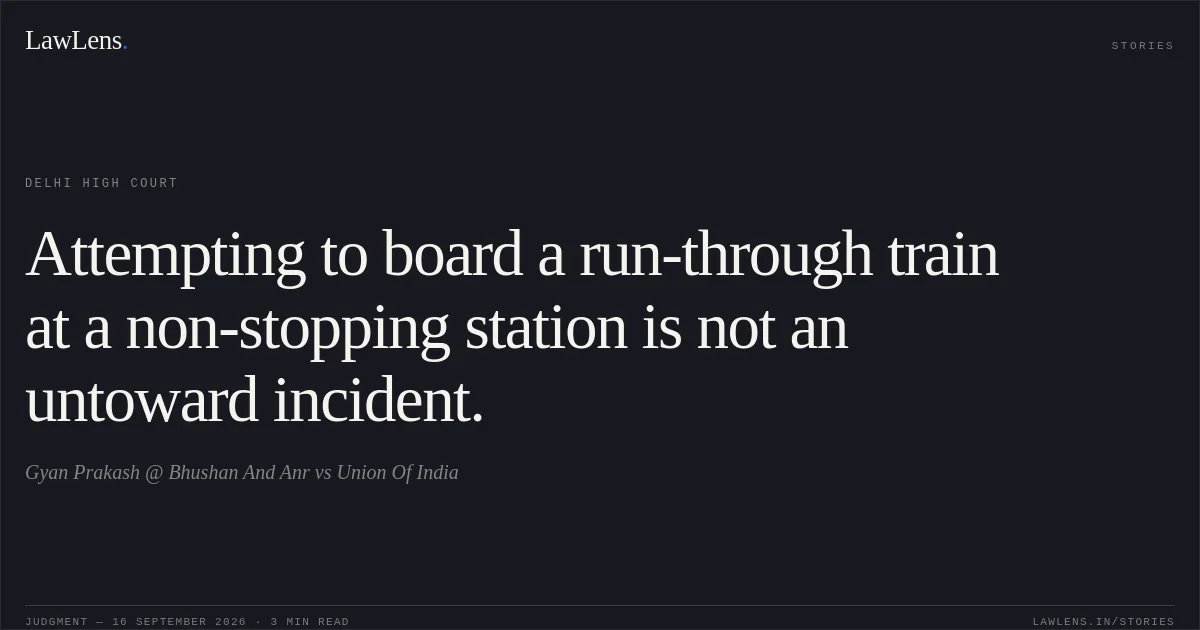
Source reference: p.2; p.3At Tilak Bridge, he attempted to board Train No. 14681, a run-through train that was not scheduled to stop at that station. His hand slipped while boarding, causing him to fall between the train and the platform; he sustained grievous injuries and later died.
Source reference: p.2; p.3The Tribunal dismissed the claim in OA/II/2017/0293 by judgment dated 15 December 2020, holding that the occurrence was not an “untoward incident.” The deceased’s claimants challenged that decision under Section 23 of the Railway Claims Tribunal Act, 1987.
Source reference: p.1Issues
Whether the deceased’s fall while attempting to board a run-through train that had no scheduled stoppage at Tilak Bridge constituted an “untoward incident” under Section 123(c)(2) of the Railways Act, 1989.
Source reference: p.3–4Whether the deceased’s status as a bona fide passenger entitled the appellants to statutory compensation notwithstanding the circumstances in which he attempted to board the train.
Source reference: p.2–3Law Applied
The Court applied Section 23 of the Railway Claims Tribunal Act, 1987, governing appeals from orders of the Tribunal.
Source reference: p.1Under Section 123(c)(2) of the Railways Act, 1989, an accidental fall from a train may constitute an “untoward incident” attracting the statutory compensation regime; however, the occurrence must fall within the statutory concept of an accidental fall during the course of a normal railway journey.
Source reference: p.3–4The Court also considered the exclusion relating to self-inflicted injury under Section 124-A of the Railways Act, 1989, although its ultimate decision rested on the finding that the incident was not an “untoward incident”.
Source reference: p.2–3The Court relied on Naresh Kumar v. Union of India, 2026 SCC OnLine Del 6415, which held that an injury sustained while attempting to board a run-through train at a station where it had no scheduled stoppage was not covered as an “untoward incident”.
Source reference: p.3Reasoning
The Court accepted that the deceased was a bona fide passenger because the journey ticket was on record and its authenticity had been admitted in the Railway’s DRM report.
Source reference: p.3However, that status did not make every consequence of his conduct compensable. The undisputed evidence showed that he attempted to board a moving run-through train that was not scheduled to halt at Tilak Bridge, rather than falling while boarding a train that had stopped there.
Source reference: p.3Applying the principle in Naresh Kumar, the Court held that the fatal fall occurred in the course of a conscious attempt to board a train at a place where it was not scheduled to stop.
Source reference: p.3–4It was therefore not an accidental fall during a normal journey within Section 123(c)(2), and the deceased’s bona fide passenger status was insufficient to alter that conclusion.
Source reference: p.3–4Holding
The Court answered the issues against the appellants and held that the deceased’s fall while attempting to board the run-through train did not constitute an “untoward incident” under Section 123(c)(2) of the Railways Act, 1989.
Finding no error in the Tribunal’s decision, the Court dismissed the appeal and declined to grant compensation or any other relief.
Source reference: p.4Acts & Sections Cited
2 provisions across 2 statutes referred to in this judgment. Each provision opens on LawLens.
Railway Claims Tribunal Act, 19871
Railways Act, 19891
Original Court PDF
Gyan Prakash @ Bhushan And AnrvsUnion Of India
Click to open original judgment
Original judgment, available to read, download and summarize on LawLens.in