Facts
Piramal Finance extended term-loan and rolling-credit facilities to GSTAAD Hotels Pvt. Ltd. and Neo Capricorn Plaza Pvt. Ltd.
Source reference: no citationThe lenders later assigned the facilities, including ECLGS loans, to Omkara.
Source reference: no citationNeSL registered four Form-D default filings, which were not challenged.
Source reference: no citationOmkara recalled the facilities and filed applications under Section 7 of the Insolvency and Bankruptcy Code, 2016 (IBC). The NCLT admitted the applications; the NCLAT initially remanded them for fresh consideration of matters including the cash-management arrangement (CMA), debt-service reserve account (DSRA), and ECLGS proceeds. On reconsideration, the NCLT again admitted the applications, and the NCLAT affirmed. The borrowers appealed under Section 62 of the IBC, challenging, among other matters, the finding of default and the treatment of the CMA and DSRA.
Source reference: paras. 1–2, 7–15, 22–25Issues
Whether the evidence required to establish “default” under Sections 3(12) and 7 of the IBC requires proof of the precise outstanding amount, or only a summary determination that a debt became due and remained unpaid
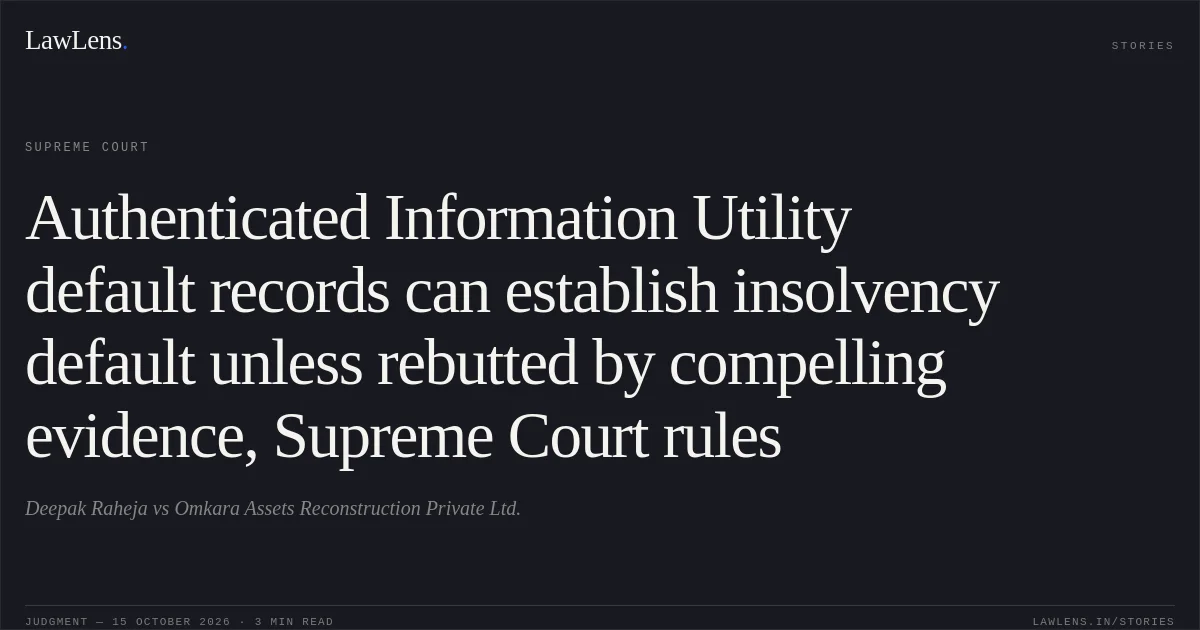
Source reference: paras. 34, 40–47Whether, and on what evidentiary basis, an Adjudicating Authority may find default under Section 7, including the weight to be given to an Information Utility record and other documentary material
Source reference: paras. 34, 48–58Whether the assignment challenge and the borrowers’ objections concerning the CMA, DSRA, quantum, and profitability disclosed a question of law warranting interference under Section 62
Source reference: paras. 27, 30–33, 59–66Law Applied
Under Sections 3(12) and 7 of the IBC, default occurs when any part or instalment of a debt has become due and payable and remains unpaid; at admission, the Adjudicating Authority makes a summary determination on a preponderance of probabilities and need not conclusively reconcile the entire account or quantify the creditor’s final claim
Source reference: paras. 40–47Section 7(3)(a) and (4) establish an evidentiary hierarchy: an authenticated Information Utility record has high evidentiary value and may prima facie establish default unless displaced by clear, cogent, credible and compelling material; other documents identified in Part V of Form 1 may establish default when assessed collectively
Source reference: paras. 49–58Section 5(7) includes a legally assigned financial debt. Under Section 62, the Supreme Court considers questions of law, not a fresh appraisal of concurrent factual findings, absent perversity, material evidentiary error, or an erroneous legal standard
Source reference: paras. 27, 30–32The Court also applied issue estoppel to the concluded challenge to the assignment and relied on *Innoventive Industries Ltd. v. ICICI Bank* on the summary Section 7 inquiry, and *Swiss Ribbons Pvt. Ltd. v. Union of India*, *Maitreya Doshi v. Anand Rathi Global Finance Ltd.*, *Devas Multimedia (P) Ltd. v. Antrix Corpn. Ltd.*, and *Kalyani Transco v. Bhushan Power & Steel Ltd.* on the statutory scheme and limits of appellate interference
Source reference: paras. 28, 31, 39Reasoning
The assignment’s validity had been upheld in proceedings brought by the borrowers and was not open to collateral reconsideration; Omkara therefore qualified as a financial creditor
Source reference: paras. 30–32The NeSL filings were unchallenged and supported the occurrence of default, while the amount exceeding the Section 4 threshold was supported by the statements of account, review reports, recall notice, and the borrowers’ contemporaneous settlement correspondence. The review reports questioned the interest rate, not the underlying computation of default
Source reference: paras. 59–62The borrowers’ case was principally that the default had been cured through the CMA and DSRA, rather than that no default had occurred; both tribunals considered those arrangements and found an unpaid shortfall. Their dispute over precise quantification did not defeat admission, and the borrowers’ own correspondence and the recorded DSCR further undermined their position
Source reference: paras. 61–66As the concurrent findings disclosed no error of law warranting intervention under Section 62, the appeals could not succeed
Source reference: paras. 27–29, 71Holding
The Court held that Section 7 requires a summary, documentary-based determination of the occurrence of default, not a final reconciliation of the debt’s precise quantum.
An unchallenged authenticated Information Utility record carries substantial evidentiary weight, while other relevant documents may be assessed collectively.
Source reference: paras. 55–58Finding default above the statutory threshold and no basis for interference under Section 62, the Court dismissed both appeals, upheld the NCLT and NCLAT orders, and directed that the CIRPs proceed in accordance with law.
Source reference: paras. 71–73Acts & Sections Cited
13 provisions across 2 statutes referred to in this judgment. Each provision opens on LawLens.
Insolvency and Bankruptcy Code, 2016.
Bharatiya Sakshya Adhiniyam, 20232
Original Court PDF
Deepak RahejavsOmkara Assets Reconstruction Private Ltd.
Click to open original judgment
Original judgment, available to read, download and summarize on LawLens.in