Facts
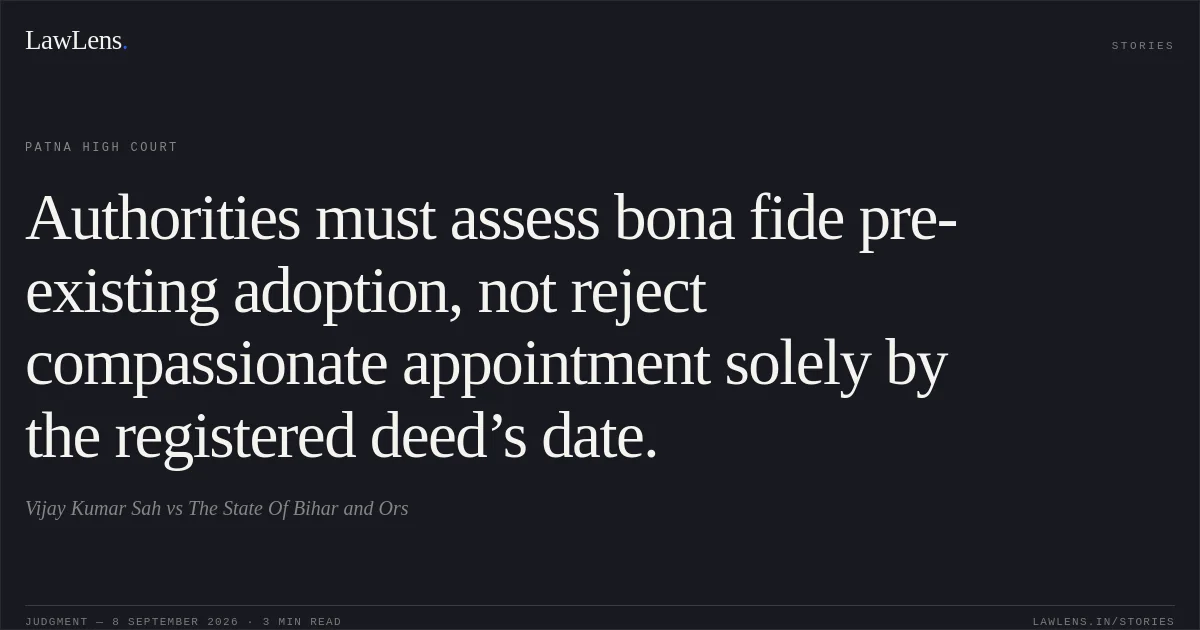
The petitioner claimed to be the adopted son of Late Reshma Devi, an employee of the North Bihar Power Distribution Company Ltd. Reshma Devi, the petitioner’s maternal grandmother, had adopted him through affidavits dated 18 February 1999 and 22 July 1999, followed by a registered adoption deed dated 12 January 2001.
Source reference: paras. 3–8The petitioner was born on 1 March 1985 and was below fifteen years of age when the affidavits were executed. Reshma Devi died in harness on 25 November 2007. The petitioner approached the authorities in January 2010 seeking compassionate appointment and death-cum-retirement benefits.
Source reference: paras. 3–8He obtained a succession certificate in 2013 and a family-members certificate in 2017, after which he submitted a formal application for compassionate appointment on 18 March 2017.
Source reference: paras. 3–8The respondents rejected the application on the grounds that the adoption violated Section 10(iv) of the Hindu Adoptions and Maintenance Act, 1956, the application was beyond the five-year period prescribed by Standing Order No. 756 dated 18 February 1994, and the succession certificate did not confer any right to compassionate appointment.
Source reference: para. 8Issues
Whether the petitioner’s adoption was invalid under Section 10(iv) of the Hindu Adoptions and Maintenance Act, 1956 merely because the registered adoption deed was executed after he had completed fifteen years of age, despite the earlier affidavits and alleged pre-existing relationship of adoption.
Source reference: paras. 24–29Whether the petitioner’s claim was barred by delay under Standing Order No. 756 dated 18 February 1994, when he had initially approached the authorities within five years of the employee’s death but submitted the prescribed form later pursuant to the respondents’ directions.
Source reference: para. 24; para. 30Whether the respondents could reject the claim for compassionate appointment on the ground that the succession certificate authorised receipt of service benefits but did not itself confer entitlement to compassionate appointment, after accepting the same adoption documents for release of those benefits.
Source reference: para. 24; para. 31Law Applied
The Court applied Section 10(iv) of the Hindu Adoptions and Maintenance Act, 1956, which ordinarily prohibits adoption of a person who has completed fifteen years unless a contrary custom or usage applies.
Source reference: para. 25It also relied on the principle that adoption is completed by the factum of giving and taking, and that a subsequently registered adoption deed may evidence an earlier adoption; Section 16 raises a presumption in favour of the validity of a registered adoption deed unless disproved.
Source reference: para. 26Relying on Most. Shitali Devi & Anr. v. Union of India, C.W.J.C. No. 7300 of 2001, the Court held that a bona fide adoption or foster-parent relationship should not be rejected through a rigid or hyper-technical interpretation of compassionate-appointment rules, though fraud or fabrication may be investigated.
Source reference: paras. 12–18, 29The Court further applied the principle that a claimant should not suffer for delay attributable to the authorities and that an administrative authority cannot adopt inconsistent positions regarding the same documents and relationship.
Source reference: para. 30–31Reasoning
The Court held that the respondents had focused mechanically on the date of the registered adoption deed, 12 January 2001, without considering the affidavits of 1999, when the petitioner was below fifteen years of age, or determining whether the adoption relationship was genuine and pre-existing.
Source reference: paras. 27–29Since there was no finding that the affidavits or adoption documents were fabricated, rejection solely on the basis of Section 10(iv) was unsustainable.
Source reference: paras. 27–29The Court also found that the petitioner had approached the authorities in January 2010, within five years of Reshma Devi’s death, and that the subsequent delay resulted from the respondents’ directions to obtain a succession certificate, family-members certificate, and prescribed application form.
Source reference: para. 30Finally, having accepted the succession certificate and adoption documents for releasing the deceased employee’s service benefits, the respondents could not inconsistently disregard the same relationship while considering compassionate appointment.
Source reference: para. 31Holding
The High Court quashed the rejection order dated 22 December 2017 and the consequential order dated 27 March 2018.
It directed the respondents to reconsider the petitioner’s claim for compassionate appointment, treating him as the legally adopted son and dependent of Late Reshma Devi and without insisting upon the technical objections rejected by the Court.
Source reference: para. 34The reconsideration was to be completed through a reasoned and speaking order within three months of receipt or production of the judgment.
Source reference: para. 34The writ petition was allowed to that extent, with no order as to costs.
Source reference: paras. 35–36Acts & Sections Cited
2 provisions across 1 statute referred to in this judgment. Each provision opens on LawLens.
Hindu Adoptions and Maintenance Act, 19562
Original Court PDF
Vijay Kumar SahvsThe State Of Bihar and Ors
Click to open original judgment
Original judgment, available to read, download and summarize on LawLens.in