Facts
The petitioner alleged that respondents 5 and 6 were constructing on land in Survey No. 114/7, measuring 0.02.55 hectares (6.29 cents), at Kidarakulam Village, without the requisite planning permission or approval.
Source reference: p.1–4He had submitted a representation to the competent authorities concerning the alleged construction. The official respondents stated that the representation would be considered in accordance with law, after giving the private parties an opportunity to be heard.
Source reference: p.1–4The petitioner sought a mandamus restraining respondents 1 to 4 from permitting construction without approval under the Tamil Nadu Town and Country Planning Act, 1971.
Source reference: p.1–4Issues
1. Whether the Court should directly restrain the alleged construction, or instead direct the competent authorities to consider the petitioner’s representation.
Source reference: p.3–52. Whether the authorities’ consideration of the representation should include a hearing for the petitioner and the affected private parties.
Source reference: p.3–5Law Applied
The petition invoked Article 226 of the Constitution of India and the Tamil Nadu Town and Country Planning Act, 1971, together with the rules framed under it.
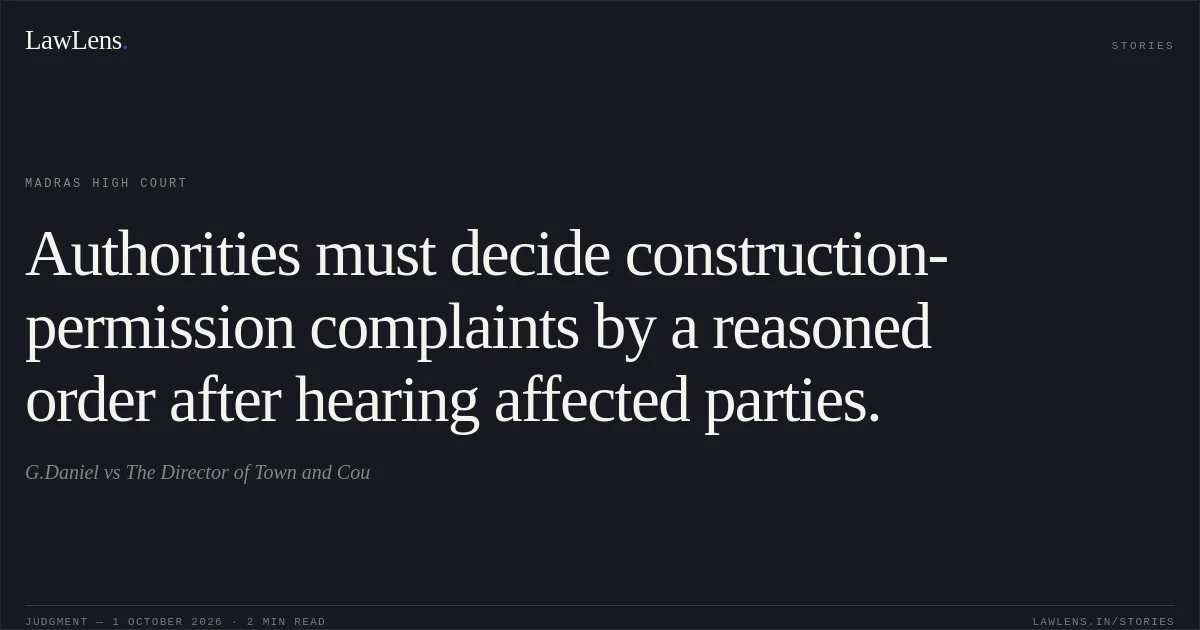
Source reference: p.1The Court directed the competent authorities to consider the representation, pass appropriate orders on merits and in accordance with law, provide a reasonable opportunity of hearing to the affected parties, and issue a reasoned and speaking order.
Source reference: p.4–5The judgment cited no precedent and did not determine the legality of the construction or interpret the Act’s substantive requirements.
Source reference: p.1, 4–5Reasoning
The petitioner’s counsel submitted that consideration of the pending representation would address the grievance, and the official respondents agreed to consider it after hearing the private parties.
Source reference: p.3–5In light of those submissions, the Court chose not to decide the legality of the construction or the rival claims. It instead left those matters to the competent authority, requiring an independent, reasoned decision after hearing the petitioner, respondents 5 and 6, and any other necessary parties.
Source reference: p.3–5Holding
The Court disposed of the writ petition by directing respondents 1 to 4 to consider the petitioner’s representation concerning the alleged construction in Survey No. 114/7 and pass appropriate orders on merits and in accordance with law, after providing a reasonable opportunity of hearing to the relevant parties.
The exercise was to be completed within six weeks from receipt of a copy of the order. The Court expressed no opinion on the merits of the rival claims or the legality of the construction. No costs were awarded, and the connected miscellaneous petition was closed.
Source reference: p.4–6Original Court PDF
G.DanielvsThe Director of Town and Cou
Click to open original judgment
Original judgment, available to read, download and summarize on LawLens.in