Facts
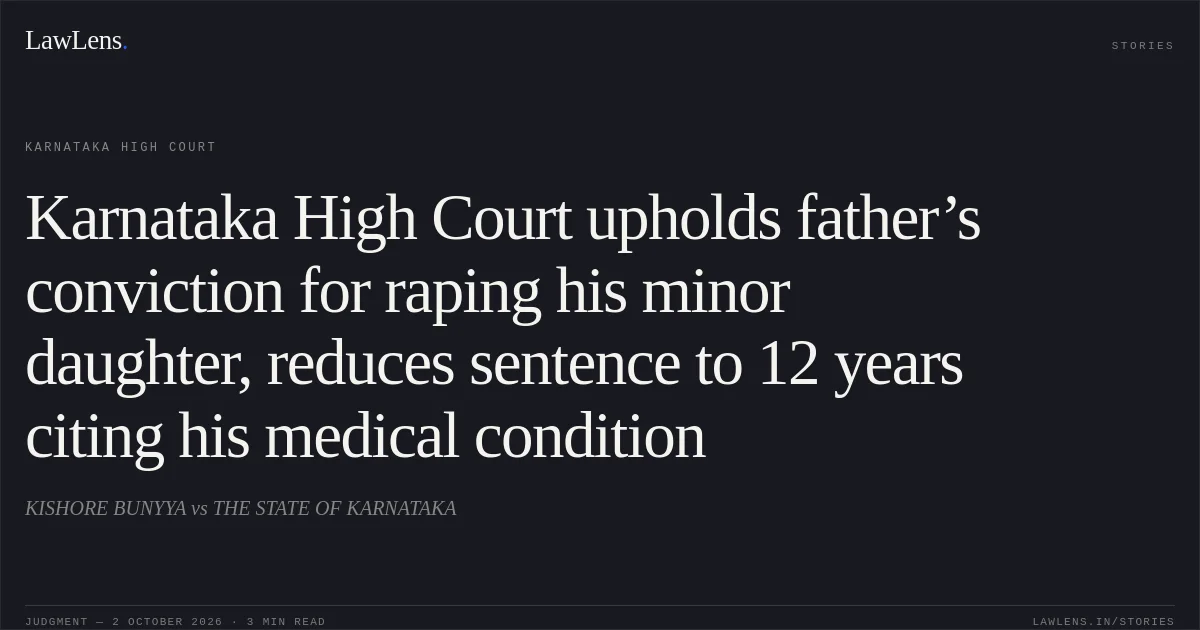
The appellant was convicted by the Special Court of offences under Sections 376 and 506 of the Indian Penal Code (IPC) and Section 6 of the Protection of Children from Sexual Offences Act, 2012 (POCSO Act).
Source reference: pp. 2–3; paras. 2–4The prosecution alleged that the appellant repeatedly sexually assaulted his daughter, who was about 14 at the relevant time, threatened her, and caused her pregnancy.
Source reference: pp. 2, 4–5; paras. 1–3, 6The victim testified to the assaults; the victim’s mother and brother did not support the prosecution.
Source reference: pp. 6–8; paras. 12–15Medical evidence recorded that the victim was pregnant, and DNA evidence identified the appellant as the child’s biological father.
Source reference: pp. 6–8; paras. 12–15The trial court imposed life imprisonment for the offences under Section 376 IPC and Section 6 POCSO, and one year’s simple imprisonment under Section 506 IPC.
Source reference: pp. 2–3; paras. 2–4On appeal, the appellant relied on medical records concerning his cardiovascular and cerebrovascular conditions and seizure disorder.
Source reference: pp. 10–11; paras. 22–23Issues
1. Whether the victim’s testimony, supported by the medical and DNA evidence, established the appellant’s guilt beyond reasonable doubt for the offences under Sections 376 and 506 IPC and Section 6 POCSO
Source reference: pp. 6–10; paras. 12–202. Whether, given the appellant’s medical condition and the punishment prescribed at the time of the offence, the sentence of life imprisonment should be modified
Source reference: pp. 10–12; paras. 22–25Law Applied
Section 376 IPC and Section 6 POCSO prescribe punishment for rape and aggravated penetrative sexual assault, respectively; where the same act is punishable under both enactments, Section 42 POCSO requires imposition of the punishment that is greater in degree.
Source reference: pp. 3, 11; paras. 4, 24Section 29 POCSO provides a statutory presumption against an accused charged with specified POCSO offences, considered by the Court alongside the evidence in this case.
Source reference: p. 9; para. 18The Court also relied on Sunil v. State of Madhya Pradesh, (2017) 2 SCC (Cri) 372, for the principle that a trustworthy victim’s testimony may sustain conviction even without DNA profiling evidence.
Source reference: p. 8; para. 16Section 428 CrPC (now Section 468 BNSS, 2023) governs set-off of pre-conviction detention against the sentence.
Source reference: p. 13; order, clause viReasoning
The Court found the victim’s testimony consistent with her complaint and her statement under Section 164 CrPC.
Source reference: pp. 5–9; paras. 10–17It considered that testimony corroborated by the medical evidence of pregnancy and the DNA report identifying the appellant as the child’s biological father; it also rejected the challenge to the DNA evidence because no basis to doubt its collection or result had been elicited from the scientific officer.
Source reference: pp. 5–9; paras. 10–17The Court further noted the victim’s evidence that the appellant threatened her and found no specific defence sufficient to displace the prosecution case.
Source reference: pp. 9–10; paras. 18–20It therefore upheld the convictions.
Source reference: pp. 9–10; paras. 18–20In sentencing, it applied the punishment prescribed under Section 6 POCSO as the greater punishment applicable at the time of the offence, but considered the appellant’s medical records sufficient to reduce the sentence.
Source reference: pp. 10–12; paras. 22–25Holding
The appeal was allowed in part.
The convictions under Sections 376 and 506 IPC and Section 6 POCSO were confirmed, but the sentence for the offences under Section 376 IPC and Section 6 POCSO was modified from life imprisonment to rigorous imprisonment for 12 years, with a fine of Rs. 5,000 and three months’ further rigorous imprisonment in default.
Source reference: pp. 12–13; order, clauses i–ivThe one-year sentence under Section 506 IPC was confirmed, with both sentences to run concurrently; set-off was allowed under Section 428 CrPC, and the trial court’s compensation order was left undisturbed.
Source reference: p. 13; order, clauses v–viiiActs & Sections Cited
13 provisions across 4 statutes referred to in this judgment. Each provision opens on LawLens.
Code of Criminal Procedure, 19733
Indian Penal Code, 18603
Protection of Children from Sexual Offences Act, 20126
Bharatiya Nagarik Suraksha Sanhita, 20231
Original Court PDF
KISHORE BUNYYAvsTHE STATE OF KARNATAKA
Click to open original judgment
Original judgment, available to read, download and summarize on LawLens.in